
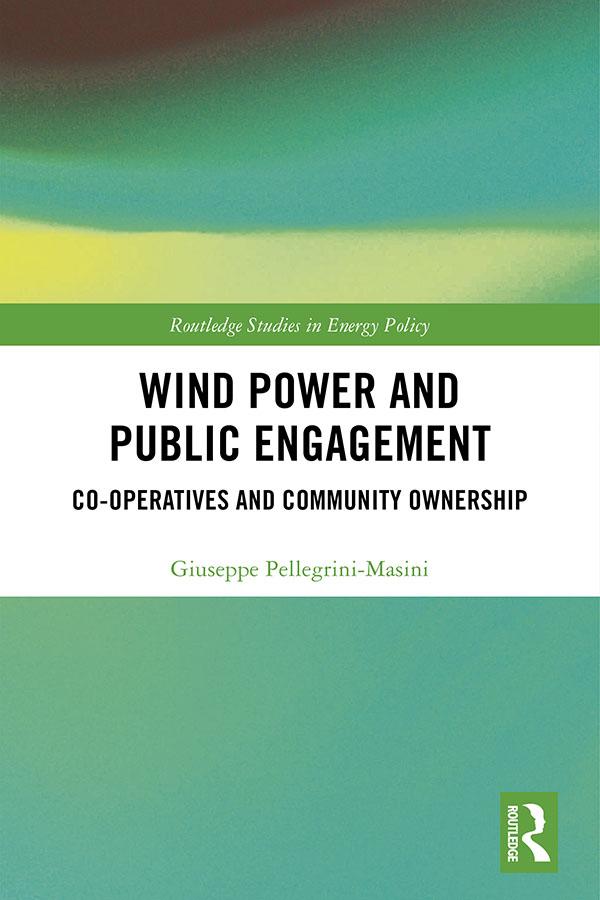
Adopting an interdisciplinary social science approach, this book examines community reactions to wind farms to form a new understanding of what facilitates social acceptance.
Based on empirical research, Wind Power and Public Engagement investigates opposition to wind energy and considers the advantages as well as the limits of the co-operative model of wind farm community ownership. Giuseppe Pellegrini-Masini compares the role of co-operative schemes with community benefits schemes in increasing acceptability, and also sheds light on the impact of social factors including pro-environmental attitudes, perceived benefits and costs, place attachment, trust, as well as individuals’ resources such as information and income. Five research cases are investigated in England and Scotland, including the first local, community-owned wind farm co-operative in the UK. Critically reviewing existing social research theories, the book offers a new viewpoint, integrating rational choice and environmental attitudinal theories, from which to assess and understand the social acceptability of wind energy. It also highlights new opportunities for raising consensus in communities around locally proposed wind farms.
The book will be of great interest to students and scholars of renewable energy, energy policy, environmental sociology, environmental psychology, environmental planning and sustainability in general, as well as policymakers.
Płać wygodnie kartą, Klarną, Apple Pay lub Google Pay. Nie jesteś zadowolony? Zawsze masz 14-dniową gwarancję zwrotu pieniędzy. Więcej przeczytasz w naszych warunkach. Masz pytania? Napisz do nas na hello@memmo.org.
Memmo ułatwia naukę – gdziekolwiek jesteś na świecie. U nas znajdziesz podręczniki i sprytne narzędzia do nauki w jednym miejscu: streszczenia, quizy, podcasty i fiszki. A do tego Ted, Twój kumpel do nauki, który odpowie na wszystko, co Cię nurtuje. Ponad 50 000 studentów już tu się uczy – stworzone, byś uczył się szybciej i mniej stresował.