
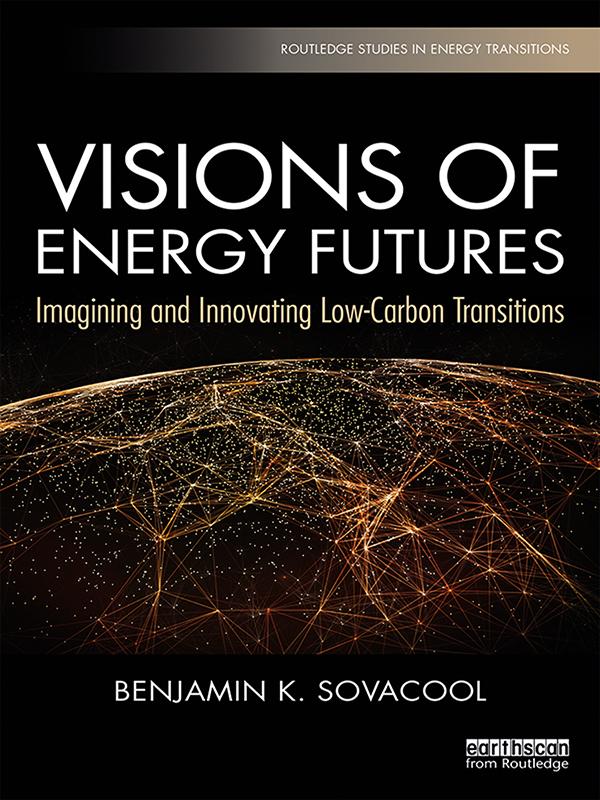
This book examines the visions, fantasies, frames, discourses, imaginaries, and expectations associated with six state-of-the-art energy systems—nuclear power, hydrogen fuel cells, shale gas, clean coal, smart meters, and electric vehicles—playing a key role in current deliberations about low-carbon energy supply and use.
Visions of Energy Futures: Imagining and Innovating Low-Carbon Transitions unveils what the future of energy systems could look like, and how their meanings are produced, often alongside moments of contestation. Theoretically, it analyzes these technological case studies with emerging concepts from various disciplines: utopianism (history of technology), symbolic convergence (communication studies), technological frames (social construction of technology), discursive coalitions (discourse analysis and linguistics), sociotechnical imaginaries (science and technology studies), and the sociology of expectations (innovation studies, future studies). It draws from these cases to create a synthetic set of dichotomies and frameworks for energy futures based on original data collected across two global epistemic communities— nuclear physicists and hydrogen engineers—and experts in Eastern Europe and the Nordic region, stakeholders in South Africa, and newspapers in the United Kingdom. This book is motivated by the premise that tackling climate change via low-carbon energy systems and practices is one of the most significant challenges of the twenty-first century, and that success will require not only new energy technologies, but also new ways of understanding language, visions, and discursive politics. The discursive creation of the energy systems of tomorrow are propagated in polity, hoping to be realized as the material fact of the future, but processed in conflicting ways with underlying tensions as to how contemporary societies ought to be ordered.
This book will be essential reading for students and scholars of energy policy, energy and environment, and technology assessment.
Płać wygodnie kartą, Klarną, Apple Pay lub Google Pay. Nie jesteś zadowolony? Zawsze masz 14-dniową gwarancję zwrotu pieniędzy. Więcej przeczytasz w naszych warunkach. Masz pytania? Napisz do nas na hello@memmo.org.
Memmo ułatwia naukę – gdziekolwiek jesteś na świecie. U nas znajdziesz podręczniki i sprytne narzędzia do nauki w jednym miejscu: streszczenia, quizy, podcasty i fiszki. A do tego Ted, Twój kumpel do nauki, który odpowie na wszystko, co Cię nurtuje. Ponad 50 000 studentów już tu się uczy – stworzone, byś uczył się szybciej i mniej stresował.