
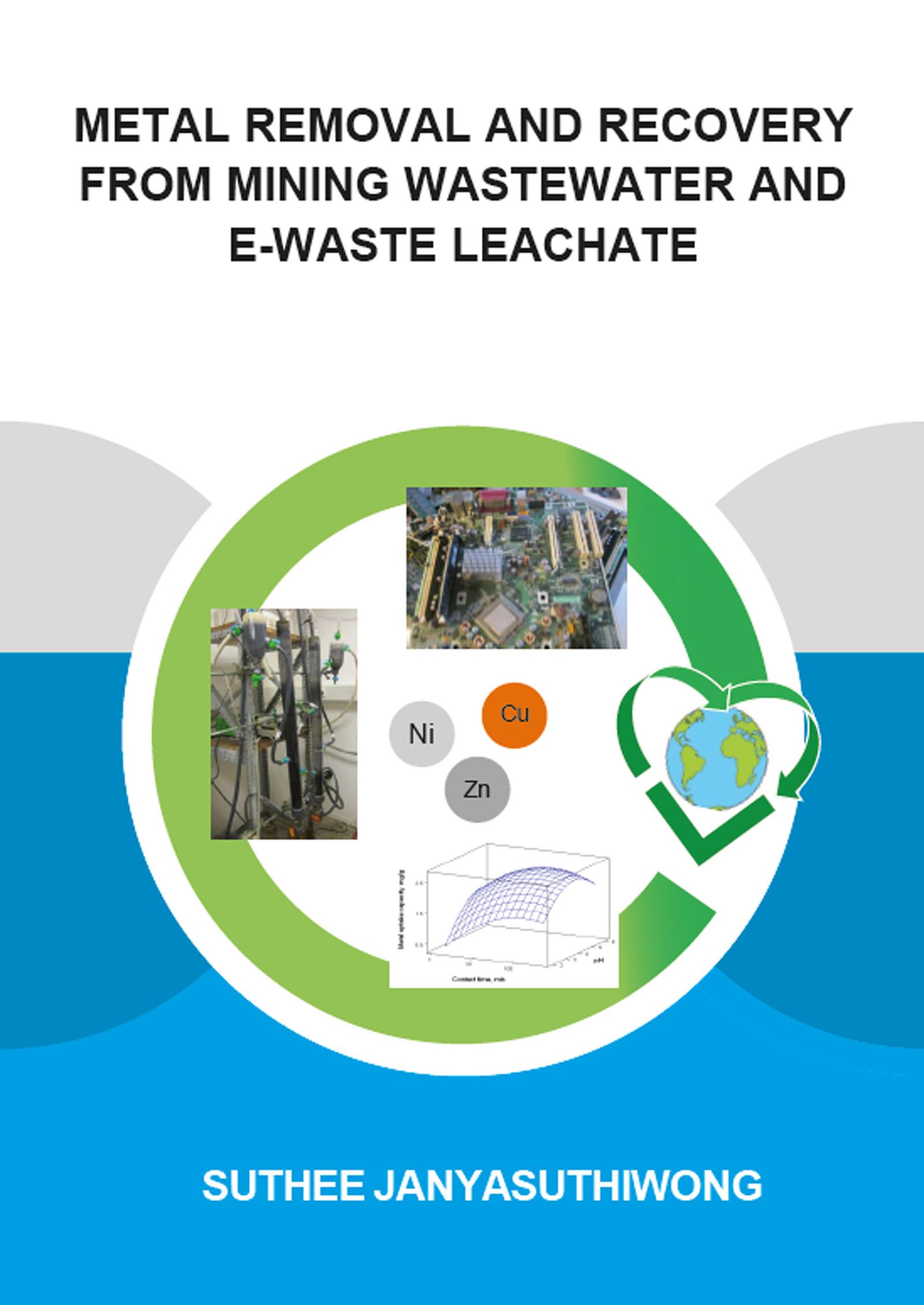
Metal contamination in the environment is a persisting global issue. The metal reservoirs in the earth have declined due to society’s needs and due to uncontrolled mining activities. Therefore, the idea to recover metals from waste streams has emerged.
In this thesis, cost competitive technologies such as adsorption using agro-wastes and precipitation using an inverse fluidized bed (IFB) reactor were investigated, with special emphasis on the recovery of base metals. Groundnut shell showed good potential for metal (Cu, Pb and Zn) removal. From artificial neural network modeling, the performance of the sulfate reducing bacteria (SRB) was found to be strongly pH dependent; the removal efficiency of Cu and Zn in the IFB at pH 5.0 was >97%. Electronic waste is a good candidate as secondary metal resource. The recovery of Cu from computer printed circuited boards (PCBs) using biogenic sulfide precipitation was investigated as well. Using this technology, Cu could be recovered at ~0.48 g Cu/g PCBs.
Płać wygodnie kartą, Klarną, Apple Pay lub Google Pay. Nie jesteś zadowolony? Zawsze masz 14-dniową gwarancję zwrotu pieniędzy. Więcej przeczytasz w naszych warunkach. Masz pytania? Napisz do nas na hello@memmo.org.
Memmo ułatwia naukę – gdziekolwiek jesteś na świecie. U nas znajdziesz podręczniki i sprytne narzędzia do nauki w jednym miejscu: streszczenia, quizy, podcasty i fiszki. A do tego Ted, Twój kumpel do nauki, który odpowie na wszystko, co Cię nurtuje. Ponad 50 000 studentów już tu się uczy – stworzone, byś uczył się szybciej i mniej stresował.