
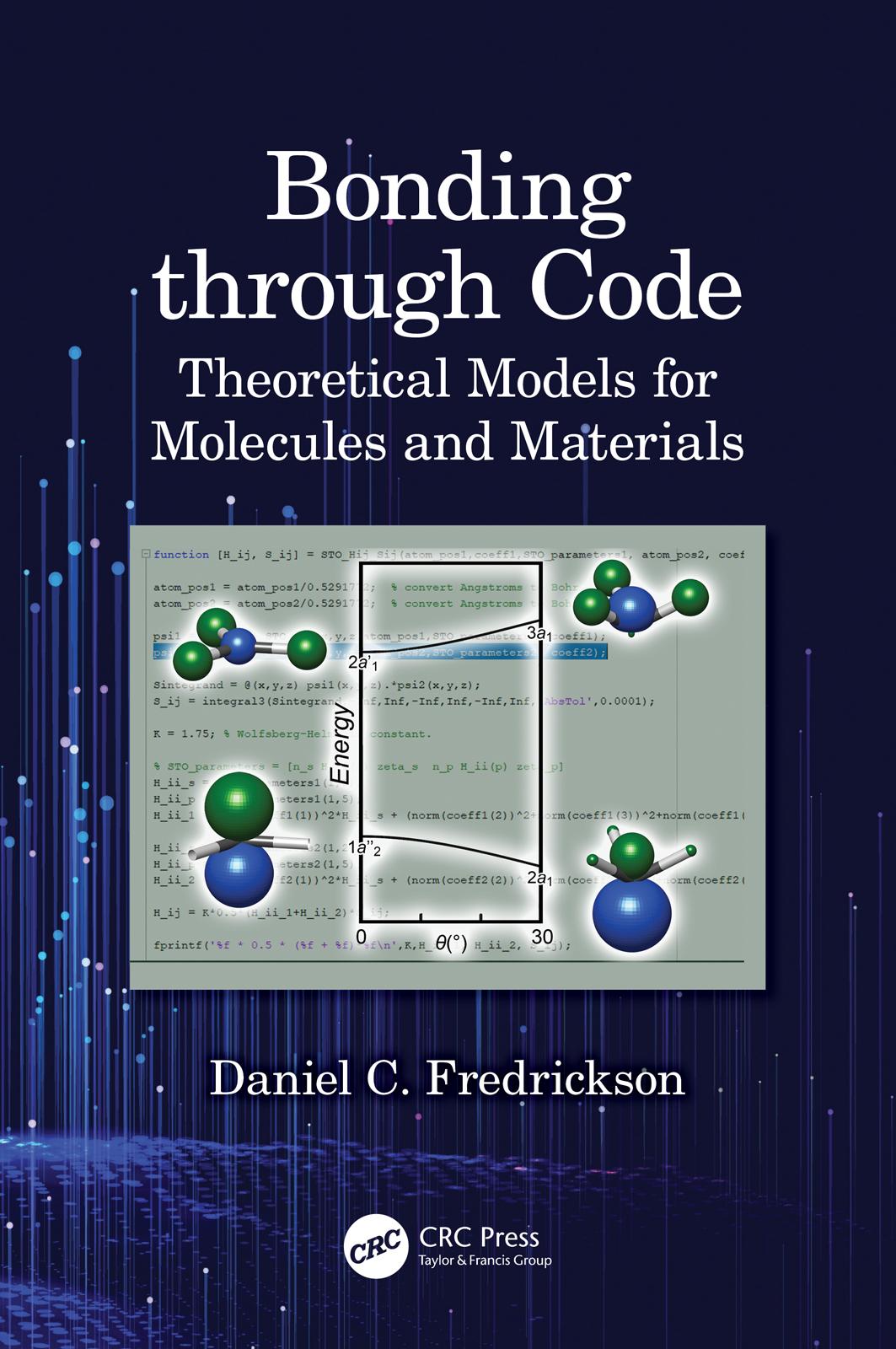
This timely and unique publication is designed for graduate students and researchers in inorganic and materials chemistry and covers bonding models and applications of symmetry concepts to chemical systems. The book discusses the quantum mechanical basis for molecular orbital concepts, the connections between molecular orbitals and localized views of bonding, group theory, bonding models for a variety of compounds, and the extension of these ideas to solid state materials in band theory. Unlike other books, the concepts are made tangible to the readers by guiding them through their implementation in MATLAB functions. No background in MATLAB or computer programming is needed; the book will provide the necessary skills.
Key Features
- Visualization of the Postulates of Quantum Mechanics to build conceptual understanding
- MATLAB functions for rendering molecular geometries and orbitals
- Do-it-yourself approach to building a molecular orbital and band theory program
- Introduction to Group Theory harnessing the 3D graphing capabilities of MATLAB
- Online access to a growing collection of applications of the core material and other appendices
Bonding through Code is ideal for first-year graduate students and advanced undergraduates in chemistry, materials science, and physics. Researchers wishing to gain new tools for theoretical analysis or deepen their understanding of bonding phenomena can also benefit from this text.
About the Author
Daniel Fredrickson is a Professor in the Department of Chemistry at the University of Wisconsin–Madison, where his research group focuses on understanding and harnessing the structural chemistry of intermetallic phases using a combination of theory and experiment. His interests in crystals, structure, and bonding can be traced to his undergraduate research at the University of Washington (B.S. in Biochemistry, 2000) with Prof. Bart Kahr, his Ph.D. studies at Cornell University (2000–2005) with Profs. Stephen Lee and Roald Hoffmann, and his post-doctoral work with Prof. Sven Lidin at Stockholm University (2005–2008). As part of his teaching at UW–Madison since 2009, he has worked to enhance his department’s graduate course, Physical Inorganic Chemistry I: Symmetry and Bonding, through the incorporation of new material and the development of computer-based exercises.
Płać wygodnie kartą, Klarną, Apple Pay lub Google Pay. Nie jesteś zadowolony? Zawsze masz 14-dniową gwarancję zwrotu pieniędzy. Więcej przeczytasz w naszych warunkach. Masz pytania? Napisz do nas na hello@memmo.org.
Memmo ułatwia naukę – gdziekolwiek jesteś na świecie. U nas znajdziesz podręczniki i sprytne narzędzia do nauki w jednym miejscu: streszczenia, quizy, podcasty i fiszki. A do tego Ted, Twój kumpel do nauki, który odpowie na wszystko, co Cię nurtuje. Ponad 50 000 studentów już tu się uczy – stworzone, byś uczył się szybciej i mniej stresował.