
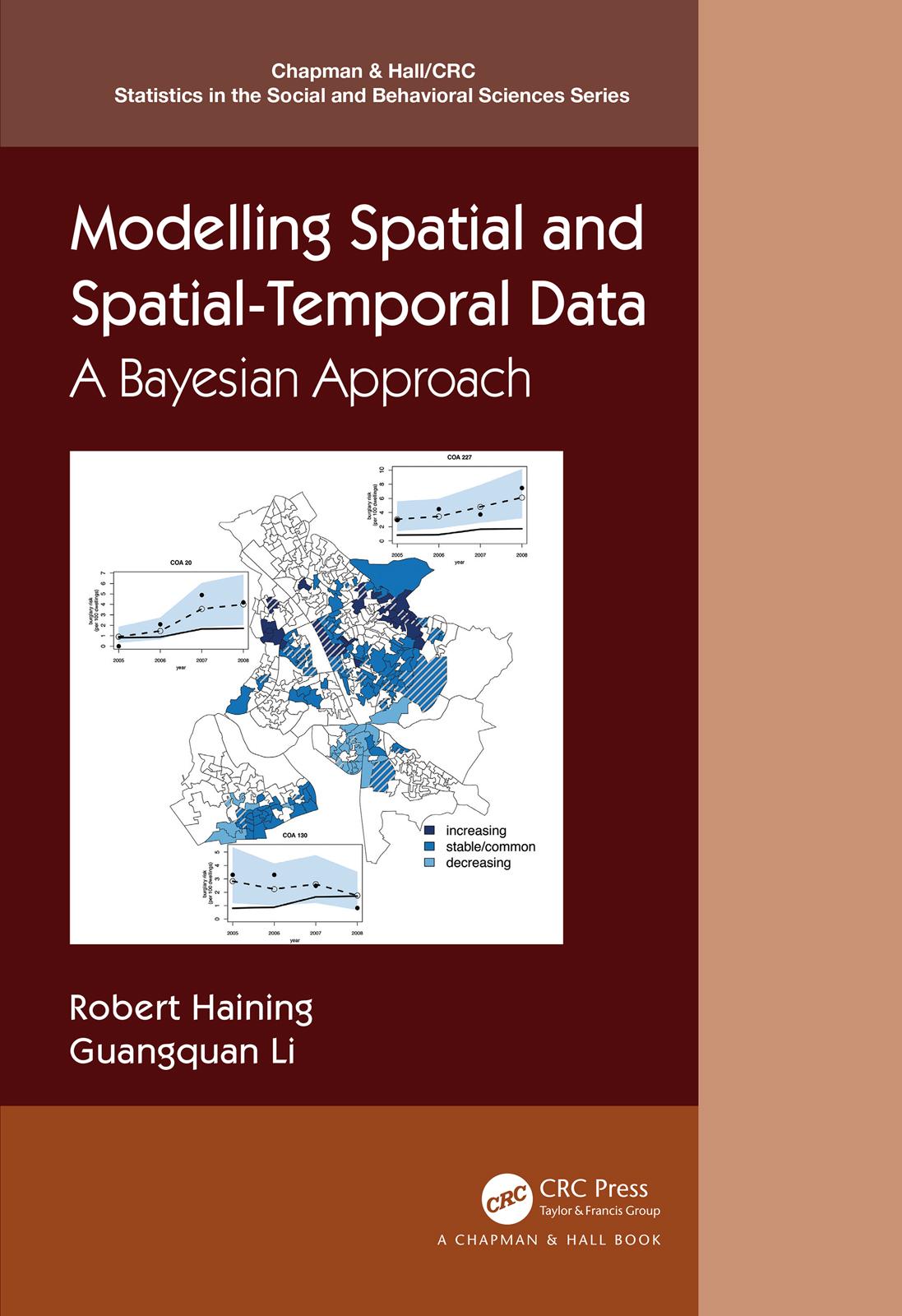
Modelling Spatial and Spatial-Temporal Data: A Bayesian Approach is aimed at statisticians and quantitative social, economic and public health students and researchers who work with spatial and spatial-temporal data. It assumes a grounding in statistical theory up to the standard linear regression model. The book compares both hierarchical and spatial econometric modelling, providing both a reference and a teaching text with exercises in each chapter. The book provides a fully Bayesian, self-contained, treatment of the underlying statistical theory, with chapters dedicated to substantive applications. The book includes WinBUGS code and R code and all datasets are available online.
Part I covers fundamental issues arising when modelling spatial and spatial-temporal data. Part II focuses on modelling cross-sectional spatial data and begins by describing exploratory methods that help guide the modelling process. There are then two theoretical chapters on Bayesian models and a chapter of applications. Two chapters follow on spatial econometric modelling, one describing different models, the other substantive applications. Part III discusses modelling spatial-temporal data, first introducing models for time series data. Exploratory methods for detecting different types of space-time interaction are presented followed by two chapters on the theory of space-time separable (without space-time interaction) and inseparable (with space-time interaction) models. An applications chapter includes: the evaluation of a policy intervention; analysing the temporal dynamics of crime hotspots; chronic disease surveillance; and testing for evidence of spatial spillovers in the spread of an infectious disease. A final chapter suggests some future directions and challenges.
Płać wygodnie kartą, Klarną, Apple Pay lub Google Pay. Nie jesteś zadowolony? Zawsze masz 14-dniową gwarancję zwrotu pieniędzy. Więcej przeczytasz w naszych warunkach. Masz pytania? Napisz do nas na hello@memmo.org.
Memmo ułatwia naukę – gdziekolwiek jesteś na świecie. U nas znajdziesz podręczniki i sprytne narzędzia do nauki w jednym miejscu: streszczenia, quizy, podcasty i fiszki. A do tego Ted, Twój kumpel do nauki, który odpowie na wszystko, co Cię nurtuje. Ponad 50 000 studentów już tu się uczy – stworzone, byś uczył się szybciej i mniej stresował.