
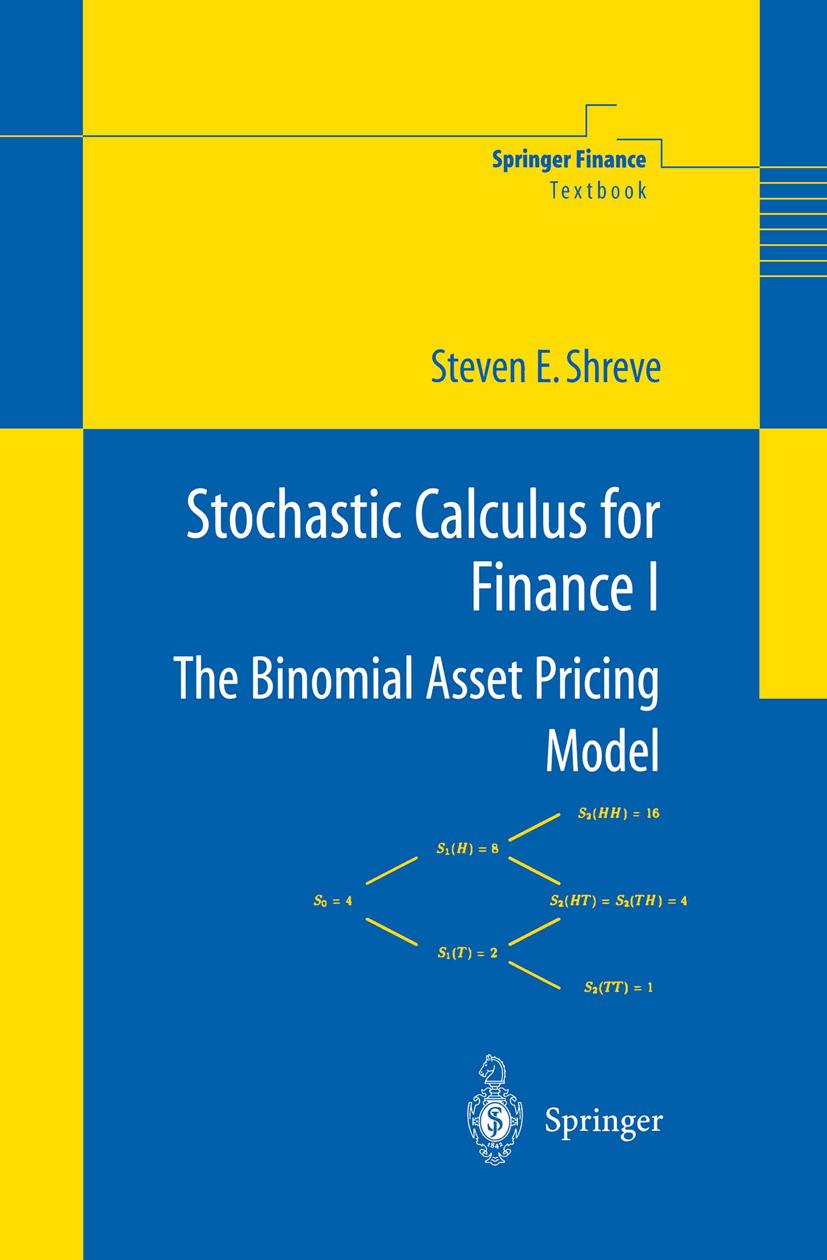
Stochastic Calculus for Finance evolved from the first ten years of the Carnegie Mellon Professional Master's program in Computational Finance. The content of this book has been used successfully with students whose mathematics background consists of calculus and calculus-based probability. The text gives both precise statements of results, plausibility arguments, and even some proofs, but more importantly intuitive explanations developed and refine through classroom experience with this material are provided. The book includes a self-contained treatment of the probability theory needed for stochastic calculus, including Brownian motion and its properties. Advanced topics include foreign exchange models, forward measures, and jump-diffusion processes.
This book is being published in two volumes. The first volume presents the binomial asset-pricing model primarily as a vehicle for introducing in the simple setting the concepts needed for the continuous-time theory in the second volume.
Chapter summaries and detailed illustrations are included. Classroom tested exercises conclude every chapter. Some of these extend the theory and others are drawn from practical problems in quantitative finance.
Advanced undergraduates and Masters level students in mathematical finance and financial engineering will find this book useful.
Steven E. Shreve is Co-Founder of the Carnegie Mellon MS Program in Computational Finance and winner of the Carnegie Mellon Doherty Prize for sustained contributions to education.
Płać wygodnie kartą, Klarną, Apple Pay lub Google Pay. Nie jesteś zadowolony? Zawsze masz 14-dniową gwarancję zwrotu pieniędzy. Więcej przeczytasz w naszych warunkach. Masz pytania? Napisz do nas na hello@memmo.org.
Memmo ułatwia naukę – gdziekolwiek jesteś na świecie. U nas znajdziesz podręczniki i sprytne narzędzia do nauki w jednym miejscu: streszczenia, quizy, podcasty i fiszki. A do tego Ted, Twój kumpel do nauki, który odpowie na wszystko, co Cię nurtuje. Ponad 50 000 studentów już tu się uczy – stworzone, byś uczył się szybciej i mniej stresował.