
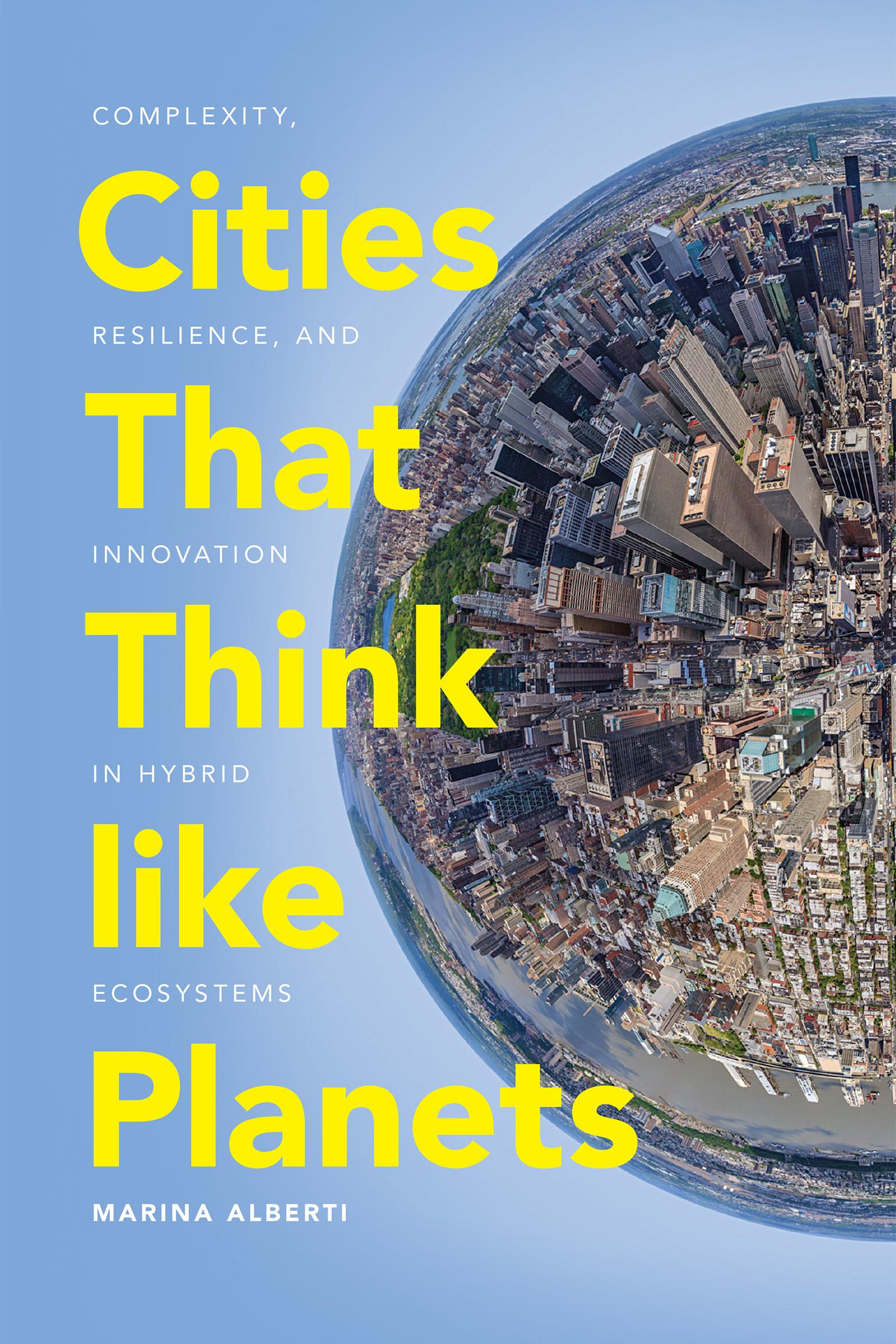
As human activity and environmental change come to be increasingly recognized as intertwined phenomena on a rapidly urbanizing planet, the field of urban ecology has risen to offer useful ways of thinking about coupled human and natural systems.
On the forefront of this discipline is Marina Alberti, whose innovative work offers a conceptual framework for uncovering fundamental laws that govern the complexity and resilience of cities, which she sees as key to understanding and responding to planetary change and the evolution of Earth. Bridging the fields of urban planning and ecology, Alberti describes a science of cities that work on a planetary scale and that links unpredictable dynamics to the potential for innovation. It is a science that considers interactions - at all scales - between people and built environments and between cities and their larger environments.
Cities That Think like Planets advances strategies for planning a future that may look very different from the present, as rapid urbanization could tip the Earth toward abrupt and nonlinear change. Alberti's analyses of the various hybrid ecosystems, such as self-organization, heterogeneity, modularity, multiple equilibria, feedback, and transformation, may help humans participate in guiding the Earth away from inadvertent collapse and toward a new era of planetary co-evolution and resilience.
Płać wygodnie kartą, Klarną, Apple Pay lub Google Pay. Nie jesteś zadowolony? Zawsze masz 14-dniową gwarancję zwrotu pieniędzy. Więcej przeczytasz w naszych warunkach. Masz pytania? Napisz do nas na hello@memmo.org.
Memmo ułatwia naukę – gdziekolwiek jesteś na świecie. U nas znajdziesz podręczniki i sprytne narzędzia do nauki w jednym miejscu: streszczenia, quizy, podcasty i fiszki. A do tego Ted, Twój kumpel do nauki, który odpowie na wszystko, co Cię nurtuje. Ponad 50 000 studentów już tu się uczy – stworzone, byś uczył się szybciej i mniej stresował.