
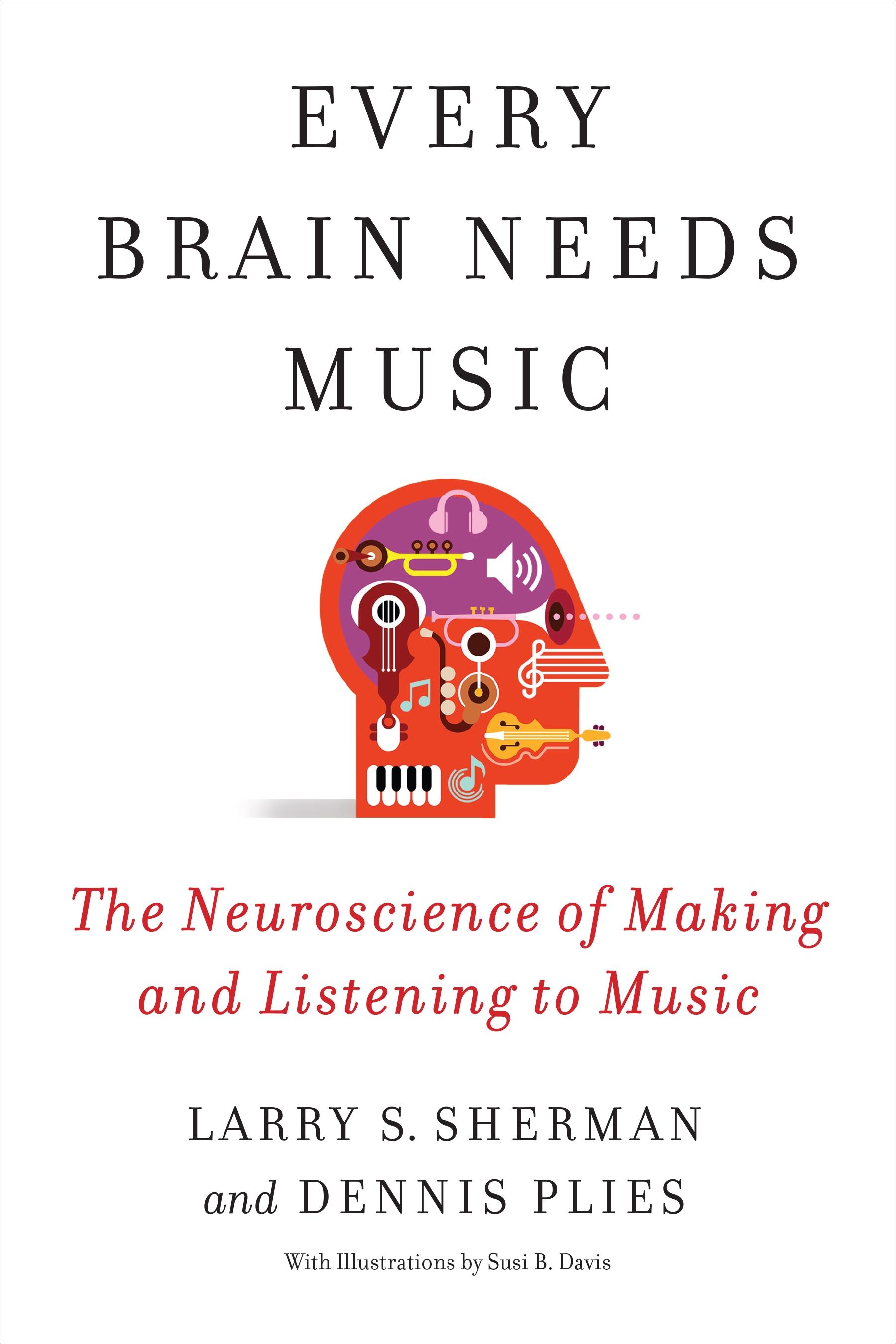
Whenever a person engages with music—when a piano student practices a scale, a jazz saxophonist riffs on a melody, a teenager sobs to a sad song, or a wedding guest gets down on the dance floor—countless neurons are firing. Playing an instrument requires all of the resources of the nervous system, including cognitive, sensory, and motor functions. Composition and improvisation are remarkable demonstrations of the brain’s capacity for creativity. Something as seemingly simple as listening to a tune involves mental faculties most of us don’t even realize we have.
Larry S. Sherman, a neuroscientist and lifelong musician, and Dennis Plies, a professional musician and teacher, collaborate to show how our brains and music work in harmony. They consider music in all the ways we encounter it—teaching, learning, practicing, listening, composing, improvising, and performing—in terms of neuroscience as well as music pedagogy, showing how the brain functions and even changes in the process. Every Brain Needs Music draws on leading behavioral, cellular, and molecular neuroscience research as well as surveys of more than a hundred musical people. It provides new perspectives on learning to play, teaching, how to practice and perform, the ways we react to music, and why the brain benefits from musical experiences.
Written for both musical and nonmusical people, including newcomers to brain science, this book is a lively and easy-to-read exploration of the neuroscience of music and its significance in our lives.
Płać wygodnie kartą, Klarną, Apple Pay lub Google Pay. Nie jesteś zadowolony? Zawsze masz 14-dniową gwarancję zwrotu pieniędzy. Więcej przeczytasz w naszych warunkach. Masz pytania? Napisz do nas na hello@memmo.org.
Memmo ułatwia naukę – gdziekolwiek jesteś na świecie. U nas znajdziesz podręczniki i sprytne narzędzia do nauki w jednym miejscu: streszczenia, quizy, podcasty i fiszki. A do tego Ted, Twój kumpel do nauki, który odpowie na wszystko, co Cię nurtuje. Ponad 50 000 studentów już tu się uczy – stworzone, byś uczył się szybciej i mniej stresował.