
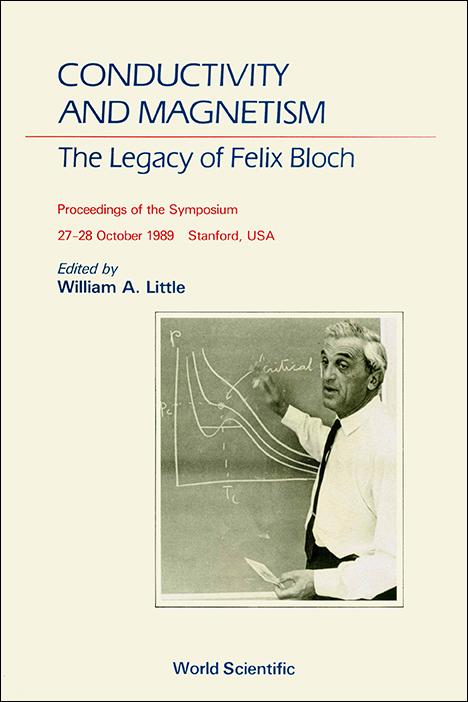
Felix Bloch was one of the foremost scientists of the 20th century. His work on the theory of metals in 1929 laid the cornerstone for the development of semiconductors and his work on magnetism was crucial for the development of a basic understanding of ferromagnetism. Nuclear Magnetic Resonance, which he discovered in 1946, and for which he shared the Nobel Prize with Edward Purcell in 1952, has become the most important spectroscopic tool in Chemistry. The year 1989 marks the sixtieth year since Bloch's paper on the Theory of Metals. This Symposium celebrated the occasion by gathering a group of distinguished scientists who presented overviews of the past, present and future of several major areas of Physics, Chemistry, Engineering, Computer Science, Biology and Medicine, many of which trace their origins to Bloch's influence.
Paga facilmente con carta, Klarna, Apple Pay o Google Pay. Non sei soddisfatto? Hai sempre 14 giorni per il rimborso. Leggi di più nei nostri termini. Per qualsiasi domanda, scrivici a hello@memmo.org.
Memmo rende lo studio più facile, ovunque tu sia nel mondo. Qui trovi i tuoi libri di testo e strumenti di studio intelligenti, tutto in un unico posto: riassunti, quiz, podcast e flashcard. E poi c'è Ted, il tuo compagno di studio che risponde a ogni tua domanda. Oltre 50.000 studenti studiano già qui: è stato creato per aiutarti a imparare più velocemente e a stressarti meno.
Potrebbe interessarti anche
Acquista il libro0