
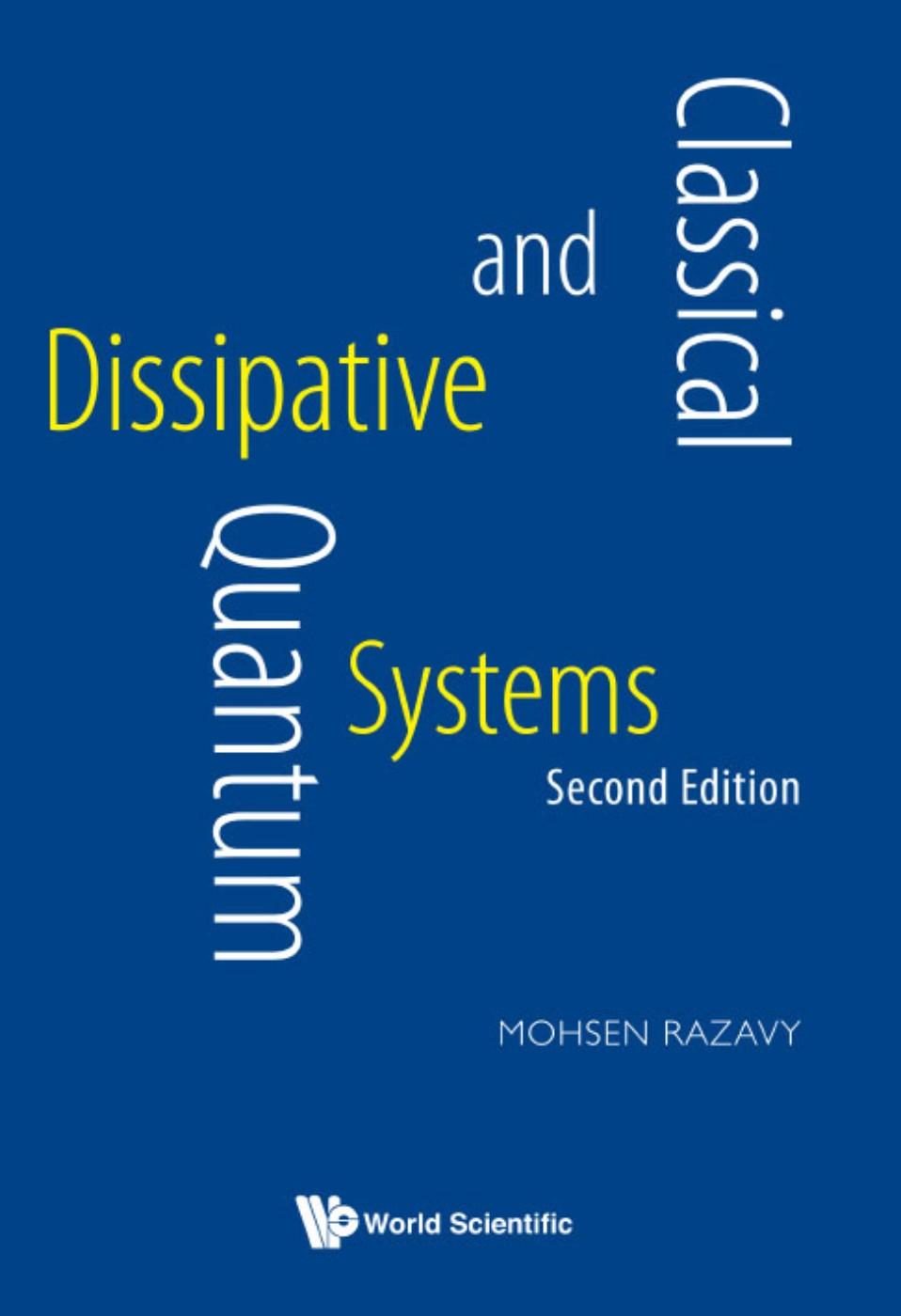
Dissipative forces play an important role in problems of classical as well as quantum mechanics. Since these forces are not among the basic forces of nature, it is essential to consider whether they should be treated as phenomenological interactions used in the equations of motion, or they should be derived from other conservative forces. In this book we discuss both approaches in detail starting with the Stoke's law of motion in a viscous fluid and ending with a rather detailed review of the recent attempts to understand the nature of the drag forces originating from the motion of a plane or a sphere in vacuum caused by the variations in the zero-point energy. In the classical formulation, mathematical techniques for construction of Lagrangian and Hamiltonian for the variational formulation of non-conservative systems are discussed at length. Various physical systems of interest including the problem of radiating electron, theory of natural line width, spin-boson problem, scattering and trapping of heavy ions and optical potential models of nuclear reactions are considered and solved.
Paga facilmente con carta, Klarna, Apple Pay o Google Pay. Non sei soddisfatto? Hai sempre 14 giorni per il rimborso. Leggi di più nei nostri termini. Per qualsiasi domanda, scrivici a hello@memmo.org.
Memmo rende lo studio più facile, ovunque tu sia nel mondo. Qui trovi i tuoi libri di testo e strumenti di studio intelligenti, tutto in un unico posto: riassunti, quiz, podcast e flashcard. E poi c'è Ted, il tuo compagno di studio che risponde a ogni tua domanda. Oltre 50.000 studenti studiano già qui: è stato creato per aiutarti a imparare più velocemente e a stressarti meno.
Potrebbe interessarti anche
Acquista il libro0