
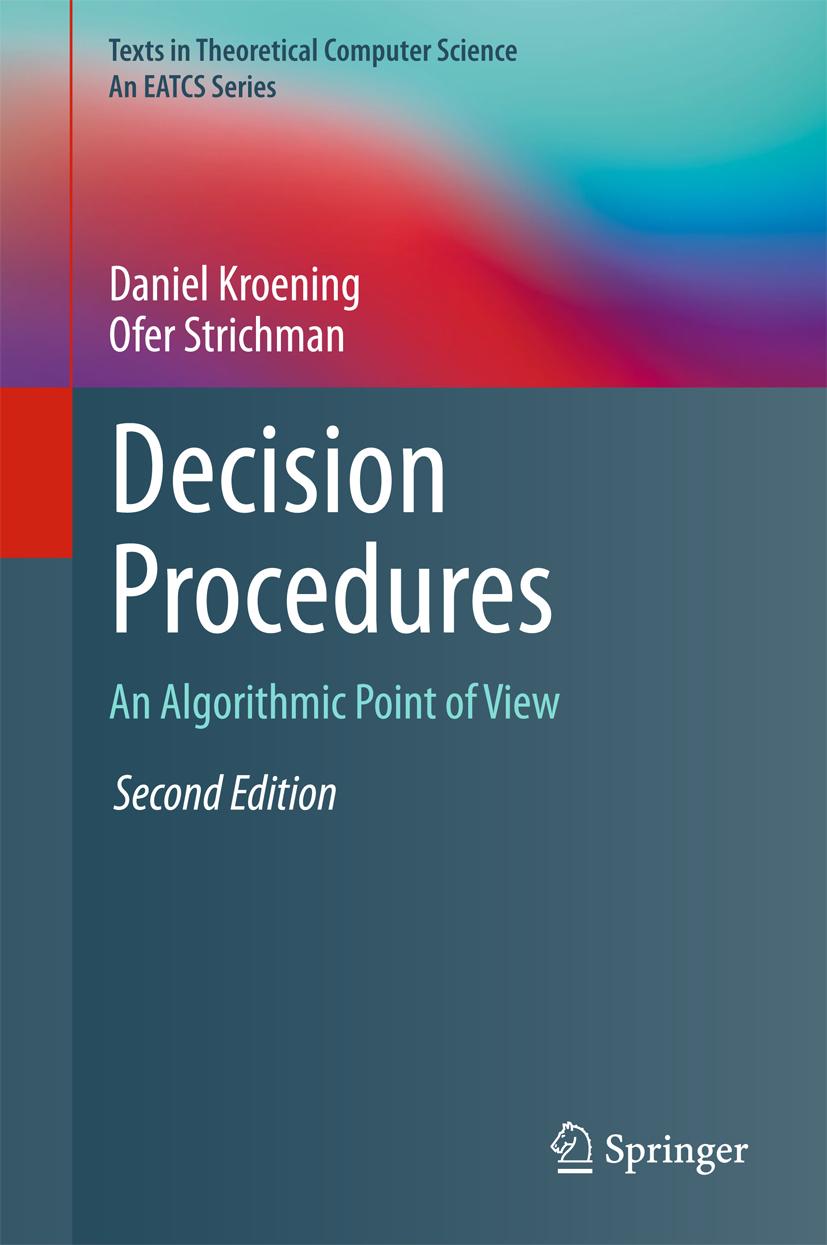
A decision procedure is an algorithm that, given a decision problem, terminates with a correct yes/no answer. Here, the authors focus on theories that are expressive enough to model real problems, but are still decidable. Specifically, the book concentrates on decision procedures for first-order theories that are commonly used in automated verification and reasoning, theorem-proving, compiler optimization and operations research. The techniques described in the book draw from fields such as graph theory and logic, and are routinely used in industry.
The authors introduce the basic terminology of SAT, Satisfiability Modulo Theories (SMT) and the DPLL(T) framework. Then, in separate chapters, they study decision procedures for propositional logic; equalities and uninterpreted functions; linear arithmetic; bit vectors; arrays; pointer logic; and quantified formulas. They also study the problem of deciding combined theories based on the Nelson-Oppen procedure.
Thefirst edition of this book was adopted as a textbook in courses worldwide. It was published in 2008 and the field now called SMT was then in its infancy, without the standard terminology and canonic algorithms it has now; this second edition reflects these changes. It brings forward the DPLL(T) framework. It also expands the SAT chapter with modern SAT heuristics, and includes a new section about incremental satisfiability, and the related Constraints Satisfaction Problem (CSP). The chapter about quantifiers was expanded with a new section about general quantification using E-matching and a section about Effectively Propositional Reasoning (EPR). The book also includes a new chapter on the application of SMT in industrial software engineering and in computational biology, coauthored by Nikolaj Bjørner and Leonardo de Moura, and Hillel Kugler, respectively.
Each chapter includes a detailed bibliography and exercises. Lecturers’ slides and a C++ library for rapid prototyping of decision procedures are available from the authors’ website.
Paga facilmente con carta, Klarna, Apple Pay o Google Pay. Non sei soddisfatto? Hai sempre 14 giorni per il rimborso. Leggi di più nei nostri termini. Per qualsiasi domanda, scrivici a hello@memmo.org.
Memmo rende lo studio più facile, ovunque tu sia nel mondo. Qui trovi i tuoi libri di testo e strumenti di studio intelligenti, tutto in un unico posto: riassunti, quiz, podcast e flashcard. E poi c'è Ted, il tuo compagno di studio che risponde a ogni tua domanda. Oltre 50.000 studenti studiano già qui: è stato creato per aiutarti a imparare più velocemente e a stressarti meno.