
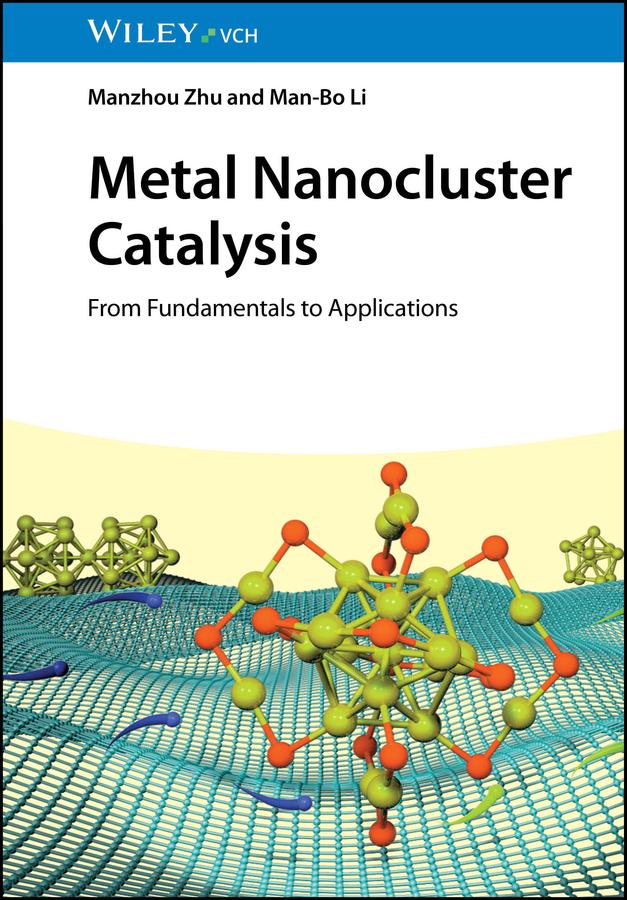
Provides insights into the structure, mechanisms, and applications of metal nanocluster catalysis
Metal nanoclusters are rapidly emerging as a distinct class of catalysts with unique properties that bridge the gap between molecular and nanoparticle systems. Their ultra-small size, atomically precise structures, and diverse metal–metal and metal–ligand interactions give rise to catalytic behaviors that combine the best attributes of both homogeneous and heterogeneous catalysts. Nanoclusters demonstrate exceptional activity, selectivity, and recyclability, making them highly promising for applications across green chemistry and sustainable energy research.
Metal Nanocluster Catalysis: From Fundamentals to Applications provides a timely and thorough examination of this rapidly expanding field. Organized into twelve chapters, the book systematically introduces the three major classes of nanocluster catalysts—in-situ generated, supported, and ligand-protected systems—covering their formation, structural features, and mechanistic pathways. Beyond conventional catalytic transformations such as oxidation and borylation, the book highlights the growing role of nanoclusters in photo-, electro-, and enzyme-catalysis, where their exceptional energy and electron transfer capabilities open new avenues for organic transformations.
Integrating theoretical frameworks and emerging practical strategies in a single volume, Metal Nanocluster Catalysis:
- Explores applications in hydrogenation, oxidation, borylation, and cross-coupling reactions
- Discusses practical aspects of industrial catalysis, including recyclability and scale-up
- Provides insight into recyclability and large-scale applications in industrial catalysis
- Addresses the challenges and opportunities that define future research directions
- Includes commentary on current challenges and future research opportunities
Metal Nanocluster Catalysis: From Fundamentals to Applications is ideal for advanced undergraduates, graduate students, and researchers in catalysis, inorganic chemistry, chemical engineering, and materials science. It is well-suited for courses such as Advanced Catalysis, Nanomaterials in Chemistry, and Sustainable Energy Chemistry within degree programs in chemistry, chemical engineering, and materials science.
Paga facilmente con carta, Klarna, Apple Pay o Google Pay. Non sei soddisfatto? Hai sempre 14 giorni per il rimborso. Leggi di più nei nostri termini. Per qualsiasi domanda, scrivici a hello@memmo.org.
Memmo rende lo studio più facile, ovunque tu sia nel mondo. Qui trovi i tuoi libri di testo e strumenti di studio intelligenti, tutto in un unico posto: riassunti, quiz, podcast e flashcard. E poi c'è Ted, il tuo compagno di studio che risponde a ogni tua domanda. Oltre 50.000 studenti studiano già qui: è stato creato per aiutarti a imparare più velocemente e a stressarti meno.