
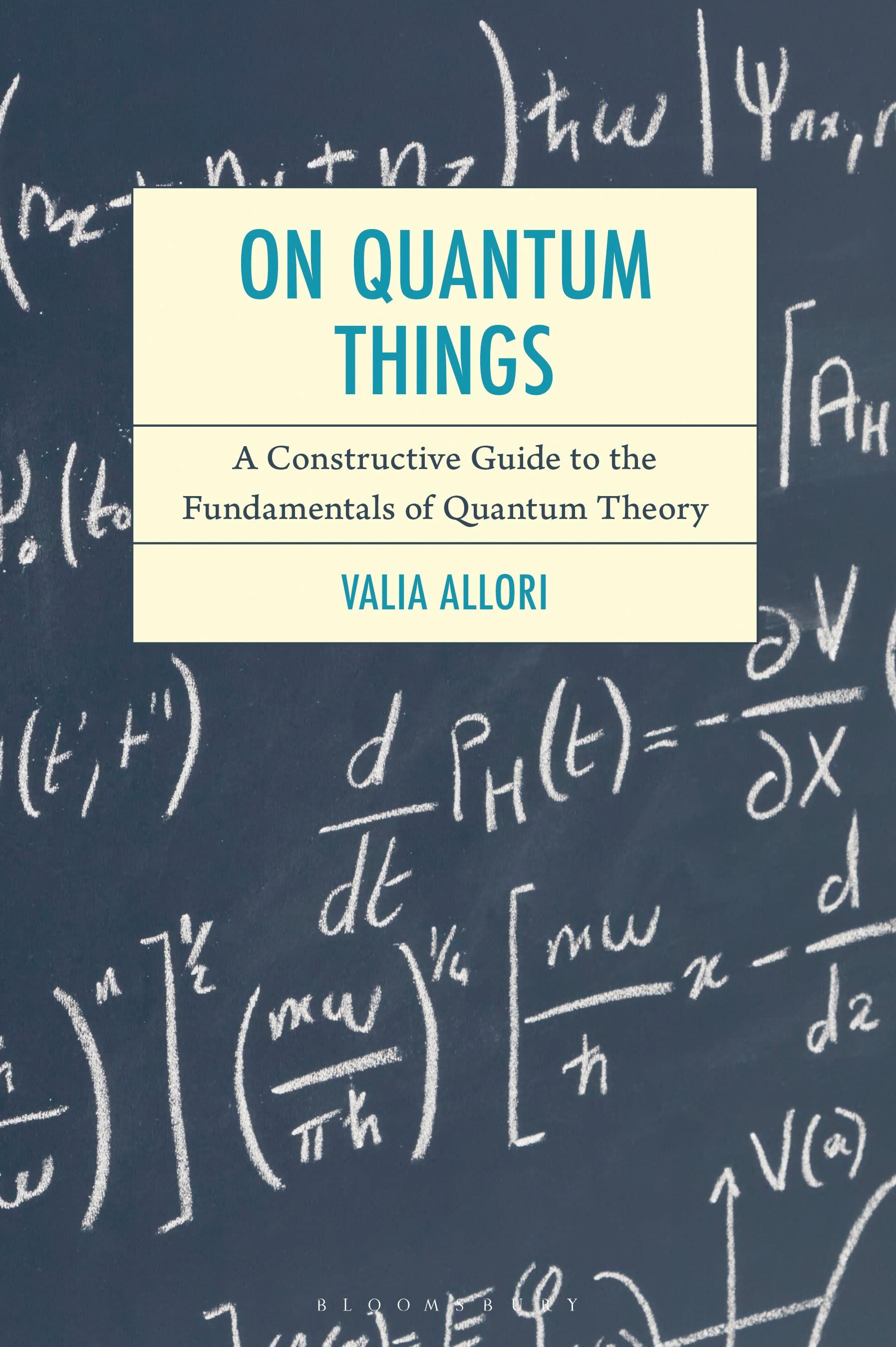
A realist, particle-based view of quantum theory-where the wavefunction no longer plays a central role-offers a clear, commonsense alternative to dominant metaphysical views.
This book explores the metaphysics of quantum theory through a lens of scientific realism-the belief that successful scientific theories describe reality. It critically evaluates various interpretations, including structural realism, wave function realism, and the many-worlds view, highlighting their limitations. Valia Allori proposes a “spatiotemporal foundational ontology” approach, grounded in particles as fundamental entities evolving in three-dimensional space and time, following uniform, symmetric laws. This view is exemplified by Bohmian mechanics (pilot-wave theory), offering a constructive, commonsensical explanation of quantum phenomena. The wave function, in this framework, is not a physical object but plays a functional, law-like role in explaining interactions. Further, the book advances a radical thesis: fundamental particles lack intrinsic properties like mass or charge and are instead “bare” objects distinguished only by the laws governing them. This thesis allows a middle path between traditional object-based metaphysics and eliminative structuralism. Ultimately, the author argues that had physics developed more rationally, instead of following a historical path shaped by contingent choices, the pilot-wave theory might have been the dominant interpretation, minimizing the proliferation of speculative alternatives.
This book explores the metaphysics of quantum theory through a lens of scientific realism-the belief that successful scientific theories describe reality. It critically evaluates various interpretations, including structural realism, wave function realism, and the many-worlds view, highlighting their limitations. Valia Allori proposes a “spatiotemporal foundational ontology” approach, grounded in particles as fundamental entities evolving in three-dimensional space and time, following uniform, symmetric laws. This view is exemplified by Bohmian mechanics (pilot-wave theory), offering a constructive, commonsensical explanation of quantum phenomena. The wave function, in this framework, is not a physical object but plays a functional, law-like role in explaining interactions. Further, the book advances a radical thesis: fundamental particles lack intrinsic properties like mass or charge and are instead “bare” objects distinguished only by the laws governing them. This thesis allows a middle path between traditional object-based metaphysics and eliminative structuralism. Ultimately, the author argues that had physics developed more rationally, instead of following a historical path shaped by contingent choices, the pilot-wave theory might have been the dominant interpretation, minimizing the proliferation of speculative alternatives.
Paga facilmente con carta, Klarna, Apple Pay o Google Pay. Non sei soddisfatto? Hai sempre 14 giorni per il rimborso. Leggi di più nei nostri termini. Per qualsiasi domanda, scrivici a hello@memmo.org.
Memmo rende lo studio più facile, ovunque tu sia nel mondo. Qui trovi i tuoi libri di testo e strumenti di studio intelligenti, tutto in un unico posto: riassunti, quiz, podcast e flashcard. E poi c'è Ted, il tuo compagno di studio che risponde a ogni tua domanda. Oltre 50.000 studenti studiano già qui: è stato creato per aiutarti a imparare più velocemente e a stressarti meno.