
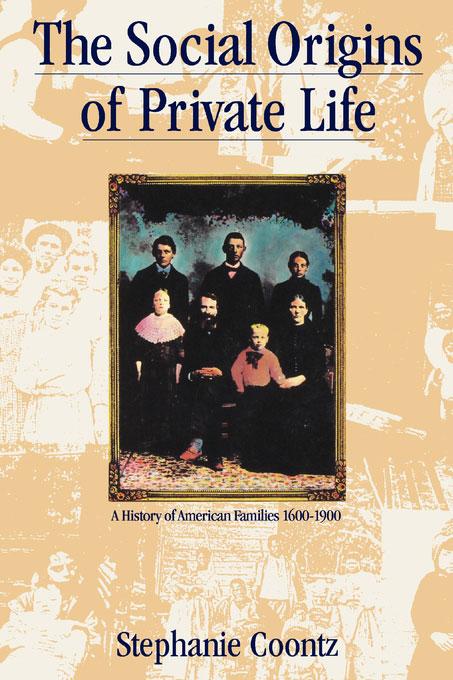
Current debates about the future of the family are often based on serious misconceptions about its past. Arguing that there is no biologically mandated or universally functional family form, Stephanie Coontz traces the complexity and variety of family arrangements in American history, from Native American kin groups to the emergence of the dominant middle-class family ideal in the 1890s.
Surveying and synthesizing a vast range of previous scholarship, as well as engaging more particular studies of family life from the seventeenth to the nineteenth centuries, Coontz offers a highly original account of the shifting structure and function of American families. Her account challenges standard interpretations of the early hegemony of middle-class privacy and "affective individualism," pointing to the rich tradition of alternative family behaviors among various ethnic and socioeconomic groups in America, and arguing that even middle-class families went through several transformations in the course of the nineteenth century.
The present dominant family form, grounded in close interpersonal relations and premised on domestic consumption of mass-produced household goods has arisen, Coontz argues, from a long and complex series of changing political and economic conjunctures, as well as from the destruction or incorporation of several alternative family systems. A clear conception of American capitalism's combined and uneven development is therefore essential if we are to understand the history of the family as a key social and economic unit. Lucid and detailed, The Social Origins of Private Life is likely to become the standard history of its subject.
Surveying and synthesizing a vast range of previous scholarship, as well as engaging more particular studies of family life from the seventeenth to the nineteenth centuries, Coontz offers a highly original account of the shifting structure and function of American families. Her account challenges standard interpretations of the early hegemony of middle-class privacy and "affective individualism," pointing to the rich tradition of alternative family behaviors among various ethnic and socioeconomic groups in America, and arguing that even middle-class families went through several transformations in the course of the nineteenth century.
The present dominant family form, grounded in close interpersonal relations and premised on domestic consumption of mass-produced household goods has arisen, Coontz argues, from a long and complex series of changing political and economic conjunctures, as well as from the destruction or incorporation of several alternative family systems. A clear conception of American capitalism's combined and uneven development is therefore essential if we are to understand the history of the family as a key social and economic unit. Lucid and detailed, The Social Origins of Private Life is likely to become the standard history of its subject.
Pagine: 366
Categoria: Sociologi
e-ISBN: 9781786630001
Peso di spedizione: 1.2 kg
Spedito in: 1-2 giorni
Paga facilmente con carta, Klarna, Apple Pay o Google Pay. Non sei soddisfatto? Hai sempre 14 giorni per il rimborso. Leggi di più nei nostri termini. Per qualsiasi domanda, scrivici a hello@memmo.org.
Memmo rende lo studio più facile, ovunque tu sia nel mondo. Qui trovi i tuoi libri di testo e strumenti di studio intelligenti, tutto in un unico posto: riassunti, quiz, podcast e flashcard. E poi c'è Ted, il tuo compagno di studio che risponde a ogni tua domanda. Oltre 50.000 studenti studiano già qui: è stato creato per aiutarti a imparare più velocemente e a stressarti meno.
Potrebbe interessarti anche
Acquista il libro0