
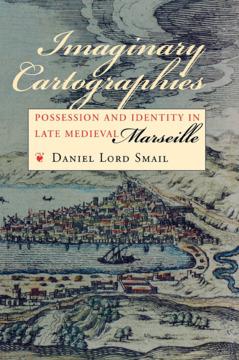
How, in the years before the advent of urban maps, did city residents conceptualize and navigate their communities? In his strikingly original book, Daniel Lord Smail develops a new method and a new vocabulary for understanding how urban men and women thought about their personal geography. His thorough research of property records of late medieval Marseille leads him to conclude that its inhabitants charted their city, its social structure, and their own identities within that structure through a set of cartographic grammars which powerfully shaped their lives.
Prior to the fourteenth century, different interest groups—notaries, royal officials, church officials, artisans—developed their own cartographies in accordance with their own social, political, or administrative agendas. These competing templates were created around units ranging from streets and islands to vicinities and landmarks. Smail shows how the notarial template, which privileged the street as the most basic marker of address, gradually emerged as the cartographic norm. This transformation, he argues, led to the rise of modern urban maps and helped to inaugurate the process whereby street addresses were attached to citizen identities, a crucial development in the larger enterprise of nation building.
Imaginary Cartographies opens up powerful new means for exploring late medieval and Renaissance urban society while advancing understanding of the role of social perceptions in history.
Paga facilmente con carta, Klarna, Apple Pay o Google Pay. Non sei soddisfatto? Hai sempre 14 giorni per il rimborso. Leggi di più nei nostri termini. Per qualsiasi domanda, scrivici a hello@memmo.org.
Memmo rende lo studio più facile, ovunque tu sia nel mondo. Qui trovi i tuoi libri di testo e strumenti di studio intelligenti, tutto in un unico posto: riassunti, quiz, podcast e flashcard. E poi c'è Ted, il tuo compagno di studio che risponde a ogni tua domanda. Oltre 50.000 studenti studiano già qui: è stato creato per aiutarti a imparare più velocemente e a stressarti meno.