
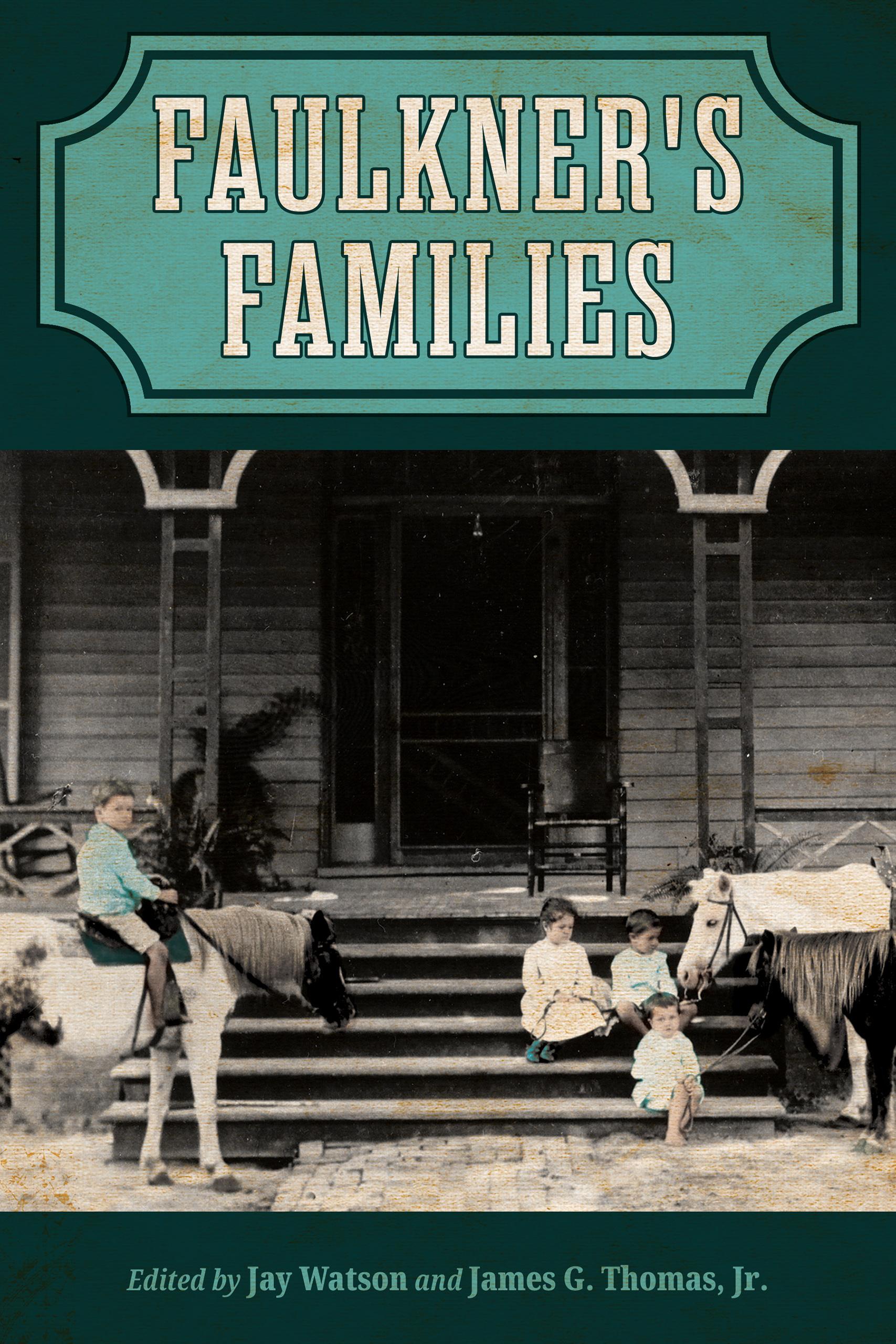
Contributions by Josephine Adams, Jeff Allred, Garry Bertholf, Maxwell Cassity, John N. Duvall, Katherine Henninger, Maude Hines, Robert Jackson, Julie Beth Napolin, Rebecca Nisetich, George Porter Thomas, Jay Watson, and Yuko Yamamoto
If it seems outrageous to suggest that one of the twentieth century’s most important literary cartographers of the private recesses of consciousness is also among its great novelists of family, William Faulkner nonetheless fits the bill on both counts. Family played an outsized role in both his life and his writings, often in deeply problematic ways, surfacing across his oeuvre in a dazzling range of distorted, defamiliarized, and transgressive forms, while on other occasions serving as a crucible for crushing forces of conformity, convention, and tradition. The dozen essays featured in this collection approach Faulkner’s many families—actual and imagined—as especially revealing windows to his work and his world.
Contributors explore the role of the child in Faulkner’s vision of family and regional society; sibling relations throughout the author's body of work; the extension of family networks beyond blood lineage and across racial lines; the undutiful daughters of Yoknapatawpha County; the critical power of family estrangement and subversive genealogies in Faulkner’s imagination; forms of queer and interspecies kinship; the epidemiological imagination of Faulkner’s notorious Snopes family as social contagion; the experiences of the African American families who worked on the writer’s Greenfield Farm property; and Faulkner’s role in promoting a Cold War–era ideology of “the family of man” in post–World War II Japan.
If it seems outrageous to suggest that one of the twentieth century’s most important literary cartographers of the private recesses of consciousness is also among its great novelists of family, William Faulkner nonetheless fits the bill on both counts. Family played an outsized role in both his life and his writings, often in deeply problematic ways, surfacing across his oeuvre in a dazzling range of distorted, defamiliarized, and transgressive forms, while on other occasions serving as a crucible for crushing forces of conformity, convention, and tradition. The dozen essays featured in this collection approach Faulkner’s many families—actual and imagined—as especially revealing windows to his work and his world.
Contributors explore the role of the child in Faulkner’s vision of family and regional society; sibling relations throughout the author's body of work; the extension of family networks beyond blood lineage and across racial lines; the undutiful daughters of Yoknapatawpha County; the critical power of family estrangement and subversive genealogies in Faulkner’s imagination; forms of queer and interspecies kinship; the epidemiological imagination of Faulkner’s notorious Snopes family as social contagion; the experiences of the African American families who worked on the writer’s Greenfield Farm property; and Faulkner’s role in promoting a Cold War–era ideology of “the family of man” in post–World War II Japan.
Paga facilmente con carta, Klarna, Apple Pay o Google Pay. Non sei soddisfatto? Hai sempre 14 giorni per il rimborso. Leggi di più nei nostri termini. Per qualsiasi domanda, scrivici a hello@memmo.org.
Memmo rende lo studio più facile, ovunque tu sia nel mondo. Qui trovi i tuoi libri di testo e strumenti di studio intelligenti, tutto in un unico posto: riassunti, quiz, podcast e flashcard. E poi c'è Ted, il tuo compagno di studio che risponde a ogni tua domanda. Oltre 50.000 studenti studiano già qui: è stato creato per aiutarti a imparare più velocemente e a stressarti meno.
Potrebbe interessarti anche
Acquista il libro0