
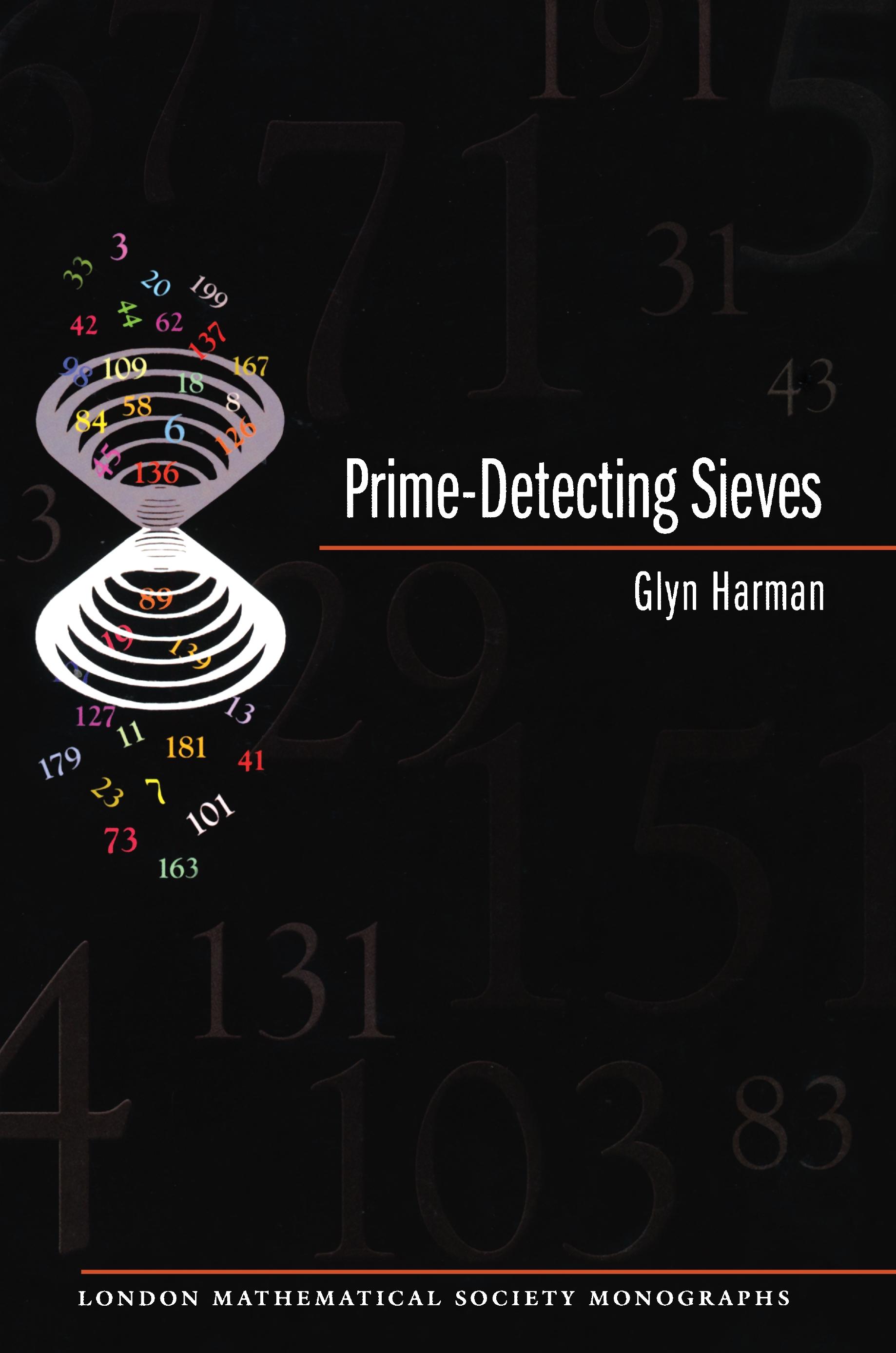
This book seeks to describe the rapid development in recent decades of sieve methods able to detect prime numbers. The subject began with Eratosthenes in antiquity, took on new shape with Legendre's form of the sieve, was substantially reworked by Ivan M. Vinogradov and Yuri V. Linnik, but came into its own with Robert C. Vaughan and important contributions from others, notably Roger Heath-Brown and Henryk Iwaniec. Prime-Detecting Sieves breaks new ground by bringing together several different types of problems that have been tackled with modern sieve methods and by discussing the ideas common to each, in particular the use of Type I and Type II information.
No other book has undertaken such a systematic treatment of prime-detecting sieves. Among the many topics Glyn Harman covers are primes in short intervals, the greatest prime factor of the sequence of shifted primes, Goldbach numbers in short intervals, the distribution of Gaussian primes, and the recent work of John Friedlander and Iwaniec on primes that are a sum of a square and a fourth power, and Heath-Brown's work on primes represented as a cube plus twice a cube. This book contains much that is accessible to beginning graduate students, yet also provides insights that will benefit established researchers.
Paga facilmente con carta, Klarna, Apple Pay o Google Pay. Non sei soddisfatto? Hai sempre 14 giorni per il rimborso. Leggi di più nei nostri termini. Per qualsiasi domanda, scrivici a hello@memmo.org.
Memmo rende lo studio più facile, ovunque tu sia nel mondo. Qui trovi i tuoi libri di testo e strumenti di studio intelligenti, tutto in un unico posto: riassunti, quiz, podcast e flashcard. E poi c'è Ted, il tuo compagno di studio che risponde a ogni tua domanda. Oltre 50.000 studenti studiano già qui: è stato creato per aiutarti a imparare più velocemente e a stressarti meno.