
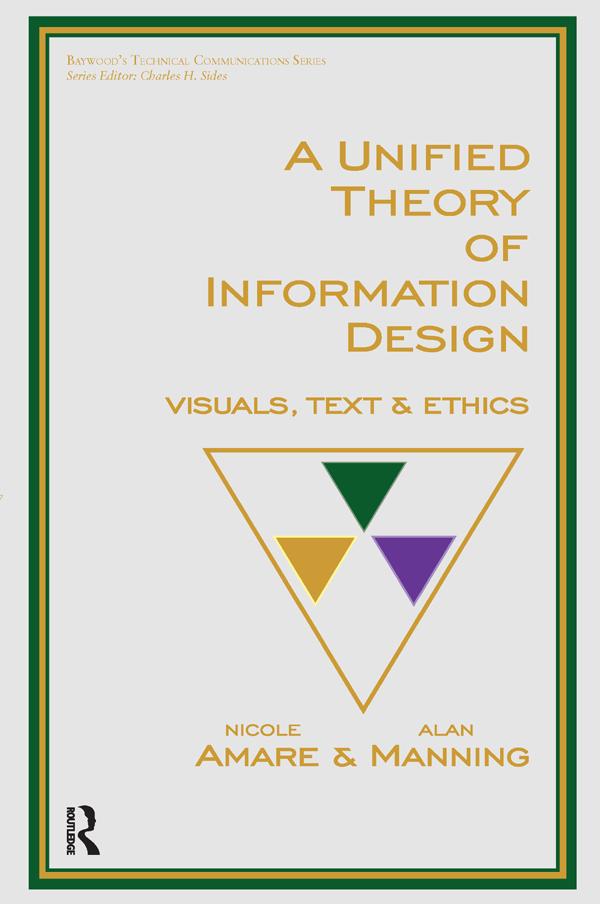
Communicative visuals, including written text, have a diverse range of forms and purposes. In this volume, the authors show that it is possible to both describe and explain the major properties of diverse visual-communication forms and purposes within a common theoretical framework of information design and ethics. For those unaccustomed to thinking of written text as a visual form belonging to the same general class as other visual forms (colour, texture, shape, imagery, etc.), consider how a text's readability suffers if we remove all white space and punctuation, which can be identified as visual signals of the same subtype as grid lines and bullet points, dividing and calling attention to adjacent information. The authors identify deep connections between foundational visual design elements and the grammar of language itself.
No physicist or chemist today questions the value of a single theory that describes and explains a wide variety of phenomena, but oddly enough, the authors have frequently been asked why they are interested in advancing a unified theory of visual communication. The simplest answer is: to treat visual communication as a science, and seeking unified theories is just what science does. In more practical terms, a unified approach to visual communication allows us to teach visual design students relatively few things that will enable them to do relatively many things.
Paga facilmente con carta, Klarna, Apple Pay o Google Pay. Non sei soddisfatto? Hai sempre 14 giorni per il rimborso. Leggi di più nei nostri termini. Per qualsiasi domanda, scrivici a hello@memmo.org.
Memmo rende lo studio più facile, ovunque tu sia nel mondo. Qui trovi i tuoi libri di testo e strumenti di studio intelligenti, tutto in un unico posto: riassunti, quiz, podcast e flashcard. E poi c'è Ted, il tuo compagno di studio che risponde a ogni tua domanda. Oltre 50.000 studenti studiano già qui: è stato creato per aiutarti a imparare più velocemente e a stressarti meno.