
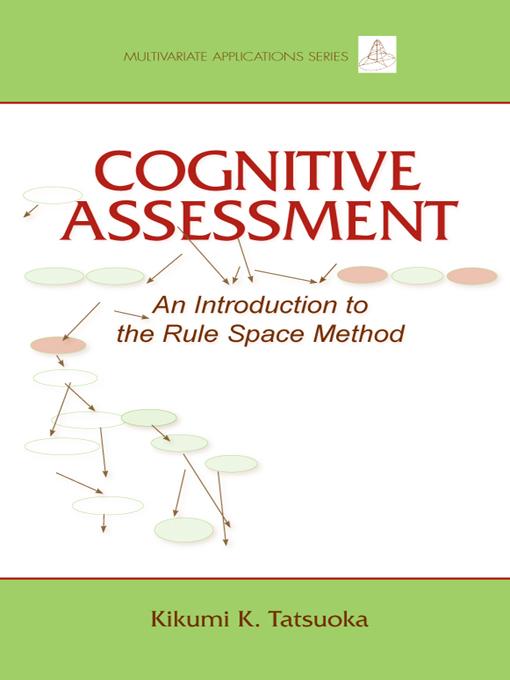
This book introduces a new methodology for the analysis of test results. Free from ambiguous interpretations, the results truly demonstrate an individual’s progress. The methodology is ideal for highlighting patterns derived from test scores used in evaluating progress. Dr. Tatsuoka introduces readers to the Rule Space Method (RSM), a technique that transforms unobservable knowledge and skill variables into observable and measurable attributes. RSM converts item response patterns into attribute mastery probabilities. RSM is the only up-to-date methodology that can handle large scale assessment for tests such as the SAT and PSAT. PSAT used the results from this methodology to create cognitively diagnostic scoring reports. In this capacity, RSM helps teachers understand what scores mean by helping them ascertain an individual’s cognitive strengths and weaknesses. For example, two students may have the exact same score, but for different reasons. One student might excel at processing grammatically complex texts but miss the main idea of the prose, while another excels at understanding the global message. Such knowledge helps teachers customize a student’s education to his or her cognitive abilities. RSM is also used for medical diagnoses, genetics research, and to help classify music into various states of emotions for treating mental problems.
The book opens with an overview of cognitive assessment research and nonparametric and parametric person-fit statistics. The Q-matrix theory is then introduced followed by the Rule Space method. Various properties of attribute mastery probabilities are then introduced along with the reliability theory of attributes and its connection to classical and item response theory. The book concludes with a discussion of how the construct validity of a test can be clarified with the Rule Space method.
Intended for researchers and graduate students in quantitative, educational, and cognitive psychology, this book also appeals to those in computer science, neuroscience, medicine, and mathematics. The book is appropriate for advanced courses on cognometrics, latent class structures, and advanced psychometrics as well as statistical pattern recognition and classification courses taught in statistics and/or math departments.
Paga facilmente con carta, Klarna, Apple Pay o Google Pay. Non sei soddisfatto? Hai sempre 14 giorni per il rimborso. Leggi di più nei nostri termini. Per qualsiasi domanda, scrivici a hello@memmo.org.
Memmo rende lo studio più facile, ovunque tu sia nel mondo. Qui trovi i tuoi libri di testo e strumenti di studio intelligenti, tutto in un unico posto: riassunti, quiz, podcast e flashcard. E poi c'è Ted, il tuo compagno di studio che risponde a ogni tua domanda. Oltre 50.000 studenti studiano già qui: è stato creato per aiutarti a imparare più velocemente e a stressarti meno.