
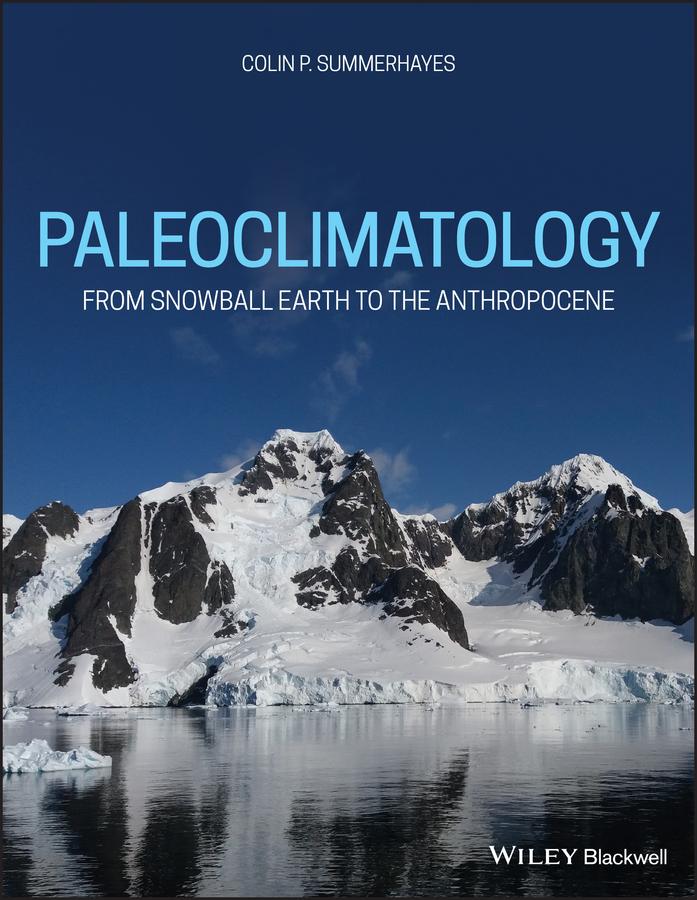
Life on our planet depends upon having a climate that changes within narrow limits – not too hot for the oceans to boil away nor too cold for the planet to freeze over. Over the past billion years Earth’s average temperature has stayed close to 14-15°C, oscillating between warm greenhouse states and cold icehouse states. We live with variation, but a variation with limits. Paleoclimatology is the science of understanding and explaining those variations, those limits, and the forces that control them. Without that understanding we will not be able to foresee future change accurately as our population grows. Our impact on the planet is now equal to a geological force, such that many geologists now see us as living in a new geological era – the Anthropocene.
Paleoclimatology describes Earth’s passage through the greenhouse and icehouse worlds of the past 800 million years, including the glaciations of Snowball Earth in a world that was then free of land plants. It describes the operation of the Earth’s thermostat, which keeps the planet fit for life, and its control by interactions between greenhouse gases, land plants, chemical weathering, continental motions, volcanic activity, orbital change and solar variability. It explains how we arrived at our current understanding of the climate system, by reviewing the contributions of scientists since the mid-1700s, showing how their ideas were modified as science progressed. And it includes reflections based on the author’s involvement in palaeoclimatic research.
The book will transform debate and set the agenda for the next generation of thought about future climate change. It will be an invaluable course reference for undergraduate and postgraduate students in geology, climatology, oceanography and the history of science.
"A real tour-de-force! An outstanding summary not only of the science and what needs to be done, but also the challenges that are a consequence of psychological and cultural baggage that threatens not only the survival of our own species but the many others we are eliminating as well."
Peter Barrett
Emeritus Professor of Geology, Antarctic Research Centre, Victoria University of Wellington, New Zealand
"What a remarkable and wonderful synthesis... it will be a wonderful source of [paleoclimate] information and insights."
Christopher R. Scotese
Professor, Department of Earth and Planetary Sciences, Northwestern University, Evanston, IL, USA
Paga facilmente con carta, Klarna, Apple Pay o Google Pay. Non sei soddisfatto? Hai sempre 14 giorni per il rimborso. Leggi di più nei nostri termini. Per qualsiasi domanda, scrivici a hello@memmo.org.
Memmo rende lo studio più facile, ovunque tu sia nel mondo. Qui trovi i tuoi libri di testo e strumenti di studio intelligenti, tutto in un unico posto: riassunti, quiz, podcast e flashcard. E poi c'è Ted, il tuo compagno di studio che risponde a ogni tua domanda. Oltre 50.000 studenti studiano già qui: è stato creato per aiutarti a imparare più velocemente e a stressarti meno.