
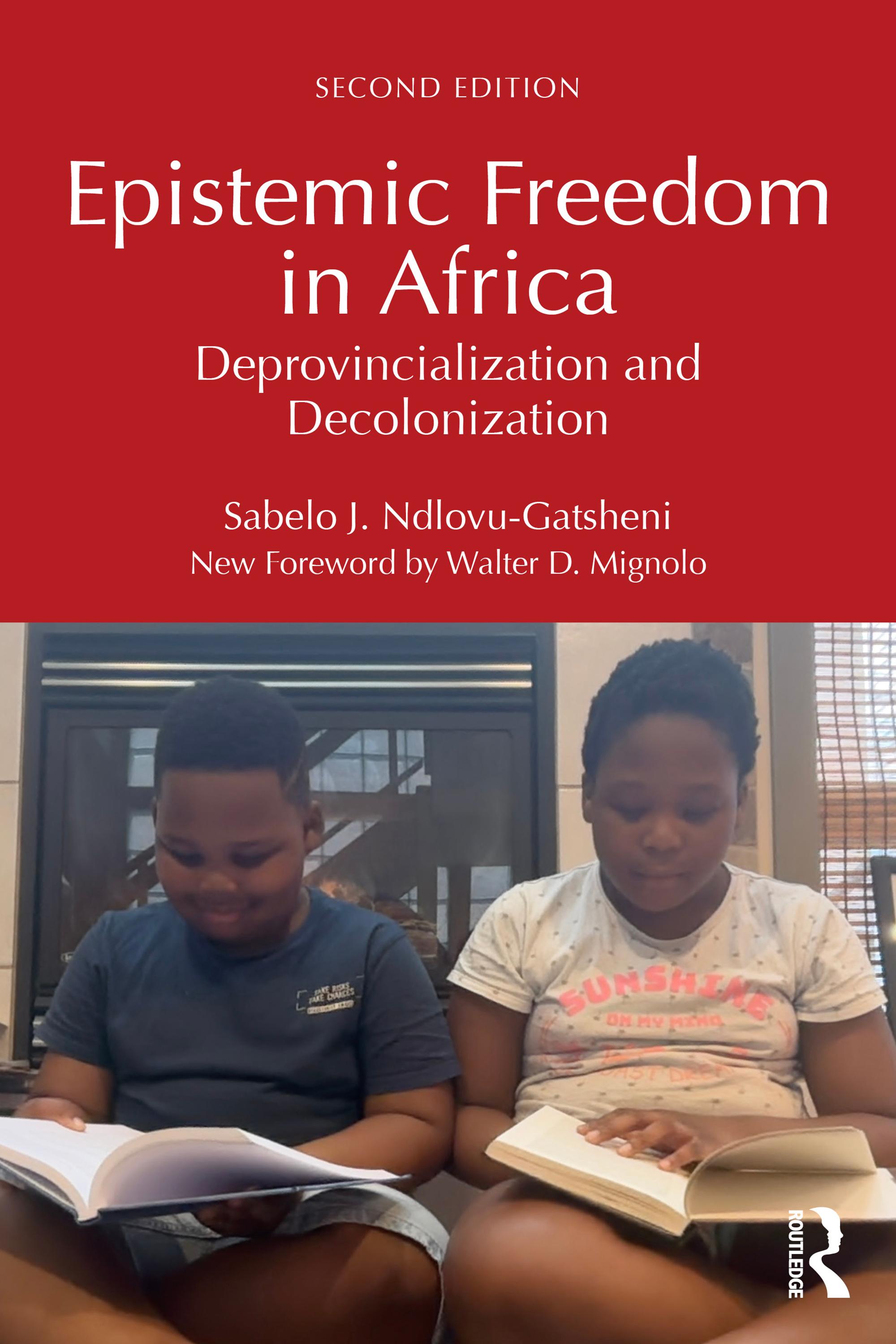
Epistemic Freedom in Africa is about the struggle for African people to think, theorize, interpret the world, and write from where they are located, unencumbered by Eurocentrism. The imperial denial of common humanity to some human beings meant that in turn their knowledges and experiences lost their value, their epistemic virtue. Now, in the twenty-first century, descendants of enslaved, displaced, colonized, and racialized peoples have entered universities and academies across the world, proclaiming loudly that they are human beings, their lives matter, and they were born into valid and legitimate knowledge systems that are capable of helping humanity to transcend the current epistemic and systemic crises. Together, they are engaging in diverse struggles for cognitive justice, fighting against the epistemic line which haunts the twenty-first century.
Now in a new edition that brings the book’s core insights right up to date, renowned historian and decolonial theorist Sabelo J. Ndlovu-Gatsheni reflects on recent advances in decoloniality research. Two important new chapters have been added which explore decolonial methodology as a bridge between epistemology and method, and the engendering knowledge, arguing that the decolonization of knowledge is inseparable from the depatriarchization of knowledge. Throughout the book, Ndlovu-Gatsheni offers a penetrating and well-argued case for centring Africa as a legitimate historical unit of analysis and epistemic site from which to interpret the world, whilst simultaneously making an equally strong argument for globalizing knowledge from Africa so as to attain ecologies of knowledges. This is a triple helix process of deprovincializing Africa, provincializing Europe, and decolonizing knowledge. The book highlights how the mental universe of Africa was invaded and colonized, the long-standing struggles for ‘an African university’, and the trajectories of decolonial movements such as Rhodes Must Fall and Fees Must Fall in South Africa. This landmark work underscores the fact that only once the problem of epistemic freedom has been addressed can Africa achieve political, cultural, economic, and other freedoms.
The new edition of this influential book will be an important read for students and scholars across Education, History, Philosophy, Ethics, African Studies, Development Studies, Politics, International Relations, Sociology, Postcolonial Studies, and Decolonial Studies.
Paga facilmente con carta, Klarna, Apple Pay o Google Pay. Non sei soddisfatto? Hai sempre 14 giorni per il rimborso. Leggi di più nei nostri termini. Per qualsiasi domanda, scrivici a hello@memmo.org.
Memmo rende lo studio più facile, ovunque tu sia nel mondo. Qui trovi i tuoi libri di testo e strumenti di studio intelligenti, tutto in un unico posto: riassunti, quiz, podcast e flashcard. E poi c'è Ted, il tuo compagno di studio che risponde a ogni tua domanda. Oltre 50.000 studenti studiano già qui: è stato creato per aiutarti a imparare più velocemente e a stressarti meno.