
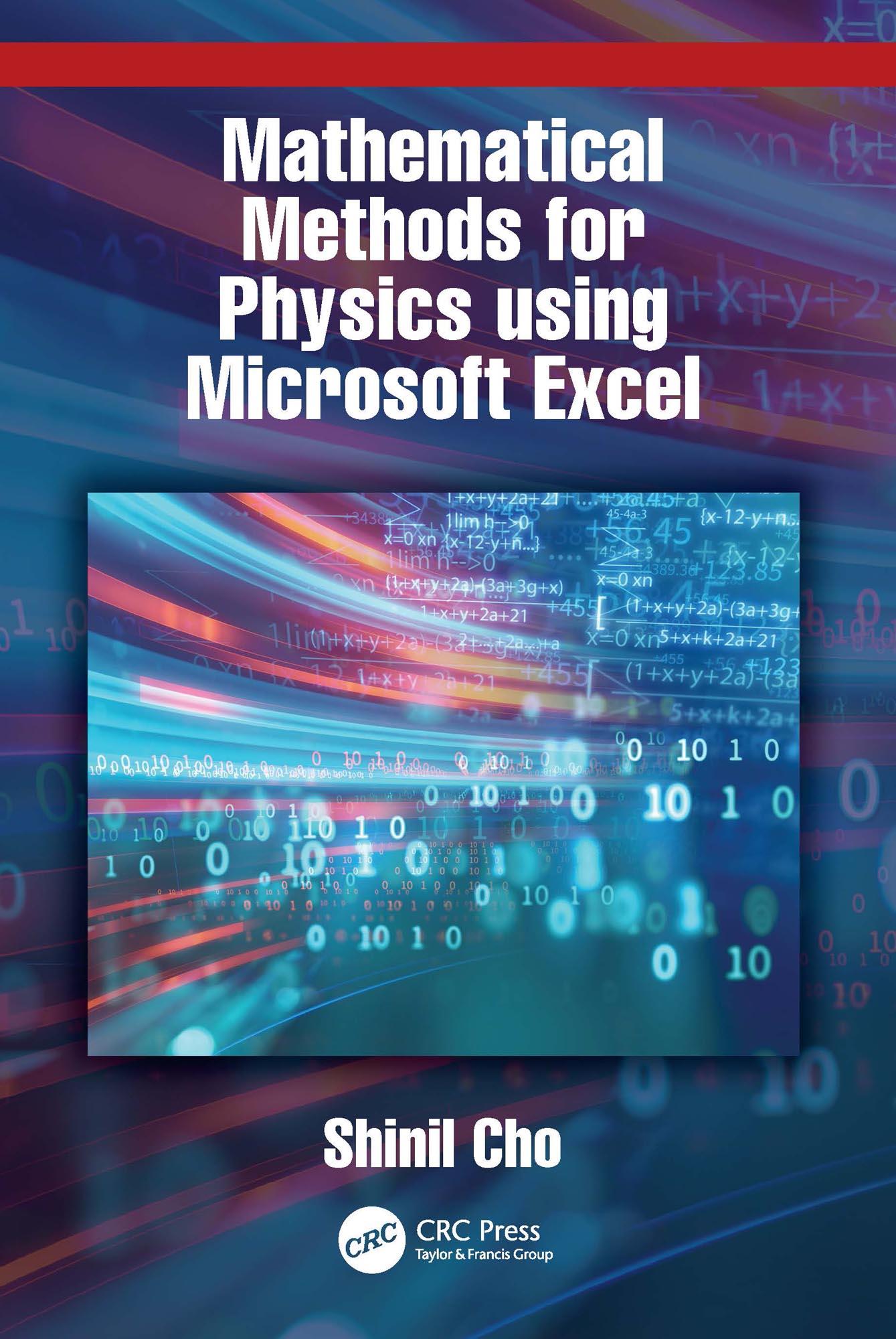
In Mathematical Methods for Physics using Microsoft Excel, readers will investigate topics from classical to quantum mechanics, which are often omitted from the course work. Some of these topics include rocket propulsion, Rutherford scattering, precession and nutation of a top under gravity, parametric oscillation, relativistic Doppler effect, concepts of entropy, kinematics of wave packets, and boundary value problems and associated special functions as orthonormal bases. Recent topics such as the Lagrange point of the James Webb Space Telescope, a muon detector in relation to Cherenkov’s radiation, and information entropy and H-function are also discussed and analyzed. Additional interdisciplinary topics, such as self-avoiding random walks for polymer length and population dynamics, are also described.
This book will allow readers to reproduce and replicate the data and experiments often found in physics textbooks, with a stronger foundation of knowledge. While investigating these subjects, readers will follow a step-by-step introduction to computational algorithms for solving differential equations for which analytical solutions are often challenging to find. For computational analysis, features of Microsoft Excel® including AutoFill, Iterative Calculation, and Visual Basic for Applications are useful to conduct hands-on projects. For the visualization of computed outcomes, the Chart output feature can be readily used. There are several first-time attempts on various topics introduced in this book such as 3D-like graphics using Euler’s angle and the behavior of wave functions of harmonic oscillators and hydrogen atoms near the true eigenvalues.
Paga facilmente con carta, Klarna, Apple Pay o Google Pay. Non sei soddisfatto? Hai sempre 14 giorni per il rimborso. Leggi di più nei nostri termini. Per qualsiasi domanda, scrivici a hello@memmo.org.
Memmo rende lo studio più facile, ovunque tu sia nel mondo. Qui trovi i tuoi libri di testo e strumenti di studio intelligenti, tutto in un unico posto: riassunti, quiz, podcast e flashcard. E poi c'è Ted, il tuo compagno di studio che risponde a ogni tua domanda. Oltre 50.000 studenti studiano già qui: è stato creato per aiutarti a imparare più velocemente e a stressarti meno.