
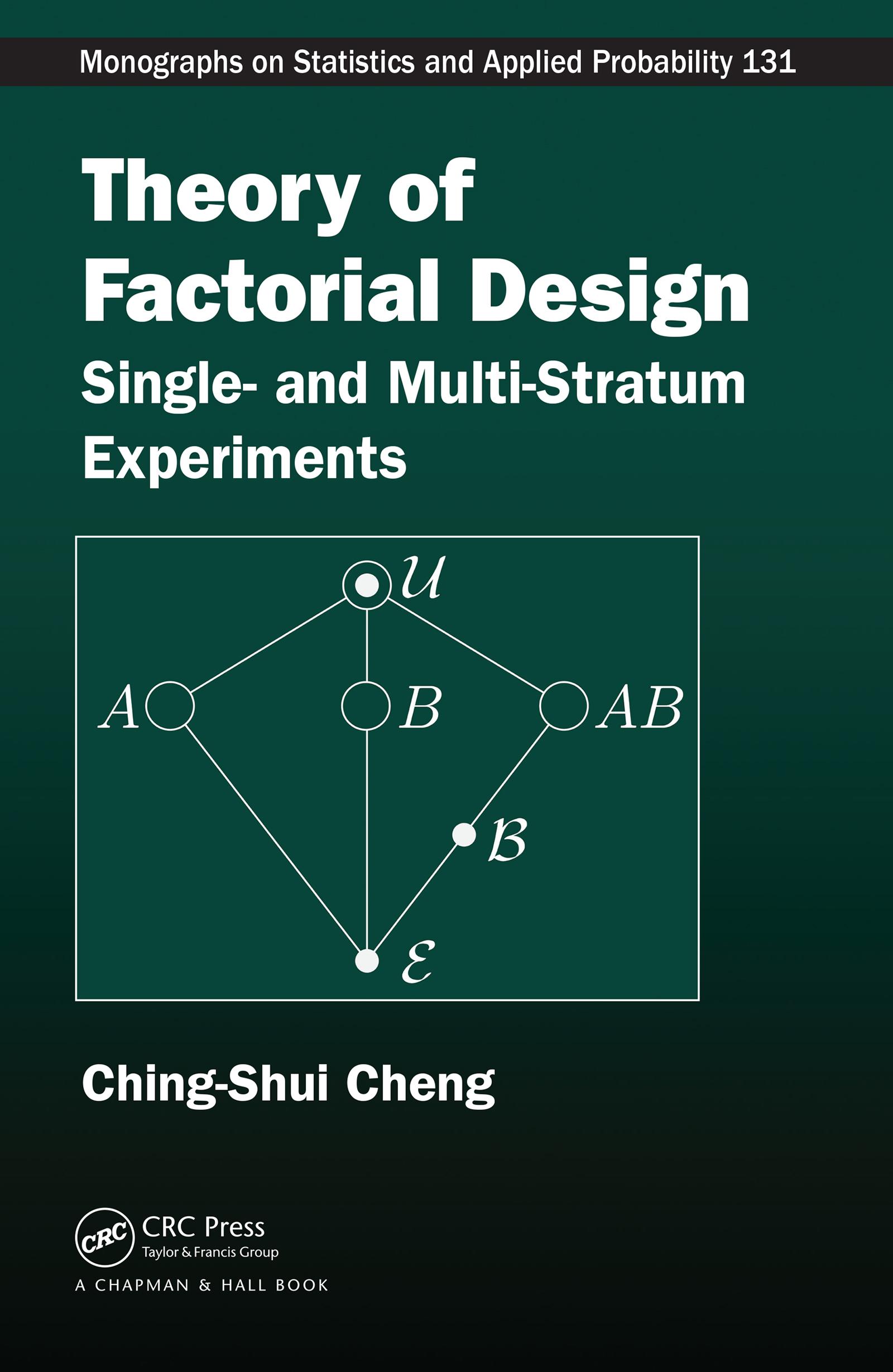
Bringing together both new and old results, Theory of Factorial Design: Single- and Multi-Stratum Experiments provides a rigorous, systematic, and up-to-date treatment of the theoretical aspects of factorial design. To prepare readers for a general theory, the author first presents a unified treatment of several simple designs, including completely randomized designs, block designs, and row-column designs. As such, the book is accessible to readers with minimal exposure to experimental design. With exercises and numerous examples, it is suitable as a reference for researchers and as a textbook for advanced graduate students. In addition to traditional topics and a thorough discussion of the popular minimum aberration criterion, the book covers many topics and new results not found in existing books. These include results on the structures of two-level resolution IV designs, methods for constructing such designs beyond the familiar foldover method, the extension of minimum aberration to nonregular designs, the equivalence of generalized minimum aberration and minimum moment aberration, a Bayesian approach, and some results on nonregular designs. The book also presents a theory that provides a unifying framework for the design and analysis of factorial experiments with multiple strata (error terms) arising from complicated structures of the experimental units. This theory can be systematically applied to various structures of experimental units instead of treating each on a case-by-case basis.
Paga facilmente con carta, Klarna, Apple Pay o Google Pay. Non sei soddisfatto? Hai sempre 14 giorni per il rimborso. Leggi di più nei nostri termini. Per qualsiasi domanda, scrivici a hello@memmo.org.
Memmo rende lo studio più facile, ovunque tu sia nel mondo. Qui trovi i tuoi libri di testo e strumenti di studio intelligenti, tutto in un unico posto: riassunti, quiz, podcast e flashcard. E poi c'è Ted, il tuo compagno di studio che risponde a ogni tua domanda. Oltre 50.000 studenti studiano già qui: è stato creato per aiutarti a imparare più velocemente e a stressarti meno.