
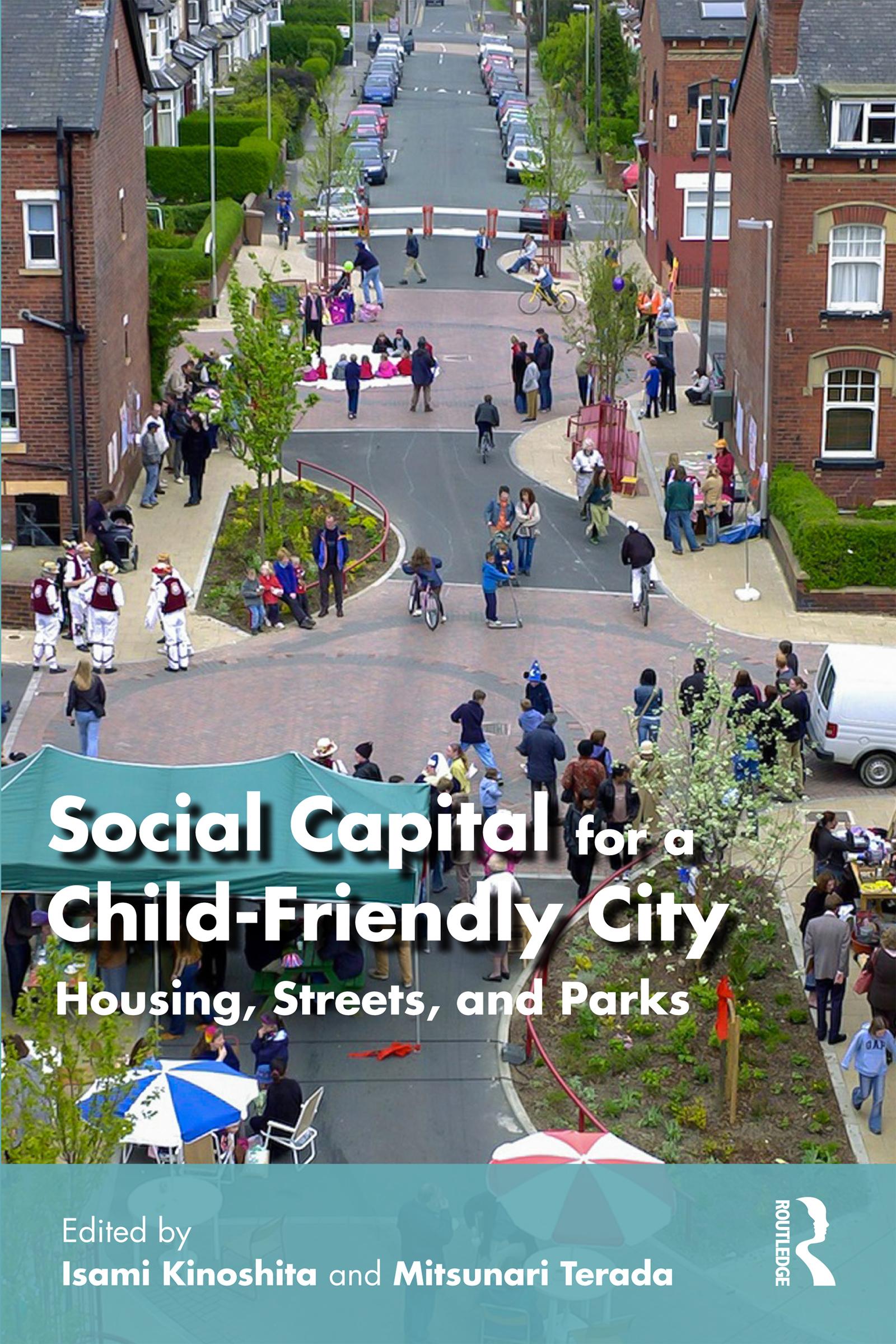
Social Capital for a Child-Friendly City argues for the importance of relationship networks (social capital) in children’s growth and socialization, and explores how child-friendly social capital can be cultivated through urban planning and community development. As outdoor play decreases and children spend more time online, Kinoshita and Terada return to John Dewey’s proposal that social capital is essential for nurturing the next generation and establish a democratic and sustainable society. The book features examples from Sweden, Finland, Germany, Switzerland, the UK, and Japan, exploring methods for cultivating social capital and spaces for children to play and develop in cooperative housing, outdoor play spaces, streets, parks, and neighbourhoods. We express our gratitude to Dr. Marketta Kytta, Professor of Aalto University, who gave valuable suggestions about the key term ‘bullerby’ and ‘social capital’.
This book will be of use to students and practitioners of urban planning and landscape architecture, as well as any community leaders or developers seeking to foster a nurturing environment where children can flourish.
Paga facilmente con carta, Klarna, Apple Pay o Google Pay. Non sei soddisfatto? Hai sempre 14 giorni per il rimborso. Leggi di più nei nostri termini. Per qualsiasi domanda, scrivici a hello@memmo.org.
Memmo rende lo studio più facile, ovunque tu sia nel mondo. Qui trovi i tuoi libri di testo e strumenti di studio intelligenti, tutto in un unico posto: riassunti, quiz, podcast e flashcard. E poi c'è Ted, il tuo compagno di studio che risponde a ogni tua domanda. Oltre 50.000 studenti studiano già qui: è stato creato per aiutarti a imparare più velocemente e a stressarti meno.