
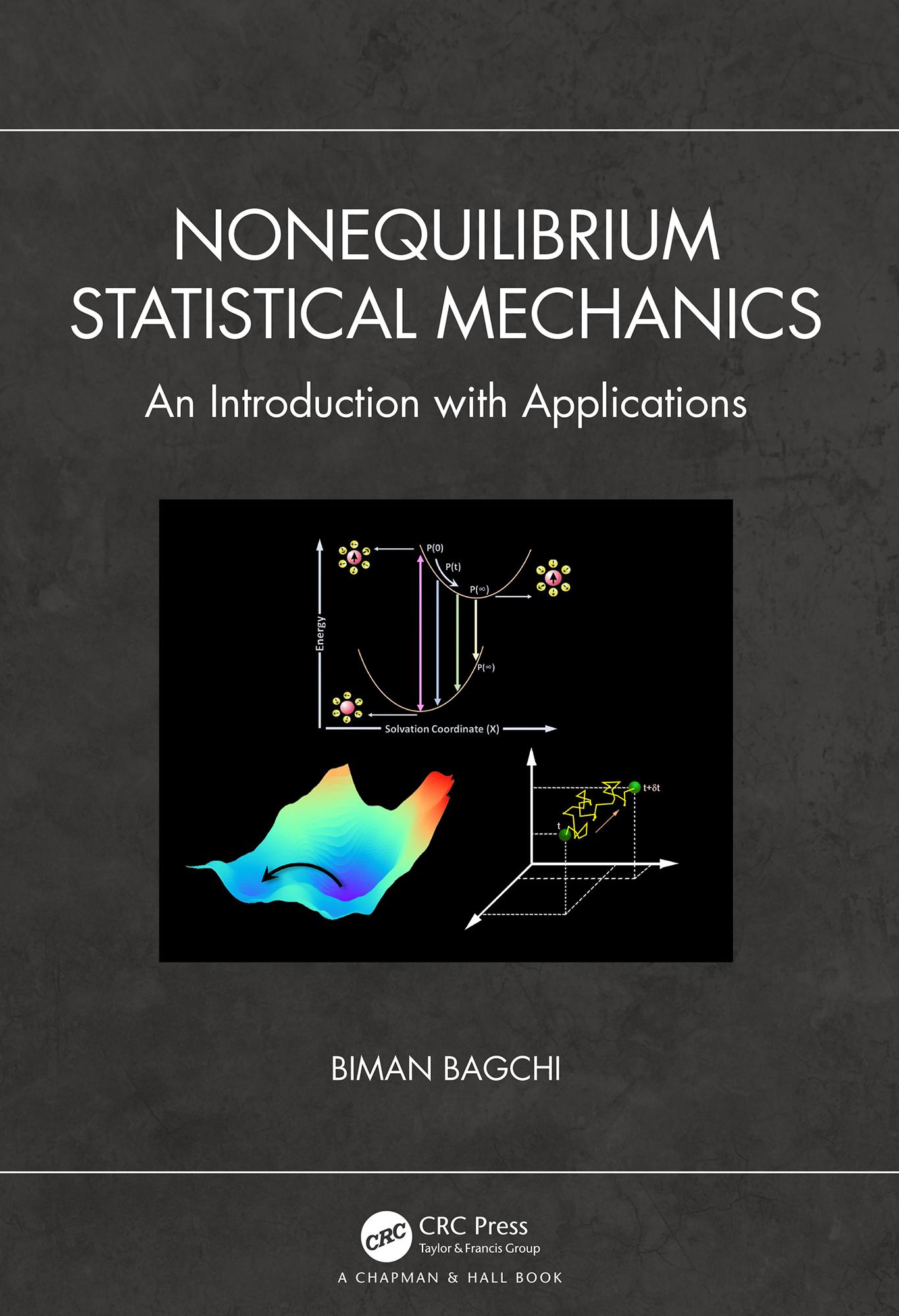
Nonequilibrium statistical mechanics (NESM), practically synonymous with time-dependent statistical mechanics (TDSM), is a beautiful and profound subject, vast in scope, diverse in applications, and indispensable in understanding the changing natural phenomena we encounter in the physical, chemical and biological world. Although time dependent phenomena have been studied from antiquity, the modern subject, the nonequilibrium statistical mechanics, has its genesis in Boltzmann’s 1872 classic paper that aimed at extending Maxwell’s kinetic theory of gases by including intermolecular interactions. Subsequent development of the subject drew upon the seminal work of Einstein and Langevin on Brownian motion, Rayleigh and Stokes on hydrodynamics, and on the works of Onsager, Prigogine, Kramers, Kubo, Mori, and Zwanzig.
One major goal of this book is to develop and present NESM in an organized fashion so that students can appreciate and understand the flow of the subject from postulates to practical uses. This book takes the students on a journey from fundamentals to applications, mostly using simple mathematics, and fundamental concepts. With the advent of computers and computational packages and techniques, a deep intuitive understanding can allow the students to tackle fairly complex problems, like proteins in lipid membranes or solvation of ions in electrolytes used in batteries. The subject is still evolving rapidly, with forays into complex biological events, and materials science.
Nonequilibrium Statistical Mechanics: An Introduction with Applications is, thus, an introductory text that aims to provide students with a background and skill essential to study and understand time-dependent (relaxation) phenomena. It will allow students to calculate transport properties like diffusion and conductivity. The book also teaches the methods to calculate reaction rate on a multi-dimensional energy surface, in another such application.
For a beginner in the field, especially for one with an aim to study chemistry and biology, and also physics, one major difficulty faced is a lack of organization of the available study material. Since NESM is a vast subject with many different theoretical tools, the above poses a problem. This book lays the foundations towards understanding time- dependent phenomena in a simple and systematic fashion. It is accessible to students and researchers who have basic training in physics and mathematics. The book can be used to teach advanced undergraduates. Some involved topics, like the projection operator technique and mode coupling theory, are more suitable for Ph.D. level.
Paga facilmente con carta, Klarna, Apple Pay o Google Pay. Non sei soddisfatto? Hai sempre 14 giorni per il rimborso. Leggi di più nei nostri termini. Per qualsiasi domanda, scrivici a hello@memmo.org.
Memmo rende lo studio più facile, ovunque tu sia nel mondo. Qui trovi i tuoi libri di testo e strumenti di studio intelligenti, tutto in un unico posto: riassunti, quiz, podcast e flashcard. E poi c'è Ted, il tuo compagno di studio che risponde a ogni tua domanda. Oltre 50.000 studenti studiano già qui: è stato creato per aiutarti a imparare più velocemente e a stressarti meno.