
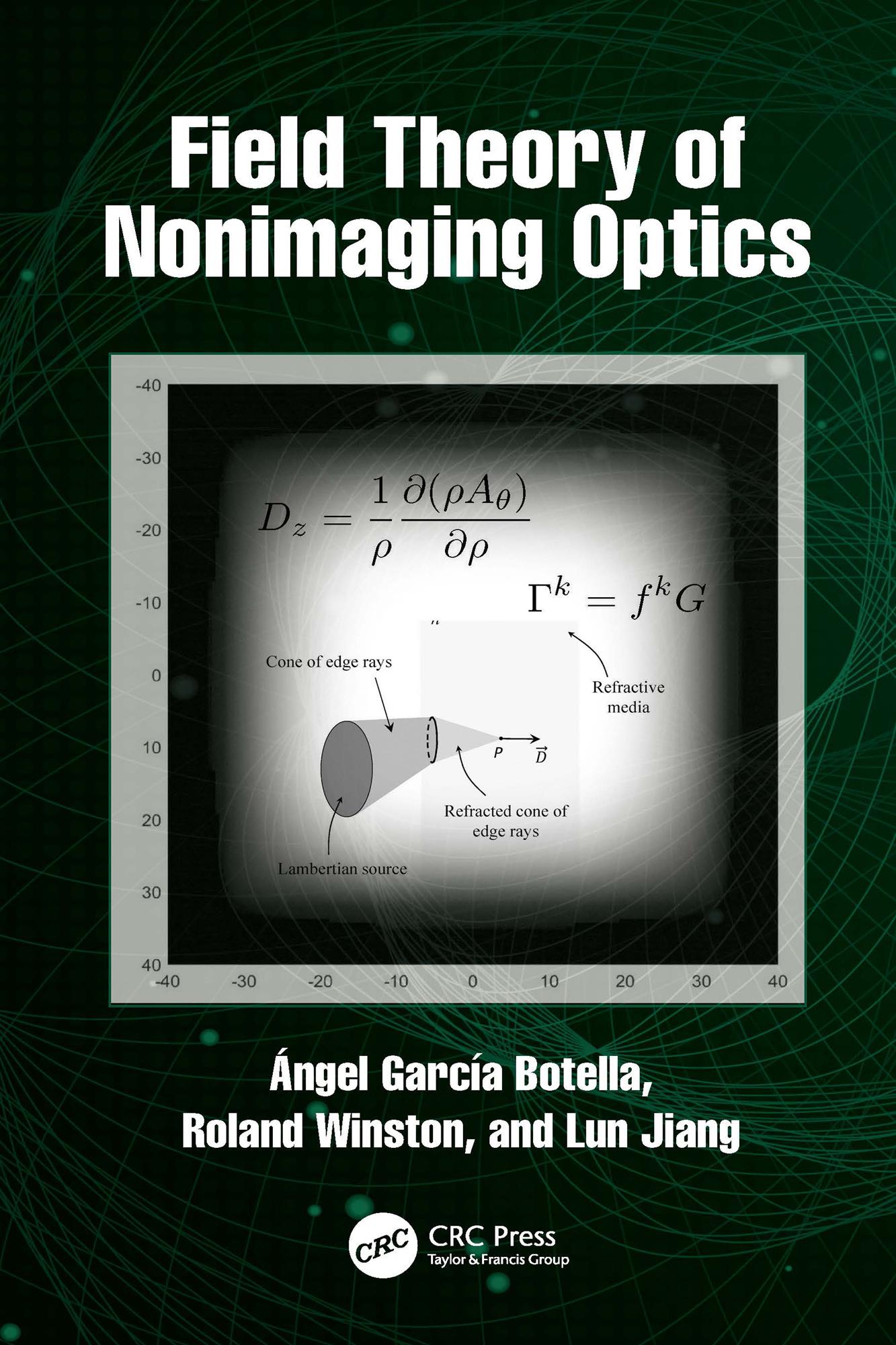
This book aims to overcome the traditional ray paradigm and provide an analytical paradigm for Nonimaging Optics based on Field Theory. As a second objective, the authors address the connections between this Field Theory of Nonimaging Optics and other radiative transfer theories.
The book introduces the Field Theory of Nonimaging Optics as a new analytical paradigm, not statistical, to analyze problems in the frame of nonimaging geometrical optics, with a formulation based on field theory of irradiance vector D. This new paradigm provides new principles and tools in the optical system design methods, complementary to flowline method, overcoming the classical ray paradigm. This new Field paradigm can be considered as a generalization of the ray paradigm and new accurate and faster computation algorithms will be developed. In a parallel way, the advance in the knowledge of the principles of Field Theory of Nonimaging Optics has produced clear advances in the connection between nonimaging optics and other apparently disconnected theories of radiation transfer. The irradiance vector D can be considered as the macroscopic average of Poynting vector, with a clear connection with radiation pressure. Lorentz geometry techniques can also be applied to study irradiance vector D. There are clear thermodynamic connections between the nonimaging concentrator and Stefan-Boltzmann law of radiation. From this thermodynamic connection, nonimaging optics and irradiance vector D can also be studied from a phase space point of view.
This book is intended for researchers, graduate students, academics and professionals looking to analyze, design and optimize optical systems.
Paga facilmente con carta, Klarna, Apple Pay o Google Pay. Non sei soddisfatto? Hai sempre 14 giorni per il rimborso. Leggi di più nei nostri termini. Per qualsiasi domanda, scrivici a hello@memmo.org.
Memmo rende lo studio più facile, ovunque tu sia nel mondo. Qui trovi i tuoi libri di testo e strumenti di studio intelligenti, tutto in un unico posto: riassunti, quiz, podcast e flashcard. E poi c'è Ted, il tuo compagno di studio che risponde a ogni tua domanda. Oltre 50.000 studenti studiano già qui: è stato creato per aiutarti a imparare più velocemente e a stressarti meno.