
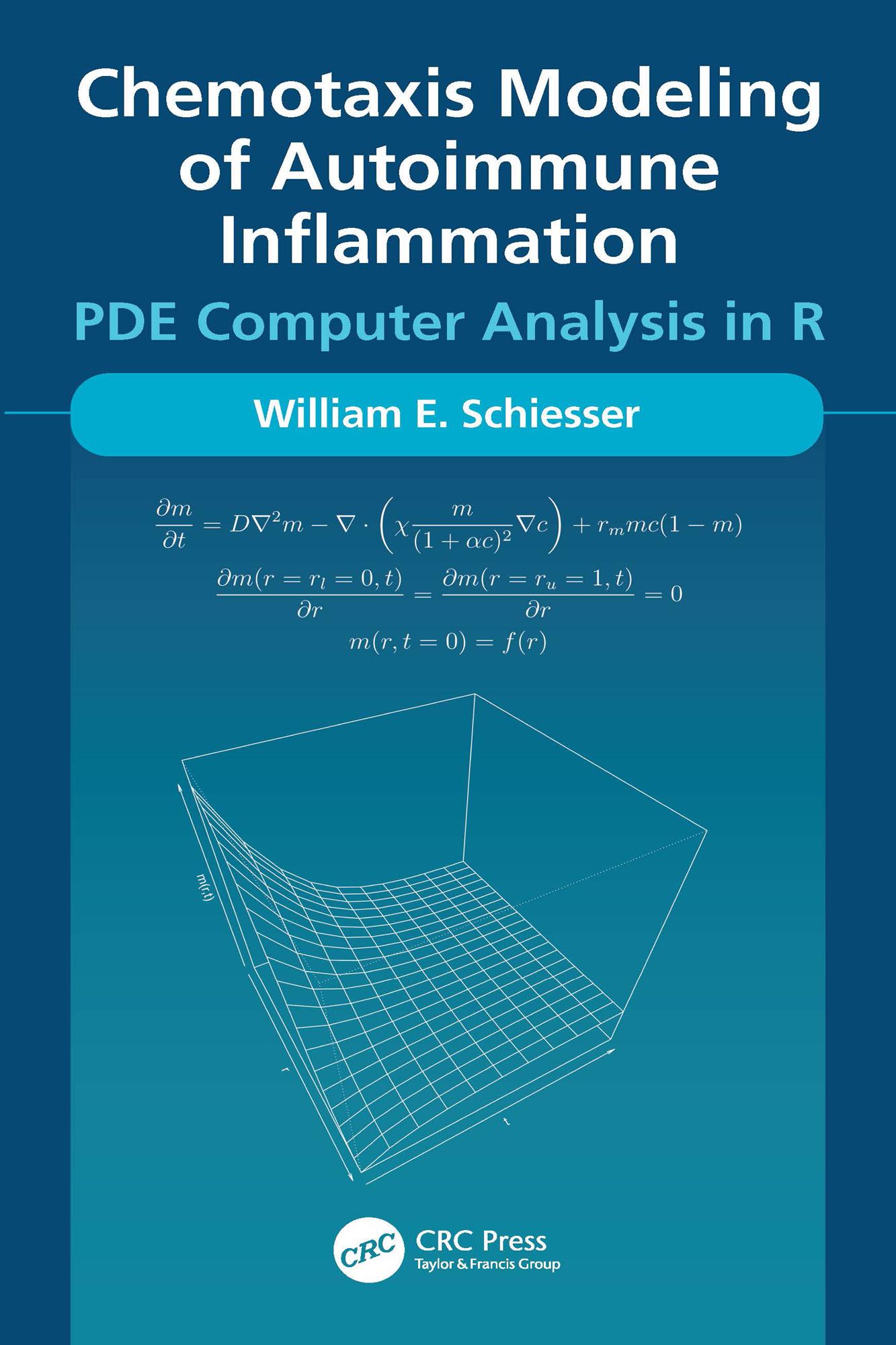
In response to an infection (e.g., from pathogens such as bacteria and viruses), the immune system can deplete macrophages (specialized white blood cells) and produce cytokines that are pro-inflammatory or anti-inflammatory. This counterproductive autoimmune response is represented mathematically as nonlinear chemotaxis diffusion.
This book is directed to the computer-based modeling of chemotaxis inflammation. The spatiotemporal analysis is
based on a model of three partial differential equations (PDEs).
The three PDE model is coded (programmed) as a set of routines in R, a quality, open-source, scientific programming system. The numerical integration (solution) of the PDEs is by the method of lines (MOL).
The three PDE model can be used for computer-based experimentation, for example, parameter variation and changes in the model equations or alternate models, to enhance a quantitative understanding of a postulated
inflammation.
This experimentation is illustrated by chapters pertaining to: (1) the computation and display of the PDE time derivatives, (2) the RHS terms of the PDEs with emphasis on the chemotaxis terms, (3) parameter variations to demonstrate parameter effects and sensitivities and (4) additonal terms in the PDEs to include PDE coupling and extensions of the basic PDE model.
Paga facilmente con carta, Klarna, Apple Pay o Google Pay. Non sei soddisfatto? Hai sempre 14 giorni per il rimborso. Leggi di più nei nostri termini. Per qualsiasi domanda, scrivici a hello@memmo.org.
Memmo rende lo studio più facile, ovunque tu sia nel mondo. Qui trovi i tuoi libri di testo e strumenti di studio intelligenti, tutto in un unico posto: riassunti, quiz, podcast e flashcard. E poi c'è Ted, il tuo compagno di studio che risponde a ogni tua domanda. Oltre 50.000 studenti studiano già qui: è stato creato per aiutarti a imparare più velocemente e a stressarti meno.