
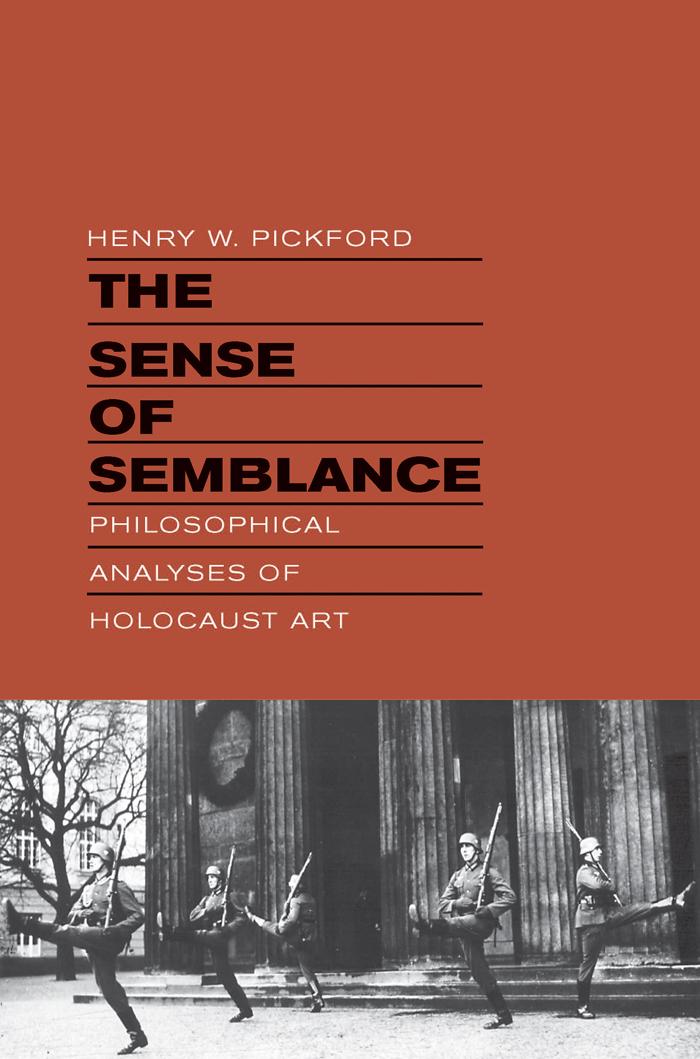
The Sense of Semblance is the first book to incorporate contemporary analytic philosophy in interpretations of art and architecture, literature, and film about the Holocaust. The book’s principal aim is to move beyond the familiar debates surrounding postmodernism by demonstrating the usefulness of alternative theories of meaning and understanding from the Anglophone analytic tradition. The book takes as its starting point the claim that Holocaust artworks must fulfill at least two specific yet potentially reciprocally countervailing desiderata: they must meet aesthetic criteria (lest they be, say, merely historical documents) and they must meet historical criteria (they must accurately represent the Holocaust, lest they be merely artworks). I locate this problematic within the tradition of philosophical aesthetics, as a version of the conflict between aesthetic autonomy and aesthetic heteronomy, and claim that Theodor W. Adorno’s “dialectic of aesthetic semblance” describes the normative demand that a successful artwork maintain a dynamic tension between these dual desiderata. While working within a framework inspired by Adorno, the book further claims that certain concepts and lines of reasoning from contemporary philosophy best explicate how individual artworks fulfill these dual desiderata, including the causal theory of names, the philosophy of tacit knowledge, analytic philosophy of quotation, Sartre’s theory of the imaginary, work in the epistemology of testimony, and Walter Benjamin’s theory of dialectical images. Individual chapters provide close readings of lyric poetry by Paul Celan (including a critique of Derridean deconstruction), Holocaust memorials in Berlin, texts by the Austrian quotational artist Heimrad Bäcker, Claude Lanzmann’s film Shoah and Art Spiegelman’s graphic novel Maus. The result is a set of interpretations of Holocaust artworks that, in their precision, specificity and clarity, inaugurate a dialogue between contemporary analytic philosophy and contemporary art.
Paga facilmente con carta, Klarna, Apple Pay o Google Pay. Non sei soddisfatto? Hai sempre 14 giorni per il rimborso. Leggi di più nei nostri termini. Per qualsiasi domanda, scrivici a hello@memmo.org.
Memmo rende lo studio più facile, ovunque tu sia nel mondo. Qui trovi i tuoi libri di testo e strumenti di studio intelligenti, tutto in un unico posto: riassunti, quiz, podcast e flashcard. E poi c'è Ted, il tuo compagno di studio che risponde a ogni tua domanda. Oltre 50.000 studenti studiano già qui: è stato creato per aiutarti a imparare più velocemente e a stressarti meno.
Potrebbe interessarti anche
Acquista il libro0