
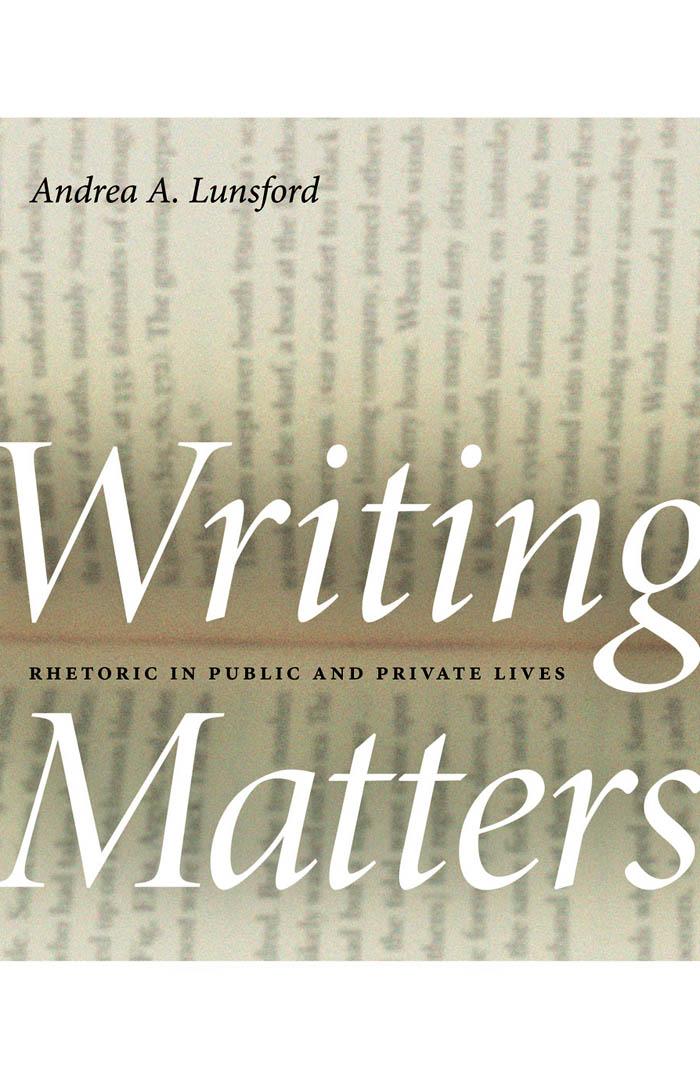
Anyone who laments the demise of print text would find a sympathetic listener in Andrea A. Lunsford. Anyone who bemoans the lack of respect for blogs, graphic novels, and other new media would find her no less understanding. Lunsford is at home in both camps because she sees beyond writing's ever-changing forms to the constancy of its power to "make space for human agency—or to radically limit such agency."
Lunsford is a celebrated scholar of rhetoric and composition, and many undergraduates taking courses in those subjects have used her textbooks. Here she helps us see that writing is not just a mode of communication, persuasion, and expression, but a web of meanings and practices that shape our lives. Lunsford tells how she gained a new respect for our digital culture's three v's—vocal, visual, verbal—while helping design and teach a course in multimedia writing. On the importance of having a linguistically pluralistic society, Lunsford draws links between such varied topics as the English Only movement, language extinction, Ebonics, and the text messaging shorthand "l33t."
Lunsford has seen how words, writing, and language enforce unfair power relationships in the academy. Most classroom settings, she writes, are authority based and stress "individualism, ranking, hierarchy, and therefore—we have belatedly come to understand—exclusion." Concerned about the paucity—still—of tenured women and minority faculty, she urges schools to revisit admission and retention practices. These are tough and divisive problems, Lunsford acknowledges. Yet if we can see that writing has the power to help prolong or solve them—that writing matters—then we have a common ground.
Lunsford is a celebrated scholar of rhetoric and composition, and many undergraduates taking courses in those subjects have used her textbooks. Here she helps us see that writing is not just a mode of communication, persuasion, and expression, but a web of meanings and practices that shape our lives. Lunsford tells how she gained a new respect for our digital culture's three v's—vocal, visual, verbal—while helping design and teach a course in multimedia writing. On the importance of having a linguistically pluralistic society, Lunsford draws links between such varied topics as the English Only movement, language extinction, Ebonics, and the text messaging shorthand "l33t."
Lunsford has seen how words, writing, and language enforce unfair power relationships in the academy. Most classroom settings, she writes, are authority based and stress "individualism, ranking, hierarchy, and therefore—we have belatedly come to understand—exclusion." Concerned about the paucity—still—of tenured women and minority faculty, she urges schools to revisit admission and retention practices. These are tough and divisive problems, Lunsford acknowledges. Yet if we can see that writing has the power to help prolong or solve them—that writing matters—then we have a common ground.
Categoria: Språk & Lingvistik
e-ISBN: 9780820342818
Paga facilmente con carta, Klarna, Apple Pay o Google Pay. Non sei soddisfatto? Hai sempre 14 giorni per il rimborso. Leggi di più nei nostri termini. Per qualsiasi domanda, scrivici a hello@memmo.org.
Memmo rende lo studio più facile, ovunque tu sia nel mondo. Qui trovi i tuoi libri di testo e strumenti di studio intelligenti, tutto in un unico posto: riassunti, quiz, podcast e flashcard. E poi c'è Ted, il tuo compagno di studio che risponde a ogni tua domanda. Oltre 50.000 studenti studiano già qui: è stato creato per aiutarti a imparare più velocemente e a stressarti meno.
Potrebbe interessarti anche
Acquista il libro0