
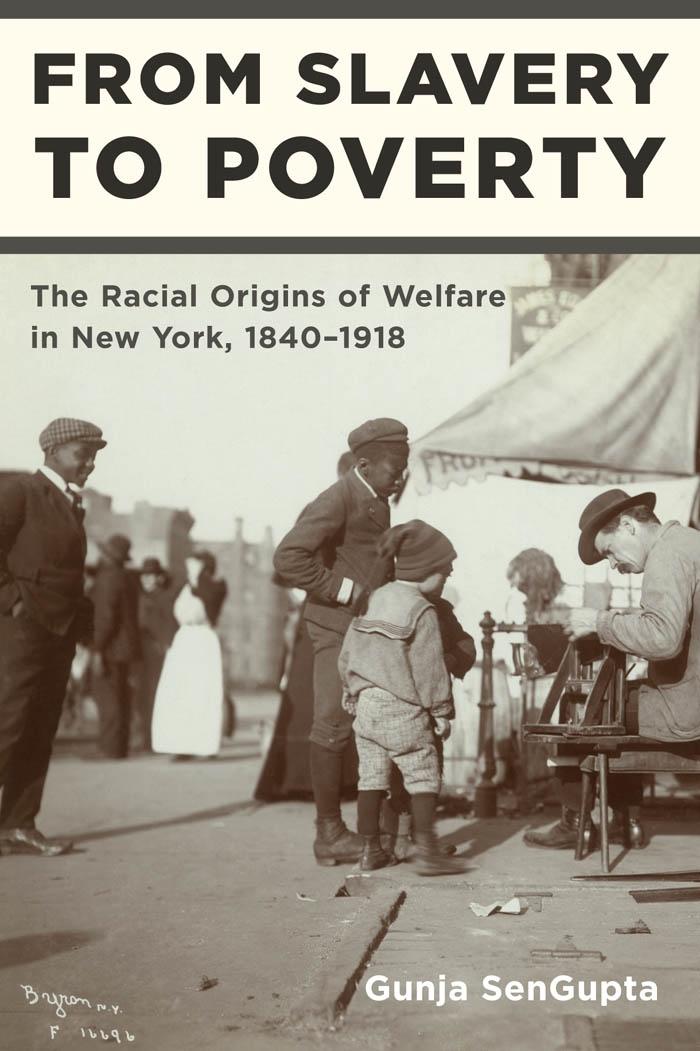
The racially charged stereotype of "welfare queen"—an allegedly promiscuous waster who uses her children as meal tickets funded by tax-payers—is a familiar icon in modern America, but as Gunja SenGupta reveals in From Slavery to Poverty, her historical roots run deep. For, SenGupta argues, the language and institutions of poor relief and reform have historically served as forums for inventing and negotiating identity.
Mining a broad array of sources on nineteenth-century New York City’s interlocking network of private benevolence and municipal relief, SenGupta shows that these institutions promoted a racialized definition of poverty and citizenship. But they also offered a framework within which working poor New Yorkers—recently freed slaves and disfranchised free blacks, Afro-Caribbean sojourners and Irish immigrants, sex workers and unemployed laborers, and mothers and children—could challenge stereotypes and offer alternative visions of community. Thus, SenGupta argues, long before the advent of the twentieth-century welfare state, the discourse of welfare in its nineteenth-century incarnation created a space to talk about community, race, and nation; about what it meant to be “American,” who belonged, and who did not. Her work provides historical context for understanding why today the notion of "welfare"—with all its derogatory “un-American” connotations—is associated not with middle-class entitlements like Social Security and Medicare, but rather with programs targeted at the poor, which are wrongly assumed to benefit primarily urban African Americans.
Paga facilmente con carta, Klarna, Apple Pay o Google Pay. Non sei soddisfatto? Hai sempre 14 giorni per il rimborso. Leggi di più nei nostri termini. Per qualsiasi domanda, scrivici a hello@memmo.org.
Memmo rende lo studio più facile, ovunque tu sia nel mondo. Qui trovi i tuoi libri di testo e strumenti di studio intelligenti, tutto in un unico posto: riassunti, quiz, podcast e flashcard. E poi c'è Ted, il tuo compagno di studio che risponde a ogni tua domanda. Oltre 50.000 studenti studiano già qui: è stato creato per aiutarti a imparare più velocemente e a stressarti meno.