
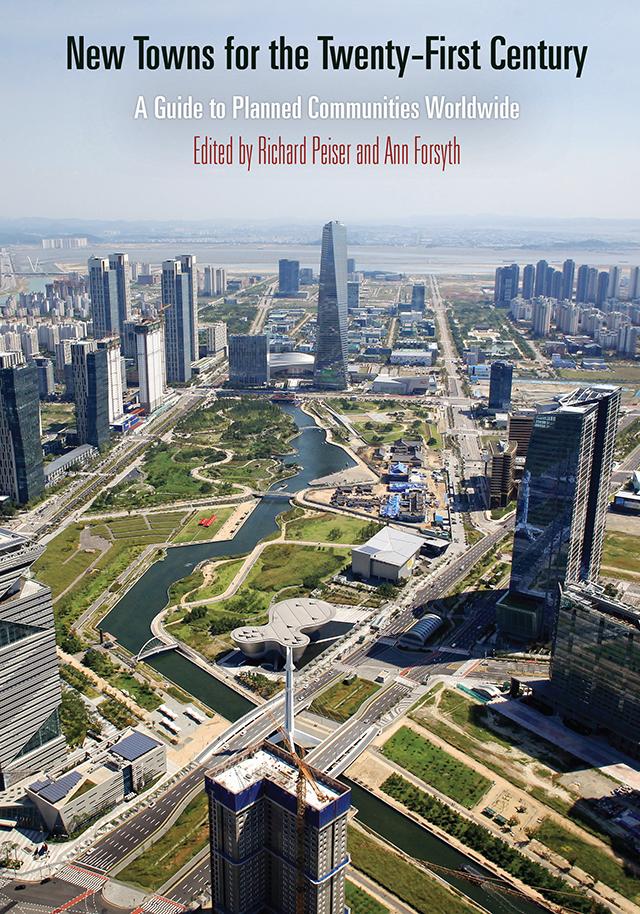
New towns—large, comprehensively planned developments on newly urbanized land—boast a mix of spaces that, in their ideal form, provide opportunities for all of the activities of daily life. From garden cities to science cities, new capitals to large military facilities, hundreds were built in the twentieth century and their approaches to planning and development were influential far beyond the new towns themselves. Although new towns are notoriously difficult to execute and their popularity has waxed and waned, major new town initiatives are increasing around the globe, notably in East Asia, South Asia, and Africa.
New Towns for the Twenty-First Century considers the ideals behind new-town development, the practice of building them, and their outcomes. A roster of international and interdisciplinary contributors examines their design, planning, finances, management, governance, quality of life, and sustainability. Case studies provide histories of new towns in the United States, Asia, Africa, and Europe and impart lessons learned from practitioners. The volume identifies opportunities afforded by new towns for confronting future challenges related to climate change, urban population growth, affordable housing, economic development, and quality of life.
Featuring inventories of classic new towns, twentieth-century new towns with populations over 30,000, and twenty-first-century new towns, the volume is a valuable resource for governments, policy makers, and real estate developers as well as planners, designers, and educators.
Contributors: Sandy Apgar, Sai Balakrishnan, JaapJan Berg, Paul Buckhurst, Felipe Correa, Carl Duke, Reid Ewing, Ann Forsyth, Robert Freestone, Shikyo Fu, Pascaline Gaborit, Elie Gamburg, Alexander Garvin, David R. Godschalk, Tony Green, ChengHe Guan, Rachel Keeton, Steven Kellenberg, Kyung-Min Kim, Gene Kohn, Todd Mansfield, Robert W. Marans, Robert Nelson, Pike Oliver, Richard Peiser, Michelle Provoost, Peter G. Rowe, Jongpil Ryu, Andrew Stokols, Adam Tanaka, Jamie von Klemperer, Fulong Wu, Ying Xu, Anthony Gar-On Yeh, Chaobin Zhou.
Paga facilmente con carta, Klarna, Apple Pay o Google Pay. Non sei soddisfatto? Hai sempre 14 giorni per il rimborso. Leggi di più nei nostri termini. Per qualsiasi domanda, scrivici a hello@memmo.org.
Memmo rende lo studio più facile, ovunque tu sia nel mondo. Qui trovi i tuoi libri di testo e strumenti di studio intelligenti, tutto in un unico posto: riassunti, quiz, podcast e flashcard. E poi c'è Ted, il tuo compagno di studio che risponde a ogni tua domanda. Oltre 50.000 studenti studiano già qui: è stato creato per aiutarti a imparare più velocemente e a stressarti meno.