
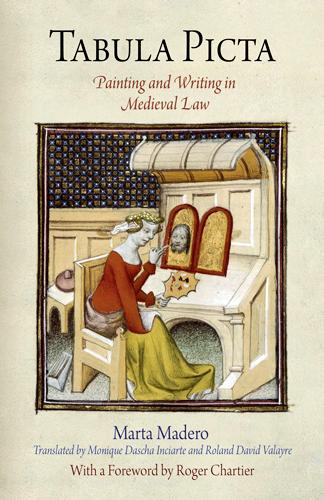
To whom does a painted tablet—a tabula picta—belong? To the owner of the physical piece of wood on which an image is painted? Or to the person who made the painting on that piece of wood? By extension, one might ask, who is the owner of a text? Is it the person who has written the words, or the individual who possesses the piece of parchment or slab of stone on which those words are inscribed?
In Tabula Picta Marta Madero turns to the extensive glosses and commentaries that medieval jurists dedicated to the above questions when articulating a notion of intellectual and artistic property radically different from our own. The most important goal for these legal thinkers, Madero argues, was to situate things—whatever they might be—within a logical framework that would allow for their description, categorization, and placement within a proper hierarchical order. Only juridical reasoning, they claimed, was capable of sorting out the individual elements that nature or human art had brought together in a single unit; by establishing sets of distinctions and taxonomies worthy of Borges, legal discourse sought to demonstrate that behind the deceptive immediacy of things, lie the concepts and arguments of what one might call the artifices of the concrete.
Paga facilmente con carta, Klarna, Apple Pay o Google Pay. Non sei soddisfatto? Hai sempre 14 giorni per il rimborso. Leggi di più nei nostri termini. Per qualsiasi domanda, scrivici a hello@memmo.org.
Memmo rende lo studio più facile, ovunque tu sia nel mondo. Qui trovi i tuoi libri di testo e strumenti di studio intelligenti, tutto in un unico posto: riassunti, quiz, podcast e flashcard. E poi c'è Ted, il tuo compagno di studio che risponde a ogni tua domanda. Oltre 50.000 studenti studiano già qui: è stato creato per aiutarti a imparare più velocemente e a stressarti meno.