
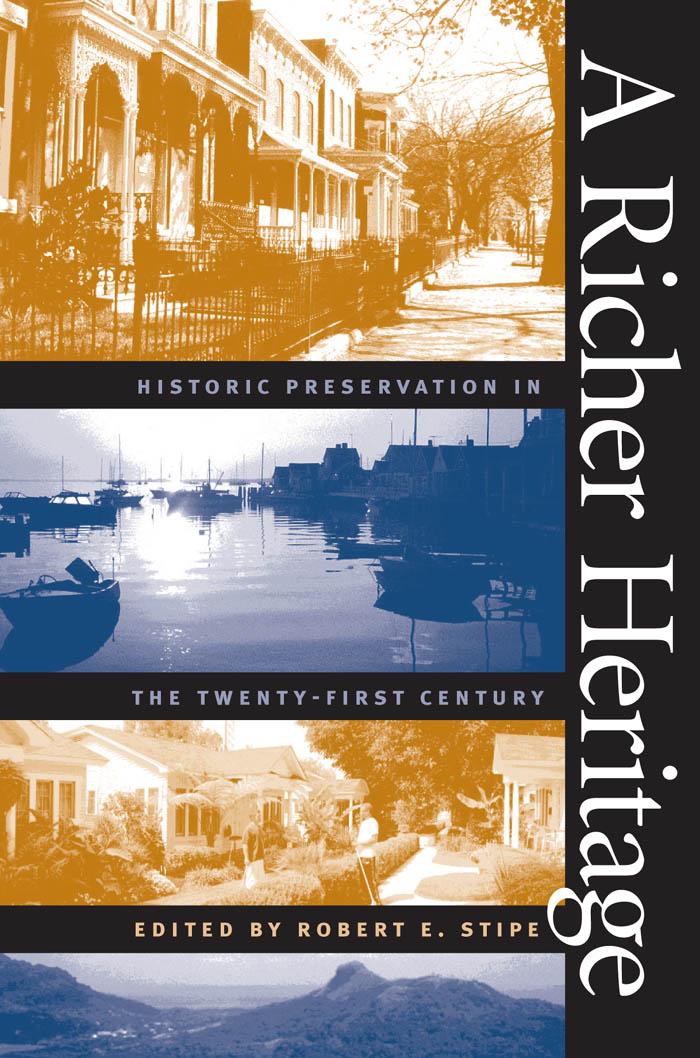
Surveying the past, present, and future of historic preservation in America, this book features fifteen essays by some of the most important voices in the field. A Richer Heritage will be an essential, thought-provoking guide for professionals as well as administrators, volunteers, and policy makers involved in preservation efforts.
An introduction traces the evolution of historic preservation in America, highlighting the principal ideas and events that have shaped and continue to shape the movement. The book also describes the workings — legal, administrative, and fiscal — of the layered federal, state, and local government partnership put in place by Congress in 1966. Individual chapters explore the preservation of designed and vernacular landscapes, the relationship between historic preservation and the larger environmental and land-trust movements, the role of new private and nonprofit players, racial and ethnic interests in historic preservation, and the preservation of our intangible cultural values. A concluding chapter analyzes the present state of the historic preservation movement and suggests future directions for the field in the twenty-first century.
Contributors include preservationists, local-government citizen activists, an architect, landscape architects, environmentalists, an archaeologist, a real-estate developer, historians, a Native American tribal leader, an ethnologist, and lawyers.
An introduction traces the evolution of historic preservation in America, highlighting the principal ideas and events that have shaped and continue to shape the movement. The book also describes the workings — legal, administrative, and fiscal — of the layered federal, state, and local government partnership put in place by Congress in 1966. Individual chapters explore the preservation of designed and vernacular landscapes, the relationship between historic preservation and the larger environmental and land-trust movements, the role of new private and nonprofit players, racial and ethnic interests in historic preservation, and the preservation of our intangible cultural values. A concluding chapter analyzes the present state of the historic preservation movement and suggests future directions for the field in the twenty-first century.
Contributors include preservationists, local-government citizen activists, an architect, landscape architects, environmentalists, an archaeologist, a real-estate developer, historians, a Native American tribal leader, an ethnologist, and lawyers.
Paga facilmente con carta, Klarna, Apple Pay o Google Pay. Non sei soddisfatto? Hai sempre 14 giorni per il rimborso. Leggi di più nei nostri termini. Per qualsiasi domanda, scrivici a hello@memmo.org.
Memmo rende lo studio più facile, ovunque tu sia nel mondo. Qui trovi i tuoi libri di testo e strumenti di studio intelligenti, tutto in un unico posto: riassunti, quiz, podcast e flashcard. E poi c'è Ted, il tuo compagno di studio che risponde a ogni tua domanda. Oltre 50.000 studenti studiano già qui: è stato creato per aiutarti a imparare più velocemente e a stressarti meno.
Potrebbe interessarti anche
Acquista il libro0