
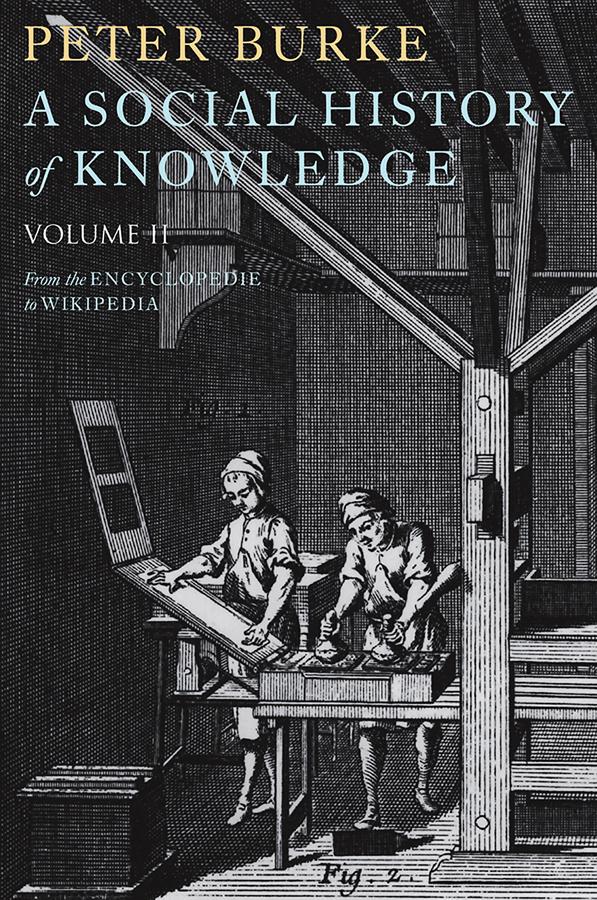
Peter Burke follows up his magisterial Social History of Knowledge, picking up where the first volume left off around 1750 at the publication of the French Encyclopédie and following the story through to Wikipedia. Like the previous volume, it offers a social history (or a retrospective sociology of knowledge) in the sense that it focuses not on individuals but on groups, institutions, collective practices and general trends.
The book is divided into 3 parts. The first argues that activities which appear to be timeless - gathering knowledge, analysing, disseminating and employing it - are in fact time-bound and take different forms in different periods and places. The second part tries to counter the tendency to write a triumphalist history of the 'growth' of knowledge by discussing losses of knowledge and the price of specialization. The third part offers geographical, sociological and chronological overviews, contrasting the experience of centres and peripheries and arguing that each of the main trends of the period - professionalization, secularization, nationalization, democratization, etc, coexisted and interacted with its opposite.
As ever, Peter Burke presents a breath-taking range of scholarship in prose of exemplary clarity and accessibility. This highly anticipated second volume will be essential reading across the humanities and social sciences.
Paga facilmente con carta, Klarna, Apple Pay o Google Pay. Non sei soddisfatto? Hai sempre 14 giorni per il rimborso. Leggi di più nei nostri termini. Per qualsiasi domanda, scrivici a hello@memmo.org.
Memmo rende lo studio più facile, ovunque tu sia nel mondo. Qui trovi i tuoi libri di testo e strumenti di studio intelligenti, tutto in un unico posto: riassunti, quiz, podcast e flashcard. E poi c'è Ted, il tuo compagno di studio che risponde a ogni tua domanda. Oltre 50.000 studenti studiano già qui: è stato creato per aiutarti a imparare più velocemente e a stressarti meno.