
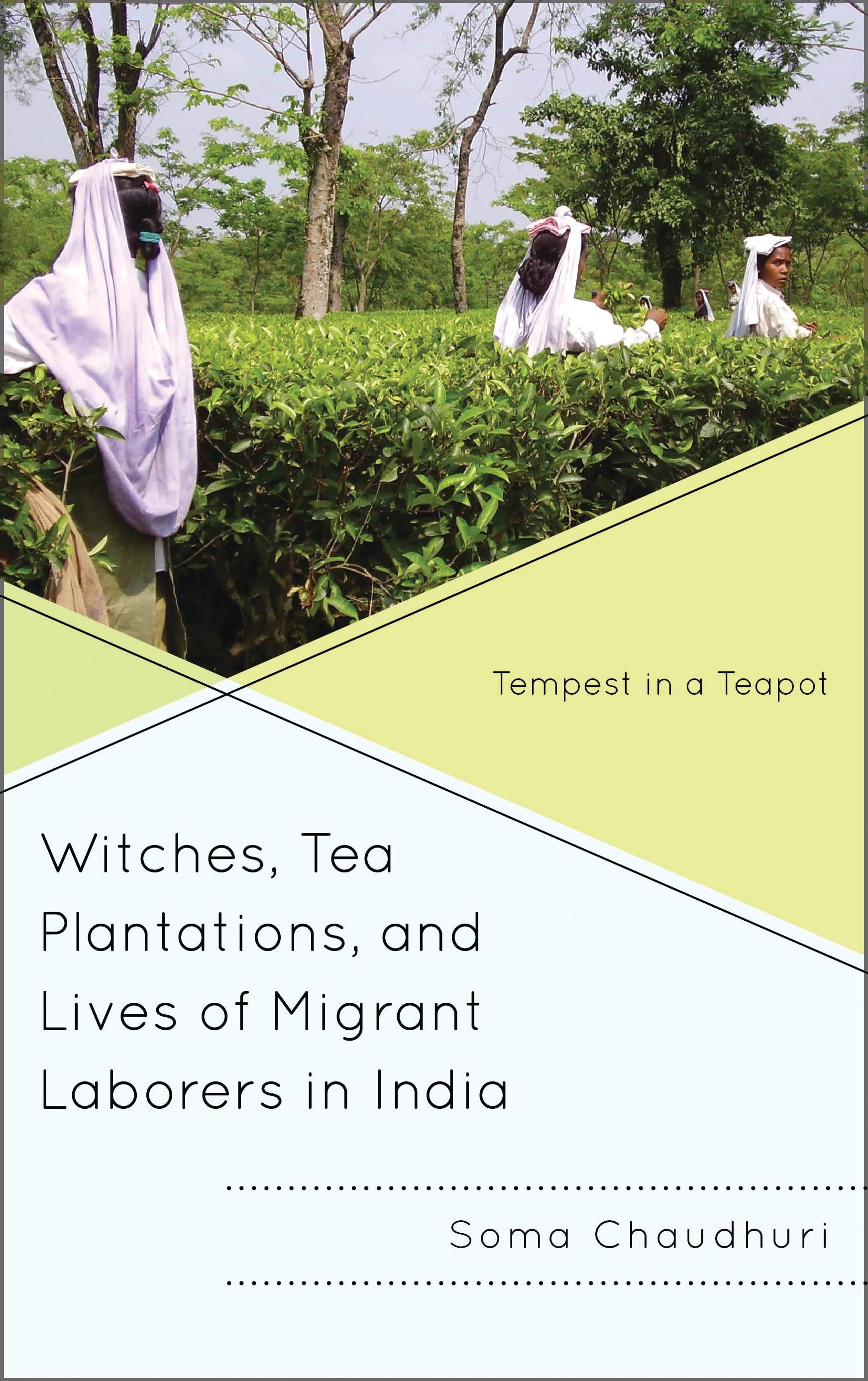
Witches, Tea Plantations, and Lives of Migrant Laborers in India: Tempest in Teapot is a unique book that brings together a holistic theoretical approach on the subject of witchcraft accusations, specifically those taking place inside a tea workers' community in India. Using a combination of in-depth and extensive qualitative methods, and drawing on sociological, anthropological, and historical perspectives, Chaudhuri explores how adivasi (tribal) migrant workers use witchcraft accusations to deal with worker-management conflict.
Chaudhuri argues that witchcraft accusations can be interpreted as a periodic reaction of the adivasi worker community against their oppression by the plantation management. The typical avenues of social protest are often unavailable to marginalized workers due to lack of organizational and political representation and resources. As a result, the dain (witch) becomes a scapegoat for the malice of the plantation economy. Within this discourse, witch hunts can be seen not as exotic and primitive rituals of a backward community, but rather as a powerful protest by a community against its oppressors. The book attempts to understand the complex network of relationships—ties of friendship, family, politics, and gender—that provide the necessary legitimacy for the witch hunt to take place. In most cases examined here, seemingly petty conflicts within the villagers often escalate to a hunt. At the height of the conflict, the exploitative relationship between the plantation management and the adivasi migrant workers often gets hidden. The book demonstrates how witchcraft accusations should be interpreted within this backdrop of labor-planters relationship, characterized by rigidity of power, patronage, and social distance.
Witches, Tea Plantations, and Lives of Migrant Laborers in India should appeal to criminologists, sociologists, anthropologists, labor historians, gender scholars, labor migration scholars, witch hunt and witchcraft accusation global scholars, adivasi scholars, South Asian scholars, and anyone interested in India’s tribes, witchcraft accusations, gender in a global world, labor conflict, and Indian tea plantations.
Chaudhuri argues that witchcraft accusations can be interpreted as a periodic reaction of the adivasi worker community against their oppression by the plantation management. The typical avenues of social protest are often unavailable to marginalized workers due to lack of organizational and political representation and resources. As a result, the dain (witch) becomes a scapegoat for the malice of the plantation economy. Within this discourse, witch hunts can be seen not as exotic and primitive rituals of a backward community, but rather as a powerful protest by a community against its oppressors. The book attempts to understand the complex network of relationships—ties of friendship, family, politics, and gender—that provide the necessary legitimacy for the witch hunt to take place. In most cases examined here, seemingly petty conflicts within the villagers often escalate to a hunt. At the height of the conflict, the exploitative relationship between the plantation management and the adivasi migrant workers often gets hidden. The book demonstrates how witchcraft accusations should be interpreted within this backdrop of labor-planters relationship, characterized by rigidity of power, patronage, and social distance.
Witches, Tea Plantations, and Lives of Migrant Laborers in India should appeal to criminologists, sociologists, anthropologists, labor historians, gender scholars, labor migration scholars, witch hunt and witchcraft accusation global scholars, adivasi scholars, South Asian scholars, and anyone interested in India’s tribes, witchcraft accusations, gender in a global world, labor conflict, and Indian tea plantations.
Pagine: 190
Categoria: Kultur-, Genus- & Postkoloniala studier
e-ISBN: 9780739185254
Peso di spedizione: 1.2 kg
Spedito in: 1-2 giorni
Paga facilmente con carta, Klarna, Apple Pay o Google Pay. Non sei soddisfatto? Hai sempre 14 giorni per il rimborso. Leggi di più nei nostri termini. Per qualsiasi domanda, scrivici a hello@memmo.org.
Memmo rende lo studio più facile, ovunque tu sia nel mondo. Qui trovi i tuoi libri di testo e strumenti di studio intelligenti, tutto in un unico posto: riassunti, quiz, podcast e flashcard. E poi c'è Ted, il tuo compagno di studio che risponde a ogni tua domanda. Oltre 50.000 studenti studiano già qui: è stato creato per aiutarti a imparare più velocemente e a stressarti meno.