
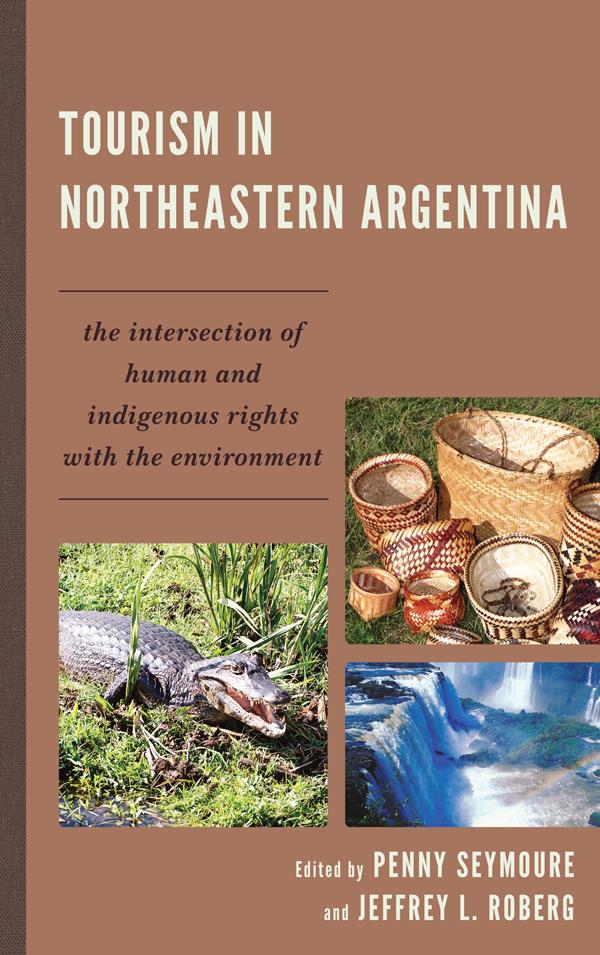
Ecotourism is often promoted as a way to visit a unique area of spectacular beauty. While tourists travel to these destinations to view environmental wonders, they seldom consider the effects of their visit on the indigenous people or on the location itself. Tourism in Northeastern Argentina: The Intersection of Human and Indigenous Rights with the Environment, an edited collection by Penny Seymoure and Jeffrey L. Roberg, examines the impact of tourism on indigenous and local populations, and the environment they live in, specifically in several locations in the northeast of Argentina.
Several of the chapters examine the lives and problems of the Mbya Guaraní people, an indigenous culture that has been attempting to survive in the rainforest of Misiones Province. In recent years, the loss of traditional lands, some of which was taken for tourist hotels, has led the Mbya to engage in tourism, with both positive and negative changes to their culture. Most of the tourists who interact with the Mbya come to the area to see the beautiful Iguazu National Park and Waterfalls, and stay in the nearby city of Puerto Iguazu. The waterfalls now draw over one million visitors a year.
The authors of this volume further explore how, while Puerto Iguazu has been engaged in mass tourism for many years, the nearby small town of Colonia Carlos Pelligrini has struggled to keep its younger tourism industry modest due, in part, to its location near pristine wetlands. This town faces a number of challenges that must be addressed soon to protect both the surrounding wetlands and the town itself.
Tourism in Northeastern Argentina explores all of these issues, and more, in the context of human and indigenous rights and the protection of the environment.
Several of the chapters examine the lives and problems of the Mbya Guaraní people, an indigenous culture that has been attempting to survive in the rainforest of Misiones Province. In recent years, the loss of traditional lands, some of which was taken for tourist hotels, has led the Mbya to engage in tourism, with both positive and negative changes to their culture. Most of the tourists who interact with the Mbya come to the area to see the beautiful Iguazu National Park and Waterfalls, and stay in the nearby city of Puerto Iguazu. The waterfalls now draw over one million visitors a year.
The authors of this volume further explore how, while Puerto Iguazu has been engaged in mass tourism for many years, the nearby small town of Colonia Carlos Pelligrini has struggled to keep its younger tourism industry modest due, in part, to its location near pristine wetlands. This town faces a number of challenges that must be addressed soon to protect both the surrounding wetlands and the town itself.
Tourism in Northeastern Argentina explores all of these issues, and more, in the context of human and indigenous rights and the protection of the environment.
Paga facilmente con carta, Klarna, Apple Pay o Google Pay. Non sei soddisfatto? Hai sempre 14 giorni per il rimborso. Leggi di più nei nostri termini. Per qualsiasi domanda, scrivici a hello@memmo.org.
Memmo rende lo studio più facile, ovunque tu sia nel mondo. Qui trovi i tuoi libri di testo e strumenti di studio intelligenti, tutto in un unico posto: riassunti, quiz, podcast e flashcard. E poi c'è Ted, il tuo compagno di studio che risponde a ogni tua domanda. Oltre 50.000 studenti studiano già qui: è stato creato per aiutarti a imparare più velocemente e a stressarti meno.