
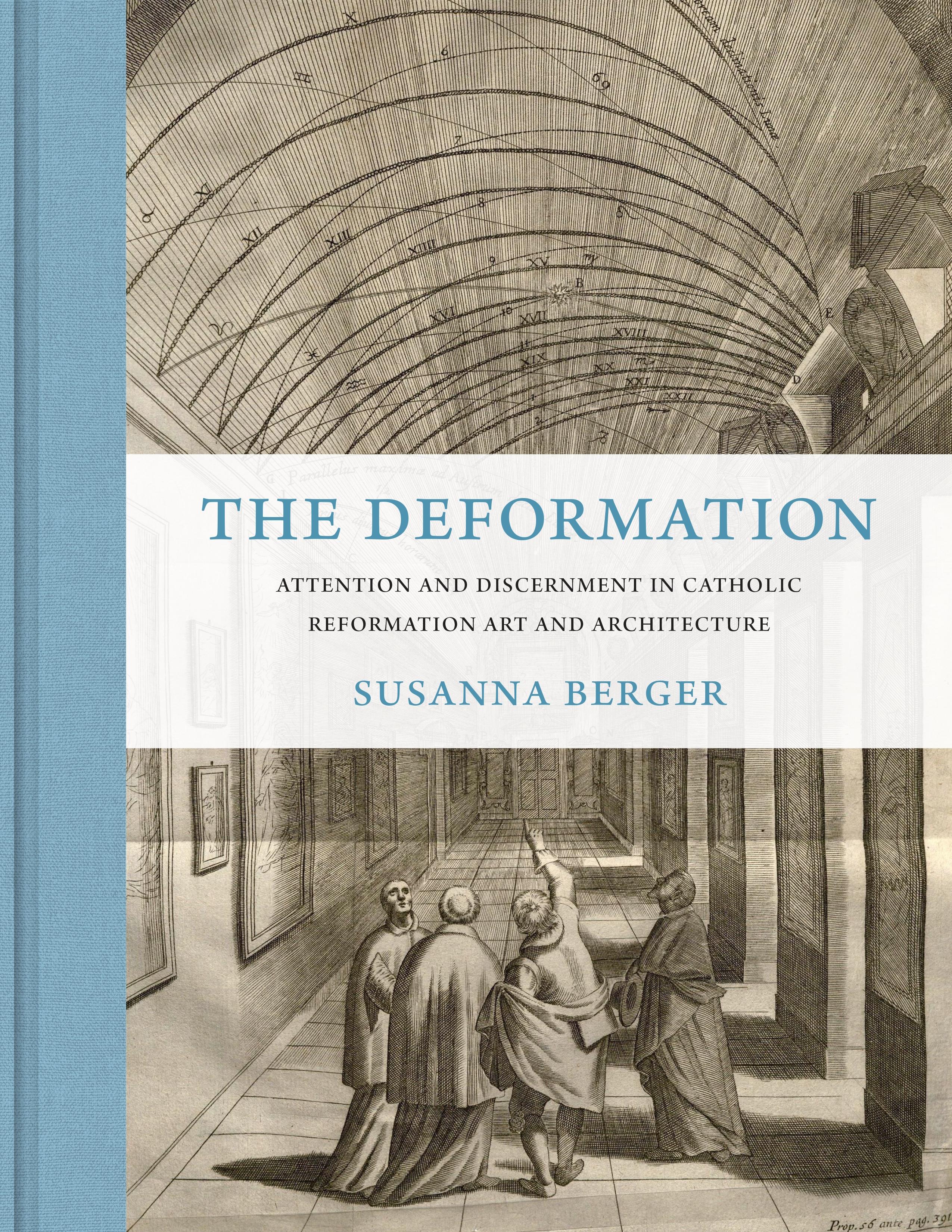
A fascinating account of the use and meaning of visual and spatial distortions in seventeenth-century art and architecture
During the Catholic Reformation, patrons, artists, architects, and viewers, especially in Rome, were strongly drawn to visual and spatial distortions or “deformations”—works of art and architecture that were designed to be visually incomprehensible, at least initially. From Borromini’s San Carlo alle Quattro Fontane in Rome to the attention-grabbing prospettiva in the city’s Palazzo Spada and the anamorphoses that define the corridors and walls of Minim and Jesuit buildings, The Deformation explores what this intriguing phenomenon reveals about contemporary religious belief, optics, and the natural sciences, as well as wider questions about attention and discernment.
Failing to conform to an established ideal, deformations required a “reformation” to achieve that ideal. Anamorphic deformations, for example, could only be reformed into clarity when viewed from a particular angle or through a special mirror. Susanna Berger examines how deformations were experienced by beholders, and how they were embraced or opposed by critics. The book shows how deformations and related works—whether altar tabernacles, ephemeral religious architecture, churches, monumental sundials, colonnades with accelerated perspective, illusionistic frescoes, turned ivories, or painted anamorphoses—focused observers’ attention on theological mysteries and the social power and sophistication of patrons. The book’s rich illustrations include two gatefolds and some anamorphic images that can be seen without distortion by using an included reflective insert as a mirror.
Looking at writings as well as visual works in multiple artistic media not typically considered in relation to each other, The Deformation offers a new interpretation of deformation that highlights the delay between perception and discernment.
Paga facilmente con carta, Klarna, Apple Pay o Google Pay. Non sei soddisfatto? Hai sempre 14 giorni per il rimborso. Leggi di più nei nostri termini. Per qualsiasi domanda, scrivici a hello@memmo.org.
Memmo rende lo studio più facile, ovunque tu sia nel mondo. Qui trovi i tuoi libri di testo e strumenti di studio intelligenti, tutto in un unico posto: riassunti, quiz, podcast e flashcard. E poi c'è Ted, il tuo compagno di studio che risponde a ogni tua domanda. Oltre 50.000 studenti studiano già qui: è stato creato per aiutarti a imparare più velocemente e a stressarti meno.