
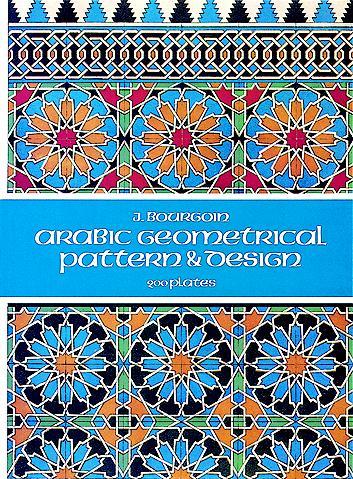
By forbidding the representation of the human figure, the Mohammedan religion helped push Islamic art along a path much different from that of traditional European art. European abounds with perspective renderings of figures and landscapes, while Islamic translates artistic impulse into elaborate geometric patterns and linear designs. Through centuries of practicing this purely abstract art, Muslim artists have perfected it to an incomparable elegance.
This book contains 190 examples exhibiting the wide range of Islamic geometrical art: hexagon designs, octagon designs, dodecagon designs, combinations of stars and rosettes (of many variations), combinations of squares and octagons, heptagon designs, and pentagon designs. These fundamental shapes give rise to hundreds of different designs, and merely altering an angle or curving a straight line can create an entirely new pattern. When transferred to metal, wood, stucco, mosaic, and paint, these patterns make up the elaborate ornamentation for which Arabic architecture is noted, and twenty-eight examples of actual applications from Cairo and Damascus are included: sanctuary doors, openwork windows, inlaid marble pavements, and ceilings.
The reader may wish to try his own hand at drawing patterns, to which purpose dotted construction lines are given for sections of the plates. Artists and designers will appreciate this book as a valuable source for Islamic art and design, which they may use directly or vary at will, and with the added use of color they will find that striking and beautiful results can often be achieved.
This book contains 190 examples exhibiting the wide range of Islamic geometrical art: hexagon designs, octagon designs, dodecagon designs, combinations of stars and rosettes (of many variations), combinations of squares and octagons, heptagon designs, and pentagon designs. These fundamental shapes give rise to hundreds of different designs, and merely altering an angle or curving a straight line can create an entirely new pattern. When transferred to metal, wood, stucco, mosaic, and paint, these patterns make up the elaborate ornamentation for which Arabic architecture is noted, and twenty-eight examples of actual applications from Cairo and Damascus are included: sanctuary doors, openwork windows, inlaid marble pavements, and ceilings.
The reader may wish to try his own hand at drawing patterns, to which purpose dotted construction lines are given for sections of the plates. Artists and designers will appreciate this book as a valuable source for Islamic art and design, which they may use directly or vary at will, and with the added use of color they will find that striking and beautiful results can often be achieved.
Paga facilmente con carta, Klarna, Apple Pay o Google Pay. Non sei soddisfatto? Hai sempre 14 giorni per il rimborso. Leggi di più nei nostri termini. Per qualsiasi domanda, scrivici a hello@memmo.org.
Memmo rende lo studio più facile, ovunque tu sia nel mondo. Qui trovi i tuoi libri di testo e strumenti di studio intelligenti, tutto in un unico posto: riassunti, quiz, podcast e flashcard. E poi c'è Ted, il tuo compagno di studio che risponde a ogni tua domanda. Oltre 50.000 studenti studiano già qui: è stato creato per aiutarti a imparare più velocemente e a stressarti meno.
Potrebbe interessarti anche
Acquista il libro0