
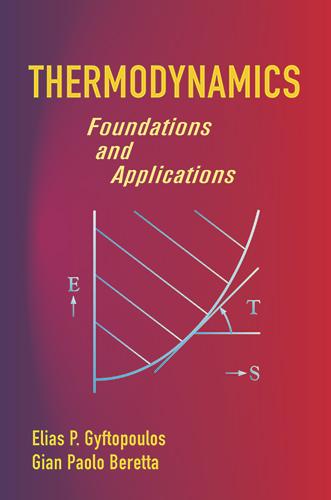
Designed for both undergraduate and graduate students, this authoritative milestone in the foundational development of thermodynamics provides a unique reference for all physicists and engineers. Basic concepts and applications are discussed in complete detail with attention to generality and logical consistency, removing ambiguities and limitations of traditional presentations. Worked-out examples and end-of-chapter problems illustrate the use of energy and entropy balances as powerful analytical keystones in physics and engineering.
The text provides material for undergraduate and graduate courses. At the introductory level, it covers heat engines, stable-equilibrium-state models for ideal-gas, incompressible-fluid and solid behaviors, heat, work and bulk-flow interactions, thermodynamic efficiency, energy conversion systems, energy, and availability/ At the intermediate level, it covers ideal and nonideal mixtures, chemical reactions, chemical equilibrium, and combustion.
At the advanced level, the unique non-traditional order of exposition of the basic concepts and principles (system, property, state, process, first law, energy, equilibrium, stable equilibrium, second law, entropy) allows rigorous general definitions of energy and entropy valid for all systems (large and small, few- and many- particles) and all states (stable and non-stable equilibrium, as well as non-equilibrium). In particular, entropy is defined before and independently of the definitions of temperature and heat, and of the simple-system model for many-particle systems.
The text provides material for undergraduate and graduate courses. At the introductory level, it covers heat engines, stable-equilibrium-state models for ideal-gas, incompressible-fluid and solid behaviors, heat, work and bulk-flow interactions, thermodynamic efficiency, energy conversion systems, energy, and availability/ At the intermediate level, it covers ideal and nonideal mixtures, chemical reactions, chemical equilibrium, and combustion.
At the advanced level, the unique non-traditional order of exposition of the basic concepts and principles (system, property, state, process, first law, energy, equilibrium, stable equilibrium, second law, entropy) allows rigorous general definitions of energy and entropy valid for all systems (large and small, few- and many- particles) and all states (stable and non-stable equilibrium, as well as non-equilibrium). In particular, entropy is defined before and independently of the definitions of temperature and heat, and of the simple-system model for many-particle systems.
Paga facilmente con carta, Klarna, Apple Pay o Google Pay. Non sei soddisfatto? Hai sempre 14 giorni per il rimborso. Leggi di più nei nostri termini. Per qualsiasi domanda, scrivici a hello@memmo.org.
Memmo rende lo studio più facile, ovunque tu sia nel mondo. Qui trovi i tuoi libri di testo e strumenti di studio intelligenti, tutto in un unico posto: riassunti, quiz, podcast e flashcard. E poi c'è Ted, il tuo compagno di studio che risponde a ogni tua domanda. Oltre 50.000 studenti studiano già qui: è stato creato per aiutarti a imparare più velocemente e a stressarti meno.
Potrebbe interessarti anche
Acquista il libro0