
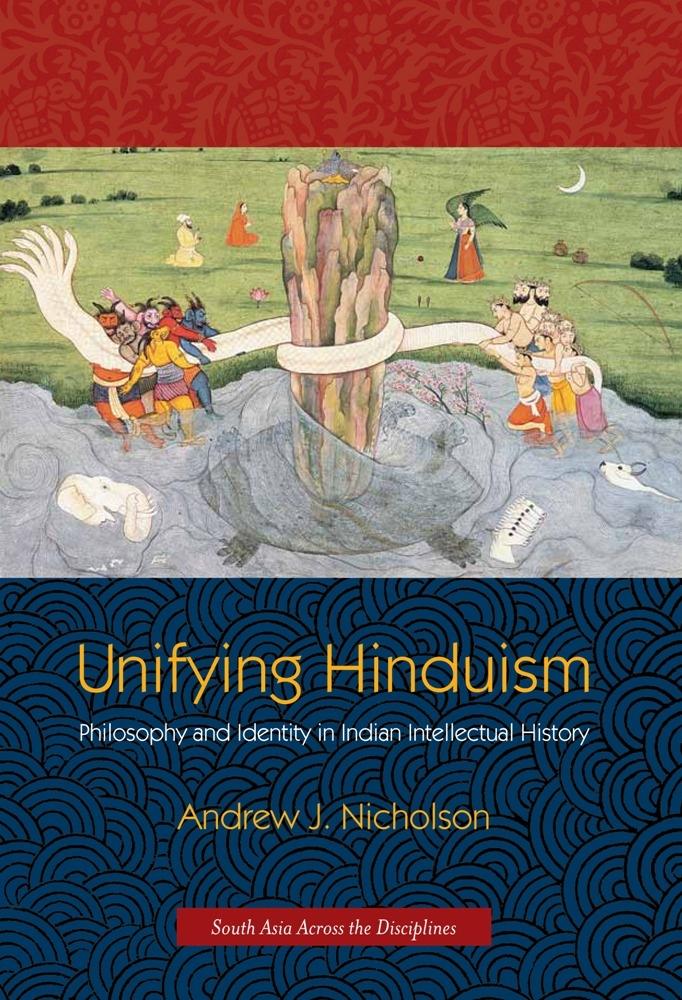
Some postcolonial theorists argue that the idea of a single system of belief known as "Hinduism" is a creation of nineteenth-century British imperialists. Andrew J. Nicholson introduces another perspective: although a unified Hindu identity is not as ancient as some Hindus claim, it has its roots in innovations within South Asian philosophy from the fourteenth to seventeenth centuries. During this time, thinkers treated the philosophies of Vedanta, Samkhya, and Yoga, along with the worshippers of Visnu, Siva, and Sakti, as belonging to a single system of belief and practice. Instead of seeing such groups as separate and contradictory, they re-envisioned them as separate rivers leading to the ocean of Brahman, the ultimate reality.
Drawing on the writings of philosophers from late medieval and early modern traditions, including Vijnanabhiksu, Madhava, and Madhusudana Sarasvati, Nicholson shows how influential thinkers portrayed Vedanta philosophy as the ultimate unifier of diverse belief systems. This project paved the way for the work of later Hindu reformers, such as Vivekananda, Radhakrishnan, and Gandhi, whose teachings promoted the notion that all world religions belong to a single spiritual unity. In his study, Nicholson also critiques the way in which Eurocentric conceptslike monism and dualism, idealism and realism, theism and atheism, and orthodoxy and heterodoxyhave come to dominate modern discourses on Indian philosophy.
Paga facilmente con carta, Klarna, Apple Pay o Google Pay. Non sei soddisfatto? Hai sempre 14 giorni per il rimborso. Leggi di più nei nostri termini. Per qualsiasi domanda, scrivici a hello@memmo.org.
Memmo rende lo studio più facile, ovunque tu sia nel mondo. Qui trovi i tuoi libri di testo e strumenti di studio intelligenti, tutto in un unico posto: riassunti, quiz, podcast e flashcard. E poi c'è Ted, il tuo compagno di studio che risponde a ogni tua domanda. Oltre 50.000 studenti studiano già qui: è stato creato per aiutarti a imparare più velocemente e a stressarti meno.