
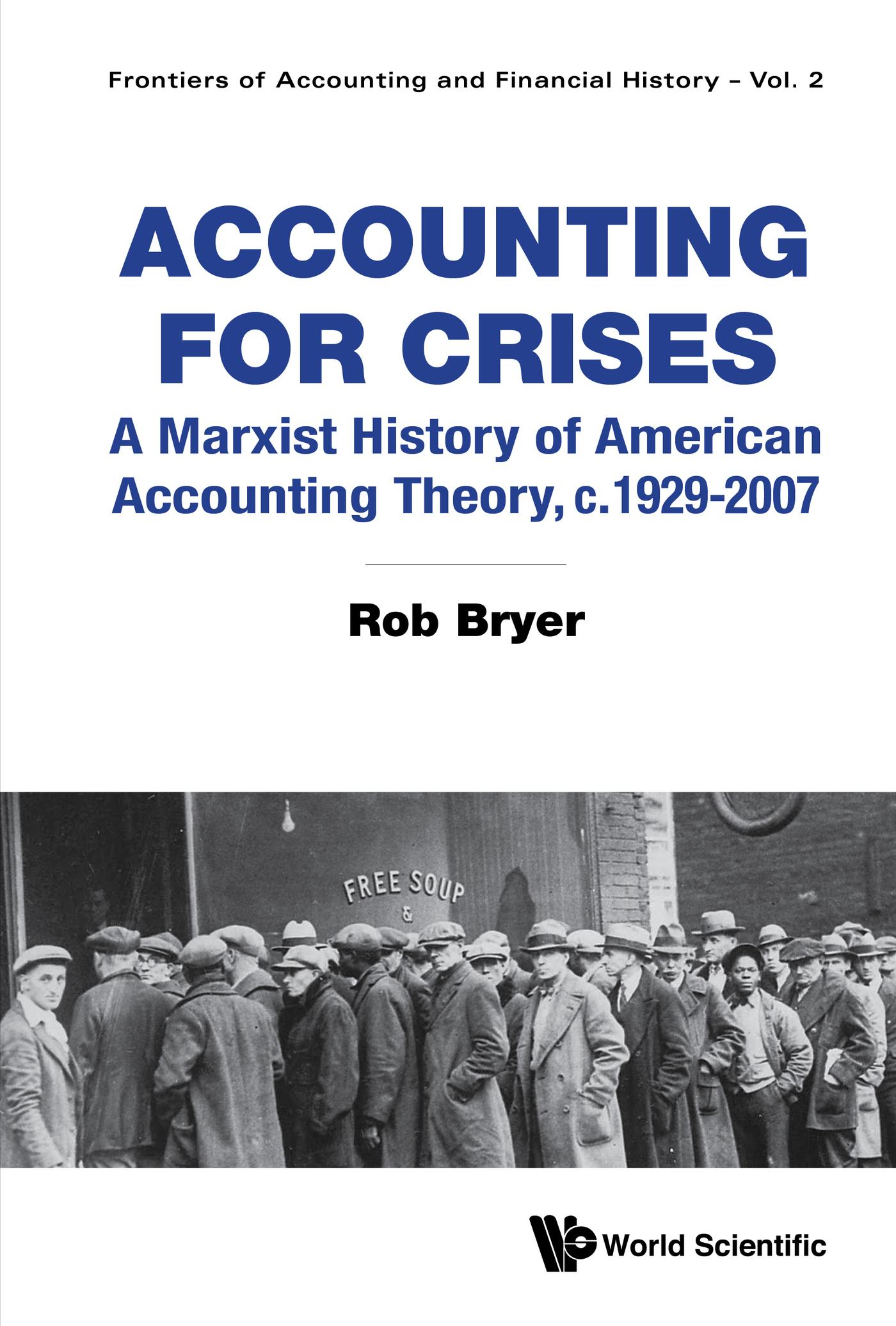
Historians have not convincingly explained modern capitalism's two major economic crises, the Great Depression of the 1930s, and the Global Financial Crisis (GFC) of 2008–2009. Accounting for Crises offers a new explanation, why both began and were more severe in the USA ('America'), based on an accounting interpretation of Marx's theory of crises. It explains their origins in capitalists' control of accumulation, which reveals important overlooked roles for Irving Fisher's accounting theory. This theory, by allowing discretion in accounts, in the context of falling rates of profit, encouraged 'swindling', overstating reported profits, and understating their risk, which facilitated and aggravated both crises. Framed by Fisher's theory, during the 1920s American accounting theorists justified discretion, which Creating the 'Big Mess' (the companion volume) concluded it management used to conservatively smooth earnings. Accounting for Crises shows that Fisher's theory , also underlays the popular new theory of investment that justified valuing shares using reported earnings, which encouraged their manipulation and legitimized 'speculation'. This, it argues, underlays America's exceptional late-1920s stock market boom, the 1929 Great Crash, and the depth and length of its Great Depression. Prominently associated with the boom, Fisher became unpopular after the crash, his name disappearing from public debate. Nevertheless, the book concludes, his theory hindered economic recovery, weakened 1930s reforms, undermined accounting regulation from the late-1930s, and following his rehabilitation from the late-1950s, underlies the Financial Accounting Standards Board's conceptual framework, which by allowing off-balance-sheet accounting for securitization-SPEs, fostered the 2007 'credit crunch' that triggered the 2008–2009 Global Financial Crisis (GFC).
Contents:
- Accounting Theory and Crises
- Marx's Theory of Crises
- The Great Collapse, 1929–1933
- Accounting for the 1929 Stock Market Crash
- Accounting Theory and Reform in the Great Depression
- 'People's Capitalism' and the Rise and Fall of GAAP
- The Profitability Crisis and the FASB's Conceptual Framework
- Accounting for the Global Financial Crisis
Readership: Academics: Accounting historians, Accounting theorists, Critical accountants, Heterodox economists, Marxist economists, Educated general readers, Libraries.
'In March 2023, Silicon Valley Bank collapsed as central banks struggled to control inflation by increasing interest rates and selling bonds, leaving commercial banks with unexpectedly significant losses. The global financial system is under severe strain, and another banking crisis has become more likely. Have we learned the accounting lessons from previous crises? All the banks that collapsed in the 2008/2009 financial crisis had clean audit reports. Surely, contemporary, globally regulated accounting has improved, and now directs attention towards financially stressed institutions? Sadly, it does not. Rob Bryer's new book, Accounting for Crises, explains why by providing a compelling, historically rigorous case that, by allowing overstating reported profits and understating their risk, accounting theory facilitated and aggravated both the 1929 and 2008 financial crises. More concerning, Bryer carefully explains that accounting practice in 2023, in spite of new regulations, would serve exactly the same function today. Current 'fair value' rules, for example, allowed SVB to avoid reporting losses on its financial assets. As with Bryer's previous books, policy makers, academics, historians and anyone who want to understand how accounting functions in society should read Accounting for Crises.' - Christine CooperProfessor of AccountingUniversity of Edinburgh Business SchoolEdinburgh, United Kingdom
'A tour de force: Engaging seriously with Marx's actual crisis theory — rather than potted versions — and marshalling the author's deep knowledge of accounting and its history, Accounting for Crises, explain why the United States was the epicentre of both the Great Depression and the Great Recession. The interplay of the tendential fall in the rate of profit, 'moral hazard' and 'swindling' is central to Rob Bryer's explanation, as is the role of accounting theory. The first three factors were stressed also by Marx; the last is Bryer's original contribution.' - Andrew KlimanEmeritus Professor of EconomicsPace UniversityNew York, USA
'Rob Bryer presents an insightful narrative that offers a captivating new perspective on the economic history of the United States. He demonstrates that major financial crises can be traced back to the shortcomings of accounting methods. By setting out rigorously argued linkages between accounting theory and its economic consequences, Bryer challenges conventional thinking and highlights the ongoing significance of Marx in comprehending the history and present-day problems of capitalism. Accounting for Crises deserves a wide audience.' - Steven TomsProfessor of AccountingAccounting and Finance Division,Leeds Business School, The University of LeedsMaurice Keyworth Building, Leeds, United Kingdom
Key Features:
- The book provides a new accounting interpretation of Marx's theory of crises
- The book provides a new critical accounting history of American accounting theory from 1929 to 2007
- The book explains the role of American accounting theory in creating and aggravating the 1929 Great Crash and Great Depression, and the 2007 "credit crunch" and 2008–2009 Global Financial Crisis
- Despite America's global pre-eminence and a sizeable journal literature on its accounting history, only one book attempts a history of American accounting from the late 19th century through the 20th century, Previts, G J and Merino, B D, A History of Accountancy in the United States: The Cultural Significance of Accounting, Second Edition. Ohio State University Press, 1998. Previts and Merino (1998), which is now out of date. Accounting for Crises and its companion volume, Creating the "Big Mess", draw on a wide range of modern literature to reinterpret and extend their work. The book's Marxist perspective offers an alternative to Previts and Merino's (1998) "cultural" perspective