
Before Memmo my notes were scattered across PDFs. Now a workspace pulls everything into one place — I see exactly what's still left to study.
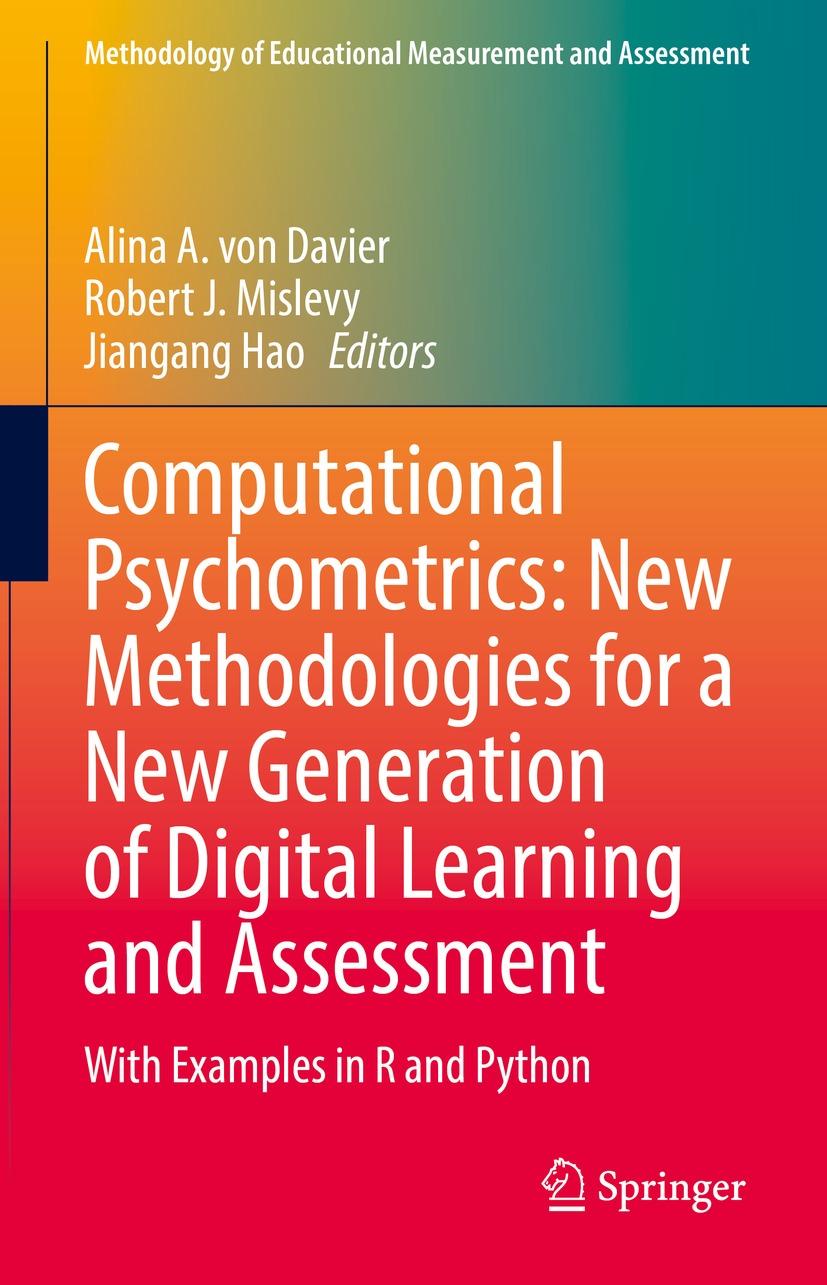
This book defines and describes a new discipline, named “computational psychometrics,” from the perspective of new methodologies for handling complex data from digital learning and assessment. The editors and the contributing authors discuss how new technology drastically increases the possibilities for the design and administration of learning and assessment systems, and how doing so significantly increases the variety, velocity, and volume of the resulting data. Then they introduce methods and strategies to address the new challenges, ranging from evidence identification and data modeling to the assessment and prediction of learners’ performance in complex settings, as in collaborative tasks, game/simulation-based tasks, and multimodal learning and assessment tasks.
Computational psychometrics has thus been defined as a blend of theory-based psychometrics and data-driven approaches from machine learning, artificial intelligence, and data science. All these together provide a better methodological framework for analysing complex data from digital learning and assessments. The term “computational” has been widely adopted by many other areas, as with computational statistics, computational linguistics, and computational economics. In those contexts, “computational” has a meaning similar to the one proposed in this book: a data-driven and algorithm-focused perspective on foundations and theoretical approaches established previously, now extended and, when necessary, reconceived. This interdisciplinarity is already a proven success in many disciplines, from personalized medicine that uses computational statistics to personalized learning that uses, well, computational psychometrics. We expect that this volume will be of interest not just within but beyond the psychometric community.In this volume, experts in psychometrics, machine learning, artificial intelligence, data science and natural language processing illustrate their work, showing how the interdisciplinary expertise of each researcher blends into a coherent methodological framework to deal with complex data from complex virtual interfaces. In the chapters focusing on methodologies, the authors use real data examples to demonstrate how to implement the new methods in practice. The corresponding programming codes in R and Python have been included as snippets in the book and are also available in fuller form in the GitHub code repository that accompanies the book.
Before Memmo my notes were scattered across PDFs. Now a workspace pulls everything into one place — I see exactly what's still left to study.
Memmo's summaries are gold before exams. I don't have to re-read 800 pages two weeks before — just the important parts.
The AI chat has saved me the night before an exam more than once. I just keep asking until I get it — no waiting on a study group to reply.
The quizzes hit exactly what I need to know. Memmo tracks what I get stuck on — so I only practice what's worth it.
Flashcards with spaced repetition are magic. Memmo knows when I'm about to forget something and brings it back.
The AI podcasts are my favorite. I listen on my way to school and get a recap without sitting at a computer.

Handbok i kvalitativa metoder
281 kr

Hållbar utveckling: en introduktion för ingenjörer och andra problemlösare
334 kr

Brymans Samhällsvetenskapliga metoder
390 kr

Projektledning
491 kr

Den orättvisa hälsan: om socioekonomiska skillnader i hälsa och livslängd
326 kr

Vetenskapsteori för nybörjare
196 kr

Organizational Leadership
429 kr

På väg mot läraryrket
172 kr

Det sociala livet i skolan: Socialpsykologiska perspektiv
253 kr

Betygsättningens didaktik
151 kr

Personality
402 kr

Studying Leadership
404 kr

Managing Innovation
477 kr

Introduktion till samhällsvetenskaplig metod
347 kr

The Psychology of Sex and Gender
698 kr

Evidens och kunskap för socialt arbete
207 kr

Introduction to Leadership
605 kr