
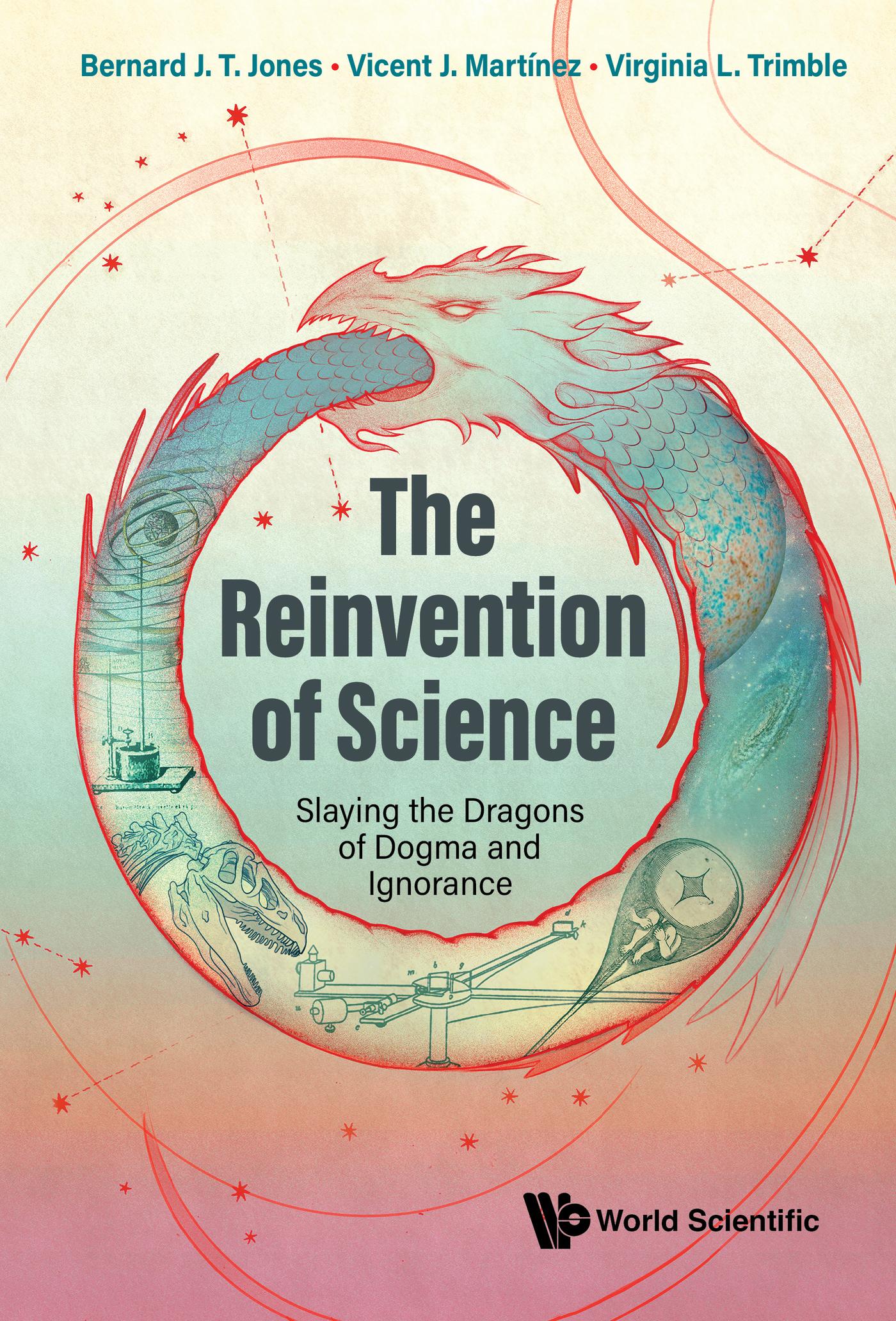
Throughout the history of science, different thinkers, philosophers and scientists postulated the existence of entities that, in spite of their not being visible or detectable in their time, or perhaps ever, were nevertheless useful to explain the real world. We started this book by looking at a handful of these entities. These included phlogiston to account for fire; the luminiferous ether for propagation of radiation; the homunculus to provide for heredity; and crystalline spheres to carry the wandering planets around the earth. Many of these erroneous beliefs had held up progress, just as dragons drawn on the edges of a map discouraged exploration. This pattern of science evolution continued through the centuries up to the present day.
The book evolved into a more extensive history of how science evolved through controversy, suppression, and the desire to maintain the status quo. Our story passes from the Babylonians and Greeks through the middle ages, the renaissance and the scientific revolution to almost current events. We discuss the evolution of our world, the controversy about the extinction of dinosaurs, and open questions in contemporary science such as dark matter, black holes and the origin of the Universe, including how we understand the subatomic world of elementary particles.
Most of the chapters deal with astronomy, cosmology and physics, but there are brief ventures into geosciences (continental drift), biosciences (the homunculus), atmospheric physics (Heaviside layer), paleontology (the extinction of dinosaurs), and computer science (artificial intelligence). The authors present a sequence of how mistakes and fallacies have been purged from our quest to understand nature. The way these changes have come about are skillfully set in their relevant historical contexts.
Contents:
- Breaking the Dragon's Egg: Science Is Born:
- Ether and Atoms
- The Lost Poem
- Bubbles and Influencers
- The End of Earth, Air, Fire and Water
- The Dragon's Fire: A New Heaven and a New Earth:
- Crystalline Spheres
- The End of the Heaven's Immutability
- Tripping the Light Fantastic
- The Dragon's Flight: How Discoveries Occur:
- The Girl Who Found Primeval Dragons
- The Backbone of the Ocean
- Great Extinctions
- The Dinosaur Extinction Debate
- The Dragon's Treasure: Awards and Extreme Stars:
- The Not-Invented Here Syndrome
- World Wars and Nobel Prizes
- Black Holes and Gravitational Waves
- The Dragon's Pride: Light and Darkness:
- Measuring the Universe
- What Is the World Made of?
- The Dragon Lords: The Whole Shebang:
- Our Cosmic Bubble
- Towards Zero
- The Dragon's Future: Science Reinvented:
- Machines Reinventing Science
Readership: General audience with an interest in Science, History of Science, Astronomy and Physical Science. Especially high school students in their final two years and junior college students. Broad public that enjoys science and general science books.
'Three noted scientists present a unique view of science history as seen through the lens of its most infamous misconceptions. Well researched and engagingly written, this book demonstrates how the scientific enterprise has evolved and matured over the centuries as clever men and women challenged the common dogmas of their day on how nature works.' - Marcia BartusiakProfessor of the Practice Emeritus at MIT and the author of seven books on astrophysics and the history of astronomy
'This is a compelling account of some of the most important questions in science, both historical and contemporary, showing how understanding develops, how wrong ideas can halt progress, and how the wrong people sometimes get the credit. Written by experts in a thoroughly engaging style, it is a great read.' - Alan HeavensProfessor of Astrostatistics, ICIC, Imperial College London
'The authors present a sequence of examples where mistakes and fallacies have undermined our quest to understand nature. The changes that had to occur to permit progress are skillfully set in a relevant historical context. Besides, it is a joy to read. I have no doubt this book will become a classic in the history of science.' - Raúl Jiménez ICREA Professor of Theoretical Astrophysics, University of Barcelona
'A fascinating tour through the history of science and the sometimes irrational behavior of supposedly rational scientists, by three people who write well and understand what they are writing about.' - Jim PeeblesEmeritus Professor, Princeton University Nobel Prize in Physics (2019)
'This fascinating and well-written book is hugely informative and wide-ranging, and deserves wide readership.' - Lord Martin ReesAstronomer Royal, UK
'What happens when three astronomers at the forefront of their field pause to look back at the origins of all they know? The result, The Reinvention of Science, calls to mind the Voyager spacecraft's photo of the Earth as a pale blue dot, taken at a distance of nearly 4 billion miles from the Sun. Here in these pages, the authors lead the reader through the ideas that have brought us from mythology to the brink of dark matter.' - Dava Sobelauthor of Longitude, Galileo's Daughter, The Planets and The Glass Universe
'A fascinating journey through different aspects of the human quest for understanding how everything works, explaining not just the facts but the complicated, tortuous process of how we, humans, with all our limitations, got to uncover and understand what we now hold as scientific truths.' - Licia VerdeICREA Professor of Astrophysics, ICCUB, Barcelona
'For the practitioner of science and the curious, cultivated reader alike, this book is a gift. It is hugely informative, is fair, and is fun. Its ambition and scope are modulated by a deep sense of humor and penchant for good stories. It is true to is stated mission of showing us how science, with all its limitations has been able to slay the dragons of dogma and ignorance.' - Jot Down
'The volume covers a vast territory, not limited to astrophysics and cosmology (in which fields the authors specialize). It is a very well-written and enjoyable read that is strong on accuracy as well as being accessible and pedagogical. I congratulate the authors on a really excellent book.' [Read Full Review] - Peter Coles @telescoper.blog
''[A] book to enrich the vision we have of the knowledge of nature and the way in which that knowledge has been produced. ... Most of the chapters deal with Astronomy, Cosmology and Physics, which seems logical given the disciplinary affiliations of the authors. But they also deal with issues from other disciplines ... The authors explain how errors and false beliefs (dragons) have been eliminated from our efforts to understand nature. ... [It is] a magnificent showcase of the way in which the conceptual edifice of science has been constructed. What we do not know — and this is something that the authors themselves point out in the last chapter — is whether it will continue to be done as it has been or whether the irruption of artificial intelligence will radically change the way in which we will acquire new knowledge in the future. ... Read the book and get to the last paragraph. It's worth the effort.' [Read Full Review] - Substack
Key Features:
- Easily readable and successfully presents a highly original approach to the history of science
- Includes original infographics explaining the more technical questions
- By weaving together classical studies, history and astronomy, the book deals with different branches of science, with a clearly multidisciplinary approach
- Social issues impact on science: discrimination against women, social class and academic elitism are all factors, as are wars and vested interest
Pay easily by card, Klarna, Apple Pay or Google Pay. Not happy? You always have a 14-day money-back guarantee. Read more in our terms. If you have any questions, email us at hello@memmo.org.
Memmo makes studying easier – wherever you are in the world. We bring your course books and smart study tools together in one place: summaries, quizzes, podcasts and flashcards. Plus Ted, your study buddy who answers anything you wonder. Over 50,000 students already study here – built to help you learn faster and stress less.