
Before Memmo my notes were scattered across PDFs. Now a workspace pulls everything into one place — I see exactly what's still left to study.
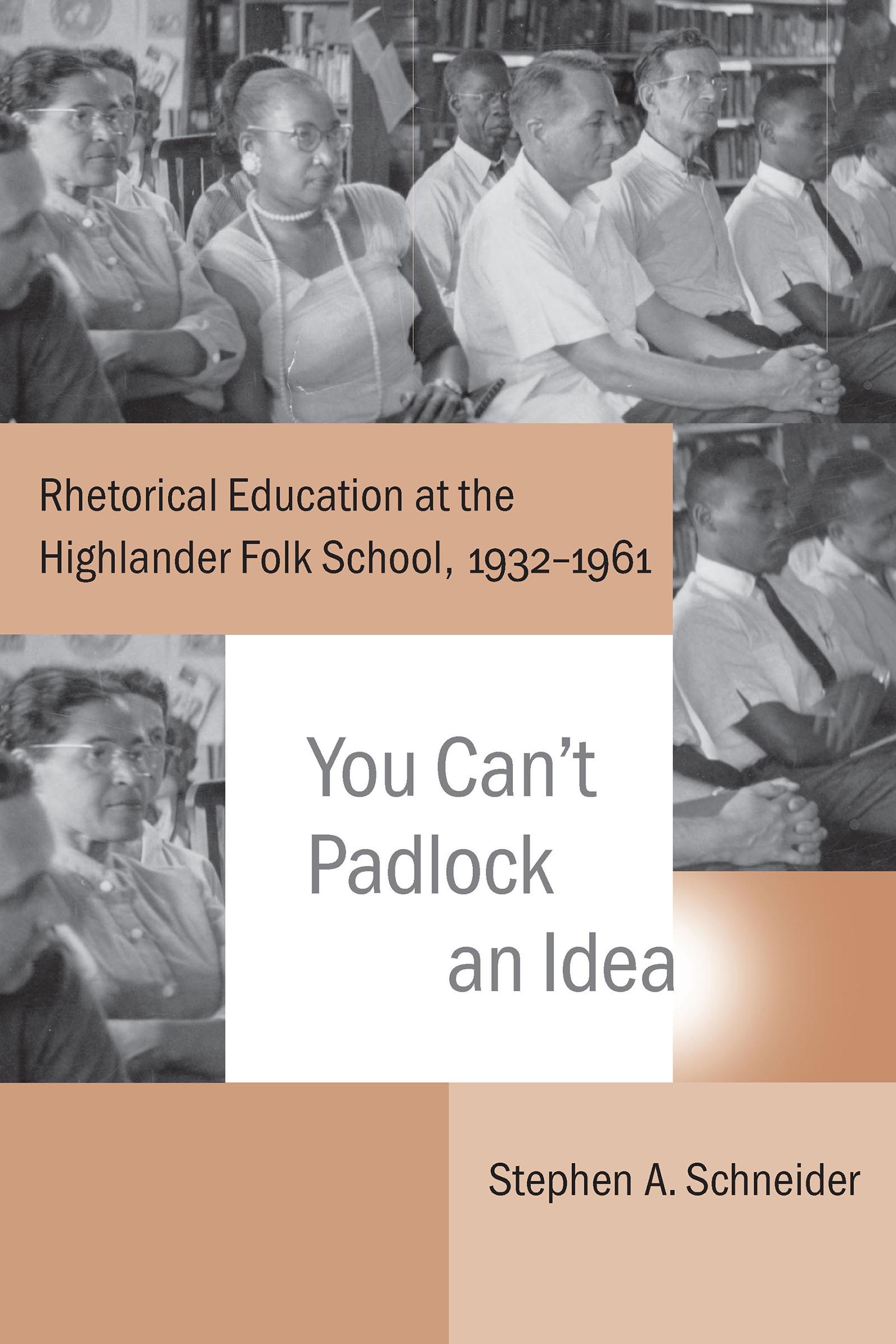
An examination of the rhetorical practices used at the Highlander Folk School to advance democratic social change
You Can't Padlock an Idea examines the educational programs undertaken at the Highlander Folk School in Tennessee and looks specifically at how these programs functioned rhetorically to promote democratic social change. Founded in 1932 by educator Myles Horton, the Highlander Folk School sought to address the economic and political problems facing communities in Appalachian Tennessee and other southern states. To this end Horton and the school's staff involved themselves in the labor and civil rights disputes that emerged across the south over the next three decades.
Drawing on the Highlander archives housed at the Wisconsin Historical Society, the Avery Research Center in South Carolina, and the Highlander Research and Education Center in Tennessee, Stephen A. Schneider reconstructs the pedagogical theories and rhetorical practices developed and employed at Highlander. He shows how the school focused on developing forms of collective rhetorical action, helped students frame social problems as spurs to direct action, and situated education as an agency for organizing and mobilizing communities.
Schneider studies how Highlander's educational programs contributed to this broader goal of encouraging social action. Specifically he focuses on four of the school's more established programs: labor drama, labor journalism, citizenship education, and music. These programs not only taught social movement participants how to create plays, newspapers, citizenship schools, and songs, they also helped the participants frame the problems they faced as having solutions based in collective democratic action. Highlander's programs thereby functioned rhetorically, insofar as they provided students with the means to define and transform oppressive social and economic conditions. By providing students with the means to comprehend social problems and with the cultural agencies (theater, journalism, literacy, and music) to address these problems directly, Highlander provided an important model for understanding the relationships connecting education, rhetoric, and social change.
Before Memmo my notes were scattered across PDFs. Now a workspace pulls everything into one place — I see exactly what's still left to study.
Memmo's summaries are gold before exams. I don't have to re-read 800 pages two weeks before — just the important parts.
The AI chat has saved me the night before an exam more than once. I just keep asking until I get it — no waiting on a study group to reply.
The quizzes hit exactly what I need to know. Memmo tracks what I get stuck on — so I only practice what's worth it.
Flashcards with spaced repetition are magic. Memmo knows when I'm about to forget something and brings it back.
The AI podcasts are my favorite. I listen on my way to school and get a recap without sitting at a computer.

Handbok i kvalitativa metoder
281 kr

Hållbar utveckling: en introduktion för ingenjörer och andra problemlösare
334 kr

Brymans Samhällsvetenskapliga metoder
390 kr

Projektledning
491 kr

Den orättvisa hälsan: om socioekonomiska skillnader i hälsa och livslängd
326 kr

Vetenskapsteori för nybörjare
196 kr

Organizational Leadership
429 kr

På väg mot läraryrket
172 kr

Det sociala livet i skolan: Socialpsykologiska perspektiv
253 kr

Betygsättningens didaktik
151 kr

Personality
402 kr

Studying Leadership
404 kr

Managing Innovation
477 kr

Introduktion till samhällsvetenskaplig metod
347 kr

The Psychology of Sex and Gender
698 kr

Evidens och kunskap för socialt arbete
207 kr

Introduction to Leadership
605 kr