
Before Memmo my notes were scattered across PDFs. Now a workspace pulls everything into one place — I see exactly what's still left to study.
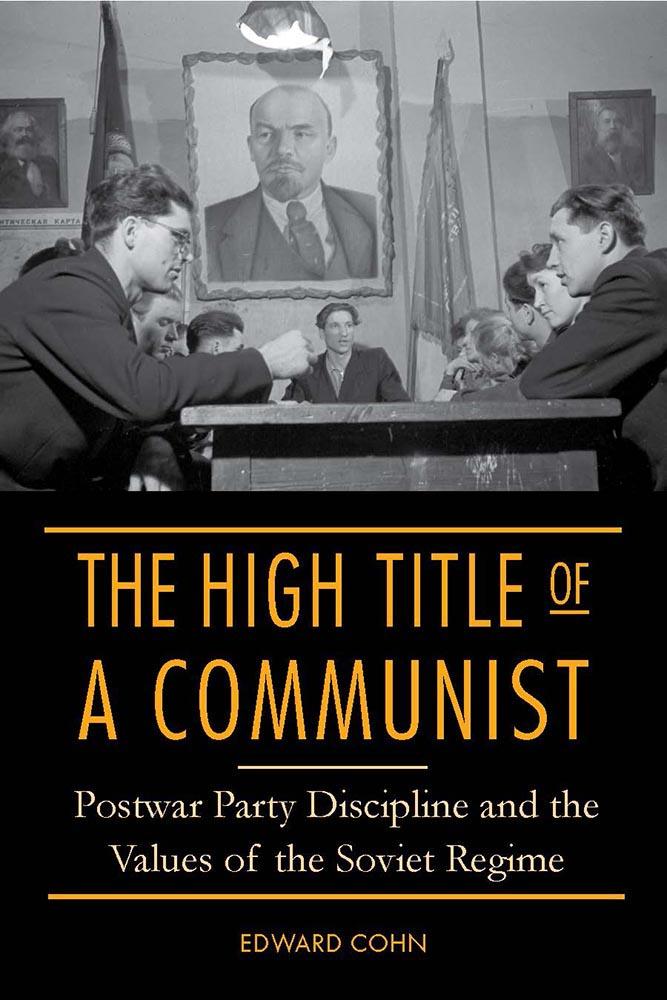
Between 1945 and 1964, six to seven million members of the Communist Party of the Soviet Union were investigated for misconduct by local party organizations and then reprimanded, demoted from full party membership, or expelled. Party leaders viewed these investigations as a form of moral education and used humiliating public hearings to discipline wrongdoers and send all Soviet citizens a message about how Communists should behave. The High Title of a Communist is the first study of the Communist Party's internal disciplinary system in the decades following World War II.
Edward Cohn uses the practices of expulsion and censure as a window into how the postwar regime defined the ideal Communist and the ideal Soviet citizen. As the regime grappled with a postwar economic crisis and evolved from a revolutionary prewar government into a more bureaucratic postwar state, the Communist Party revised its informal behavioral code, shifting from a more limited and literal set of rules about a party member's role in the economy to a more activist vision that encompassed all spheres of life. The postwar Soviet regime became less concerned with the ideological orthodoxy and political loyalty of party members, and more interested in how Communists treated their wives, raised their children, and handled their liquor. Soviet power, in other words, became less repressive and more intrusive. Cohn uses previously untapped archival sources and avoids a narrow focus on life in Moscow and Leningrad, combining rich local materials from several Russian provinces with materials from throughout the USSR. The High Title of a Communist paints a vivid portrait of the USSR's postwar era that will help scholars and students understand both the history of the Soviet Union's postwar elite and the changing values of the Soviet regime. In the end, it shows, the regime failed in its efforts to enforce a clear set of behavioral standards for its Communists—a failure that would threaten the party's legitimacy in the USSR's final days.
Before Memmo my notes were scattered across PDFs. Now a workspace pulls everything into one place — I see exactly what's still left to study.
Memmo's summaries are gold before exams. I don't have to re-read 800 pages two weeks before — just the important parts.
The AI chat has saved me the night before an exam more than once. I just keep asking until I get it — no waiting on a study group to reply.
The quizzes hit exactly what I need to know. Memmo tracks what I get stuck on — so I only practice what's worth it.
Flashcards with spaced repetition are magic. Memmo knows when I'm about to forget something and brings it back.
The AI podcasts are my favorite. I listen on my way to school and get a recap without sitting at a computer.

Handbok i kvalitativa metoder
281 kr

Hållbar utveckling: en introduktion för ingenjörer och andra problemlösare
334 kr

Brymans Samhällsvetenskapliga metoder
390 kr

Projektledning
491 kr

Den orättvisa hälsan: om socioekonomiska skillnader i hälsa och livslängd
326 kr

Vetenskapsteori för nybörjare
196 kr

Organizational Leadership
429 kr

På väg mot läraryrket
172 kr

Det sociala livet i skolan: Socialpsykologiska perspektiv
253 kr

Betygsättningens didaktik
151 kr

Personality
402 kr

Studying Leadership
404 kr

Managing Innovation
477 kr

Introduktion till samhällsvetenskaplig metod
347 kr

The Psychology of Sex and Gender
698 kr

Evidens och kunskap för socialt arbete
207 kr

Introduction to Leadership
605 kr