
Before Memmo my notes were scattered across PDFs. Now a workspace pulls everything into one place — I see exactly what's still left to study.
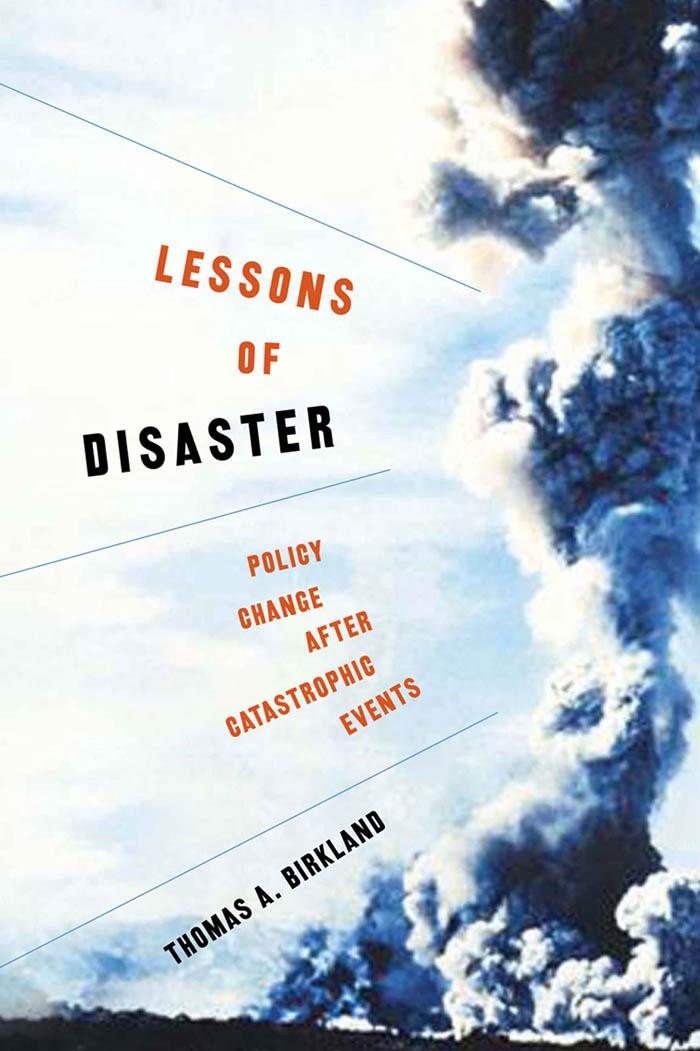
Even before the wreckage of a disaster is cleared, one question is foremost in the minds of the public: "What can be done to prevent this from happening again?" Today, news media and policymakers often invoke the "lessons of September 11" and the "lessons of Hurricane Katrina." Certainly, these unexpected events heightened awareness about problems that might have contributed to or worsened the disasters, particularly about gaps in preparation. Inquiries and investigations are made that claim that "lessons" were "learned" from a disaster, leading us to assume that we will be more ready the next time a similar threat looms, and that our government will put in place measures to protect us.
In Lessons of Disaster, Thomas Birkland takes a critical look at this assumption. We know that disasters play a role in setting policy agendas—in getting policymakers to think about problems—but does our government always take the next step and enact new legislation or regulations? To determine when and how a catastrophic event serves as a catalyst for true policy change, the author examines four categories of disasters: aviation security, homeland security, earthquakes, and hurricanes. He explores lessons learned from each, focusing on three types of policy change: change in the larger social construction of the issues surrounding the disaster; instrumental change, in which laws and regulations are made; and political change, in which alliances are created and shifted.
Birkland argues that the type of disaster affects the types of lessons learned from it, and that certain conditions are necessary to translate awareness into new policy, including media attention, salience for a large portion of the public, the existence of advocacy groups for the issue, and the preexistence of policy ideas that can be drawn upon.
This timely study concludes with a discussion of the interplay of multiple disasters, focusing on the initial government response to Hurricane Katrina and the negative effect the September 11 catastrophe seems to have had on reaction to that tragedy.
Before Memmo my notes were scattered across PDFs. Now a workspace pulls everything into one place — I see exactly what's still left to study.
Memmo's summaries are gold before exams. I don't have to re-read 800 pages two weeks before — just the important parts.
The AI chat has saved me the night before an exam more than once. I just keep asking until I get it — no waiting on a study group to reply.
The quizzes hit exactly what I need to know. Memmo tracks what I get stuck on — so I only practice what's worth it.
Flashcards with spaced repetition are magic. Memmo knows when I'm about to forget something and brings it back.
The AI podcasts are my favorite. I listen on my way to school and get a recap without sitting at a computer.

Handbok i kvalitativa metoder
281 kr

Hållbar utveckling: en introduktion för ingenjörer och andra problemlösare
334 kr

Brymans Samhällsvetenskapliga metoder
390 kr

Projektledning
491 kr

Den orättvisa hälsan: om socioekonomiska skillnader i hälsa och livslängd
326 kr

Organizational Leadership
429 kr

Vetenskapsteori för nybörjare
196 kr

På väg mot läraryrket
172 kr

Det sociala livet i skolan: Socialpsykologiska perspektiv
253 kr

Betygsättningens didaktik
151 kr

Personality
402 kr

Studying Leadership
404 kr

Managing Innovation
477 kr

Introduktion till samhällsvetenskaplig metod
347 kr

The Psychology of Sex and Gender
698 kr

Evidens och kunskap för socialt arbete
207 kr

Introduction to Leadership
605 kr