
Before Memmo my notes were scattered across PDFs. Now a workspace pulls everything into one place — I see exactly what's still left to study.
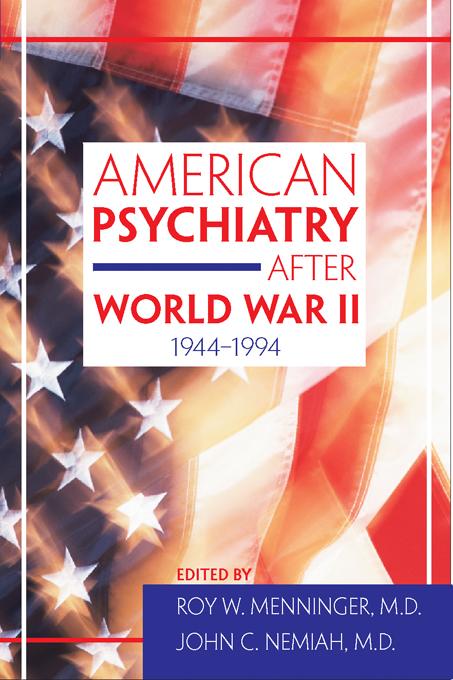
The history of psychiatry is complex, reflecting diverse origins in mythology, cult beliefs, astrology, early medicine, law religion, philosophy, and politics. This complexity has generated considerable debate and an increasing outflow of historical scholarship, ranging from the enthusiastic meliorism of pre-World War II histories, to the iconoclastic revisionism of the 1960s, to more focused studies, such as the history of asylums and the validity and efficacy of Freudian theory. This volume, intended as a successor to the centennial history of American psychiatry published by the American Psychiatric Association in 1944, summarizes the significant events and processes of the half-century following World War II. Most of this history is written by clinicians who were central figures in it.
In broad terms, the history of psychiatry after the war can be viewed as the story of a cycling sequence, shifting from a predominantly biological to a psychodynamic perspective and back again -- all presumably en route to an ultimate view that is truly integrated -- and interacting all the while with public perceptions, expectations, exasperations, and disappointments.
In six sections, Drs. Roy Menninger and John Nemiah and their colleagues cover both the continuities and the dramatic changes of this period. The first four sections of the book are roughly chronological. The first section focuses on the war and its impact on psychiatry; the second reviews postwar growth of the field (psychoanalysis and psychotherapy, psychiatric education, and psychosomatic medicine); the third recounts the rise of scientific empiricism (biological psychiatry and nosology); and the fourth discusses public attitudes and perceptions of public mental health policy, deinstitutionalization, antipsychiatry, the consumer movement, and managed care. The fifth section examines the development of specialization and differentiation, exemplified by child and adolescent psychiatry, geriatric psychiatry, addiction psychiatry, and forensic psychiatry. The concluding section examines ethics, and women and minorities in psychiatry.
Anyone interested in psychiatry will find this book a fascinating read.
Before Memmo my notes were scattered across PDFs. Now a workspace pulls everything into one place — I see exactly what's still left to study.
Memmo's summaries are gold before exams. I don't have to re-read 800 pages two weeks before — just the important parts.
The AI chat has saved me the night before an exam more than once. I just keep asking until I get it — no waiting on a study group to reply.
The quizzes hit exactly what I need to know. Memmo tracks what I get stuck on — so I only practice what's worth it.
Flashcards with spaced repetition are magic. Memmo knows when I'm about to forget something and brings it back.
The AI podcasts are my favorite. I listen on my way to school and get a recap without sitting at a computer.

Handbok i kvalitativa metoder
281 kr

Hållbar utveckling: en introduktion för ingenjörer och andra problemlösare
334 kr

Brymans Samhällsvetenskapliga metoder
390 kr

Projektledning
491 kr

Den orättvisa hälsan: om socioekonomiska skillnader i hälsa och livslängd
326 kr

Vetenskapsteori för nybörjare
196 kr

Organizational Leadership
429 kr

På väg mot läraryrket
172 kr

Det sociala livet i skolan: Socialpsykologiska perspektiv
253 kr

Betygsättningens didaktik
151 kr

Personality
402 kr

Studying Leadership
404 kr

Managing Innovation
477 kr

Introduktion till samhällsvetenskaplig metod
347 kr

The Psychology of Sex and Gender
698 kr

Evidens och kunskap för socialt arbete
207 kr

Introduction to Leadership
605 kr