
Before Memmo my notes were scattered across PDFs. Now a workspace pulls everything into one place — I see exactly what's still left to study.
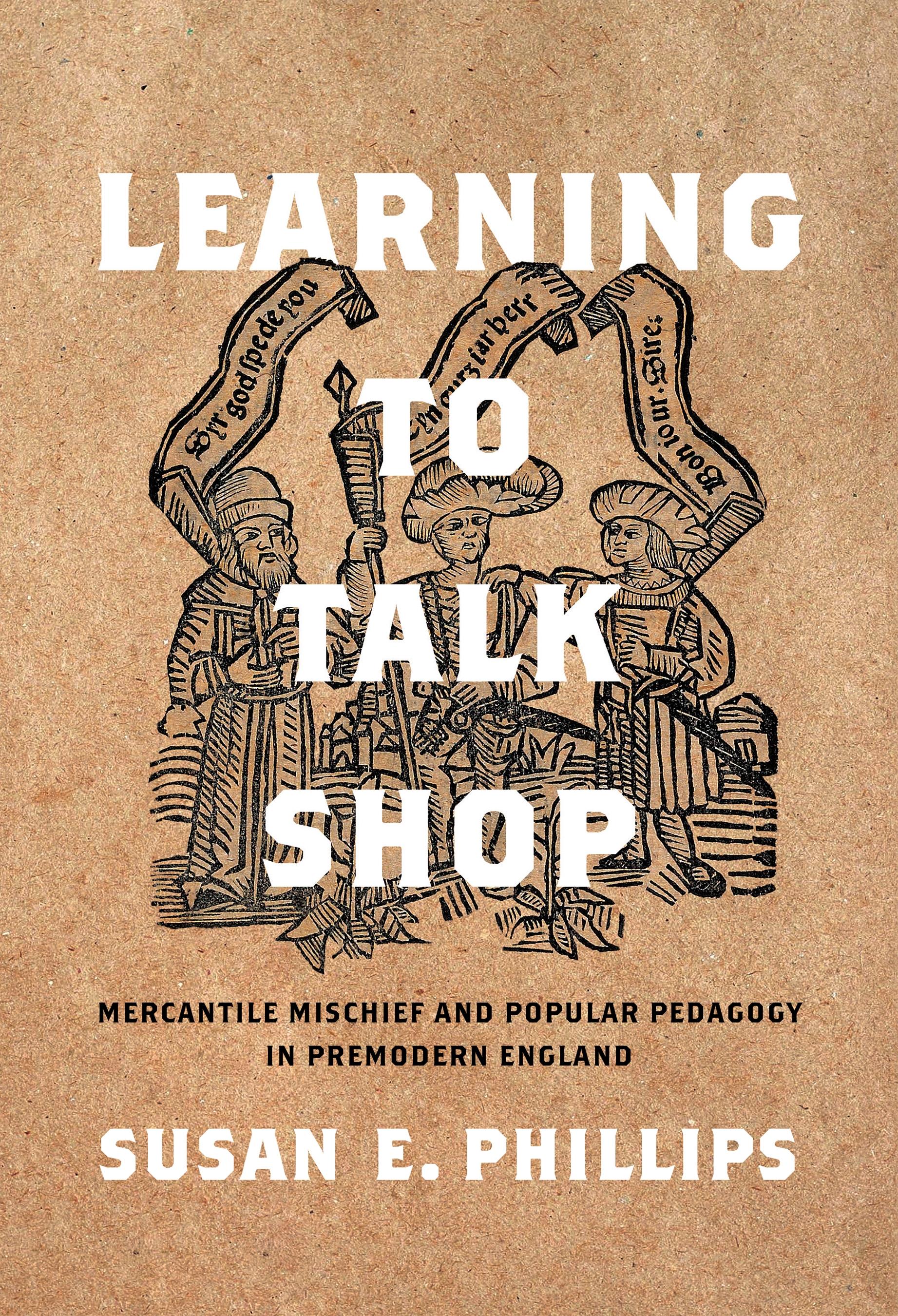
A new account of premodern education that offered non-elite readers lessons in navigating the premodern marketplace
Learning to Talk Shop explores the phrasebooks and guides to conversations that flooded the marketplace in the fifteenth and sixteenth centuries, making a virtual classroom available to an audience who could not afford or did not have access to formal education. Privileging market share and mercantile savvy over moral instruction and linguistic mastery, these mischievous little books offered readers lessons in the pragmatic, and murky, ethics of the premodern marketplace, teaching them bargaining tactics, insults, pick up lines, and strategies for welching on debts.
Revealing what happens when language learning itself undergoes a translation out of the classroom, into the marketplace and further down the social ladder, Susan E. Phillips offers a new account of premodern education, not through erudite tombs and schoolmaster sovereigns, but through these practical books that enabled non-elite readers to thrive in an environment not particularly conducive to their success. Phillips asks what we learn and whom we can see when we look at premodern education from this humbler, more mischievous perspective, telling the tales of resourceful chambermaids, savvy black stableboys, and arithmetically adept barmaids as well as the story of a schoolgirl who compiled a textbook of her own and the narrative of a black schoolmaster teaching in Shakespeare’s London.
In these stories, Phillips finds the liberatory potential in a discourse that has previously been read as upholding traditional social hierarchies in the premodern period. If we expand our archive beyond the Latin textbooks of the grammar school classroom to include these bestselling bi- and multilingual vernacular textbooks, Phillips contends, we can see a radically different set of possibilities—a premodern pedagogy that is more expansive, more flexible, and more inclusive.
Before Memmo my notes were scattered across PDFs. Now a workspace pulls everything into one place — I see exactly what's still left to study.
Memmo's summaries are gold before exams. I don't have to re-read 800 pages two weeks before — just the important parts.
The AI chat has saved me the night before an exam more than once. I just keep asking until I get it — no waiting on a study group to reply.
The quizzes hit exactly what I need to know. Memmo tracks what I get stuck on — so I only practice what's worth it.
Flashcards with spaced repetition are magic. Memmo knows when I'm about to forget something and brings it back.
The AI podcasts are my favorite. I listen on my way to school and get a recap without sitting at a computer.

Handbok i kvalitativa metoder
281 kr

Hållbar utveckling: en introduktion för ingenjörer och andra problemlösare
334 kr

Brymans Samhällsvetenskapliga metoder
390 kr

Projektledning
491 kr

Den orättvisa hälsan: om socioekonomiska skillnader i hälsa och livslängd
326 kr

Vetenskapsteori för nybörjare
196 kr

Organizational Leadership
429 kr

På väg mot läraryrket
172 kr

Det sociala livet i skolan: Socialpsykologiska perspektiv
253 kr

Betygsättningens didaktik
151 kr

Personality
402 kr

Studying Leadership
404 kr

Managing Innovation
477 kr

Introduktion till samhällsvetenskaplig metod
347 kr

The Psychology of Sex and Gender
698 kr

Evidens och kunskap för socialt arbete
207 kr

Introduction to Leadership
605 kr