
Before Memmo my notes were scattered across PDFs. Now a workspace pulls everything into one place — I see exactly what's still left to study.
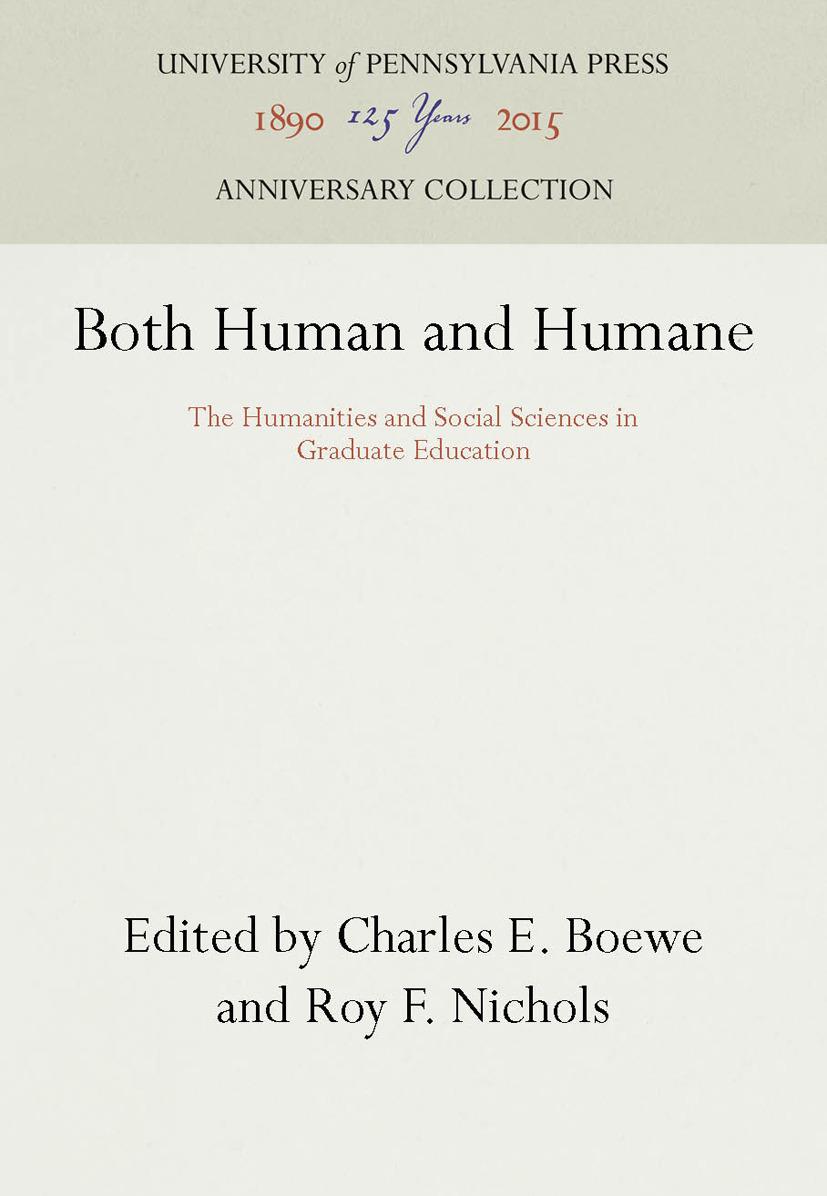
The papers in this volume, presenting a stimulating appraisal of graduate education in America, were delivered during the seventy-fifth anniversary celebration of the Graduate School of the University of Pennsylvania. Though the writers of these papers approach the overall topic from many different points of view, one striking, basic conclusion is held by all: graduate training must change from the study of "subjects" to the study of institutional aggregates evolving in time, such as cultures or civilizations, basing more of its research on the use of models, on the application of the most rigorous instruments of thought and analysis, and on a more effective assessment of value.
The papers of Max Black, Charles Frankel, and S. S. Wilks all indicate that we are developing more precise methods of definition, discovery, and communication—methods which are difficult to teach, to learn, and to use. Do we really face the problem of how well do we teach them? These papers likewise indicate a new concept of cooperation and sharing of insight, particularly in the fields of the social sciences and the humanities. Whatever gap exists between them should be bridged by the faculty, and the students should be led constantly back and forth across the bridge. John P. Gillin describes the need for the bridge and gives some specifications for planning and building it. In this matter of specifications, Whitney J. Oates, Daniel H. H. Ingalls, Leo Gershoy, and Henri Peyre join with him in stressing the "cultural" concept. There are entities in space and time, population aggregates, which have folkways and characteristics of behavior which can be defined, analyzed, and compared.
The implications as well as the definite recommendations of these papers underline the inadequacies of much of our orientation toward present Ph.D. training and add greatly to the difficulties of our situation. If we are to place the study of any phase of human behavior in its proper setting, we must provide our students with a cultural frame of reference which most of them do not now have. The study of the ancient world, Eastern cultures, recurrent behavioral patterns, and the intricate process of the creation and transmission of ideas all provide guideposts along a new road which society should demand that we travel.
Pendleton Herring, Howard Mumford Jones, and Donald Young offer suggestions, sometimes rather at variance with one another, as to the philosophy which should direct a scholarly reorientation. A need exists for more careful attention to the implications of a graduate school as an association of a mature group of scholars with a younger generation who are being trained to carry on. There should be a greater sense of men and women of varied skills working together and sharing their curiosities as well as their information, their thoughts as well as their discoveries.
Contributors: John P. Gillin, Max Black, S. S. Wilks, Howard Mumford Jones, Charles Frankel, Leo Gershoy, Henri Peyre, Pendleton Herring, Whitney J. Oates, Daniel H. H. Ingalls, Donald Young.
Before Memmo my notes were scattered across PDFs. Now a workspace pulls everything into one place — I see exactly what's still left to study.
Memmo's summaries are gold before exams. I don't have to re-read 800 pages two weeks before — just the important parts.
The AI chat has saved me the night before an exam more than once. I just keep asking until I get it — no waiting on a study group to reply.
The quizzes hit exactly what I need to know. Memmo tracks what I get stuck on — so I only practice what's worth it.
Flashcards with spaced repetition are magic. Memmo knows when I'm about to forget something and brings it back.
The AI podcasts are my favorite. I listen on my way to school and get a recap without sitting at a computer.

Handbok i kvalitativa metoder
281 kr

Hållbar utveckling: en introduktion för ingenjörer och andra problemlösare
334 kr

Brymans Samhällsvetenskapliga metoder
390 kr

Projektledning
491 kr

Den orättvisa hälsan: om socioekonomiska skillnader i hälsa och livslängd
326 kr

Organizational Leadership
429 kr

Vetenskapsteori för nybörjare
196 kr

På väg mot läraryrket
172 kr

Det sociala livet i skolan: Socialpsykologiska perspektiv
253 kr

Betygsättningens didaktik
151 kr

Personality
402 kr

Studying Leadership
404 kr

Managing Innovation
477 kr

Introduktion till samhällsvetenskaplig metod
347 kr

The Psychology of Sex and Gender
698 kr

Evidens och kunskap för socialt arbete
207 kr

Introduction to Leadership
605 kr