
Before Memmo my notes were scattered across PDFs. Now a workspace pulls everything into one place — I see exactly what's still left to study.
"The goal of our strategic defense research program, the vision and hope of the President, is to stop Soviet missiles before they could destroy any targets, be they in the United States or anywhere else. The goal is noble and straightforward: to destroy weapons that kill people. Thus, based on a realistic view of Soviet military planning, the transition to strategic defense would not be destabilizing. In fact, any initial defensive capabilities would offer many benefits. . . . This objective is far more idealistic, moral, and practical than the position taken by those who still embrace the mutual assured destruction (MAD) theory that defenses must be totally abandoned."—Caspar Weinberger
"This is basically a research program and should remain so, at least for the foreseeable future. . . . In a world that relies on an exquisite strategic balance to forestall the holocaust, it would be the worst of blunders to jolt the tightrope when the safety net is tied at only one end."—James Schlesinger
"Neither Star Wars I or Star Wars II, in whatever form one considers them, is an effective response to the public's intuitive awareness of the unacceptable risk posed by our present nuclear strategy."—Robert McNamara
"The goal of our innovative science and technology program is to establish scientific feasibility and engineering validation of revolutionary concepts. concepts with potential for full SDI technological development. This forward-looking office has a broad research charter which focuses on advanced directed energy concepts such as gamma-ray lasers. on novel sensing and data preprocessing techniques, on advanced materials for space applications, on innovations in spacepower, and on emerging spacescience applications and ultra-high-speed supercomputing. Interest in such exotic areas of science and technology clearly illustrates that SDI has greatly facilitated the mobilization of our nation's scientific community."—Lt . Gen. James Abrahamson
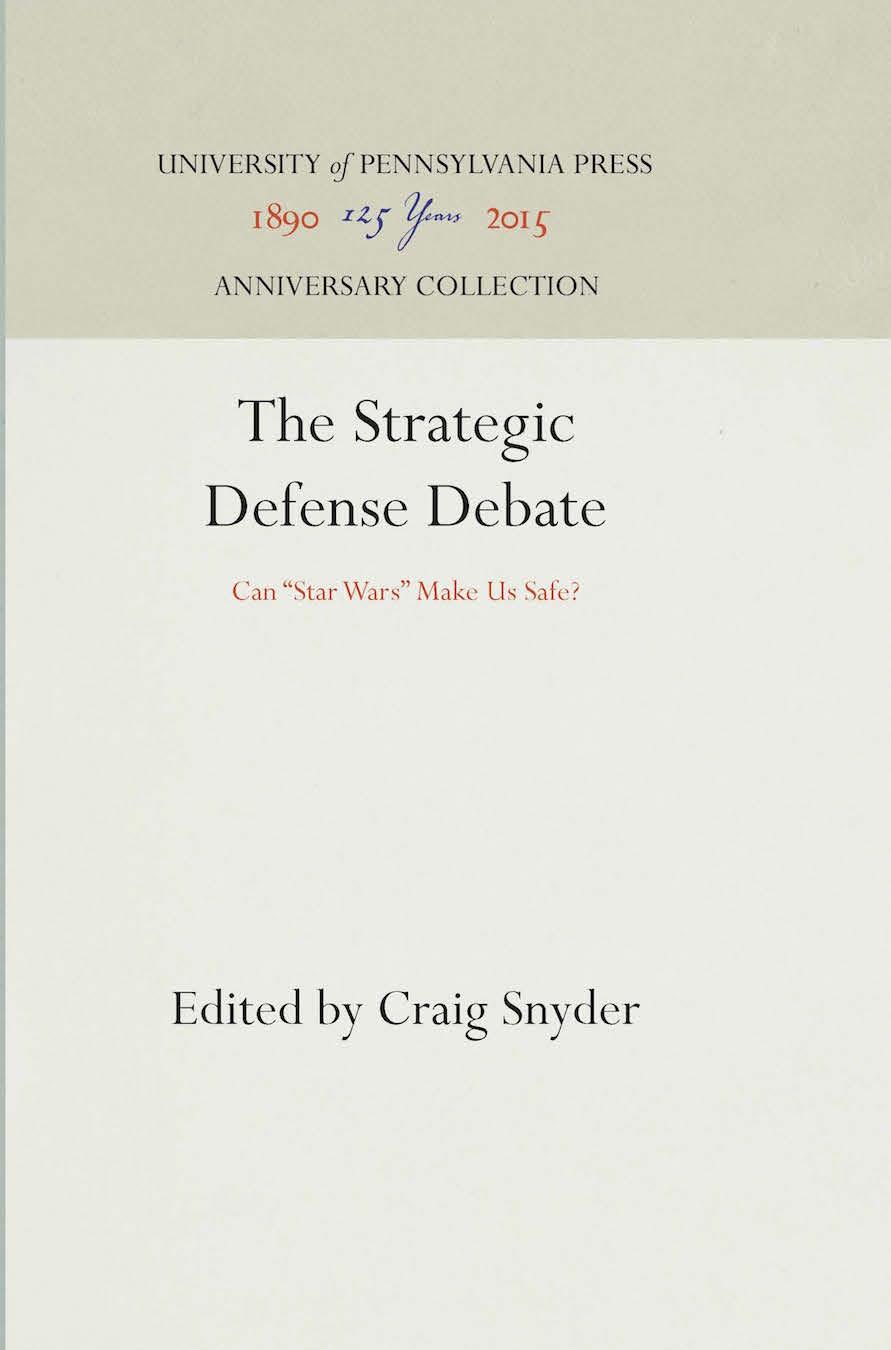
Prominent world leaders and scientists came together in 1985 to discuss the technological feasibility and the political sensibility of "Star Wars." Their essays, presented in The Strategic Defense Debate, provide, for the first time a comprehensive look at this timely and controversial subject.
Craig Snyder's introduction and headnotes to the collection highlight the critical points of each essay, as well as their conceptual significance to the overall topic. Contributors include: Caspar Weinberger, James Schlesinger, Lieutenant General James A. Abrahamson. Robert S. McNamara, Andrew Cockburn, Richard Pipes. Stephen F. Cohen, Adam Garfinkle, Leon Wieseltier. Michael Vlahos, Franklin Long, Francis Pym, Major Simon P. Worden, Richard Garwin, Robert S. Cooper, Colin S. Gray, Robert Bowman, Alex Gliksman, and Warren Zimmerman.
Excerpts from President Reagan's speech "Peace and National Security" and Ambassador Paul H. Nitze's speech "On the Road to a More Stable Peace" are also included.
The essays were originally presented at a conference sponsored by The World Affairs Council of Philadelphia in late 1985.
The Strategic Defense Debate will be invaluable to students, scholars and lay persons interested in politics, history. military strategy and Soviet relations.
Before Memmo my notes were scattered across PDFs. Now a workspace pulls everything into one place — I see exactly what's still left to study.
Memmo's summaries are gold before exams. I don't have to re-read 800 pages two weeks before — just the important parts.
The AI chat has saved me the night before an exam more than once. I just keep asking until I get it — no waiting on a study group to reply.
The quizzes hit exactly what I need to know. Memmo tracks what I get stuck on — so I only practice what's worth it.
Flashcards with spaced repetition are magic. Memmo knows when I'm about to forget something and brings it back.
The AI podcasts are my favorite. I listen on my way to school and get a recap without sitting at a computer.

Handbok i kvalitativa metoder
281 kr

Hållbar utveckling: en introduktion för ingenjörer och andra problemlösare
334 kr

Brymans Samhällsvetenskapliga metoder
390 kr

Projektledning
491 kr

Den orättvisa hälsan: om socioekonomiska skillnader i hälsa och livslängd
326 kr

Vetenskapsteori för nybörjare
196 kr

Organizational Leadership
429 kr

På väg mot läraryrket
172 kr

Det sociala livet i skolan: Socialpsykologiska perspektiv
253 kr

Betygsättningens didaktik
151 kr

Personality
402 kr

Studying Leadership
404 kr

Managing Innovation
477 kr

Introduktion till samhällsvetenskaplig metod
347 kr

The Psychology of Sex and Gender
698 kr

Evidens och kunskap för socialt arbete
207 kr

Introduction to Leadership
605 kr